

In an era of electoral volatility and deepening voter frustration with the status quo, successful campaigns must combine sophisticated data analytics with authentic messaging that meets voters where they are.
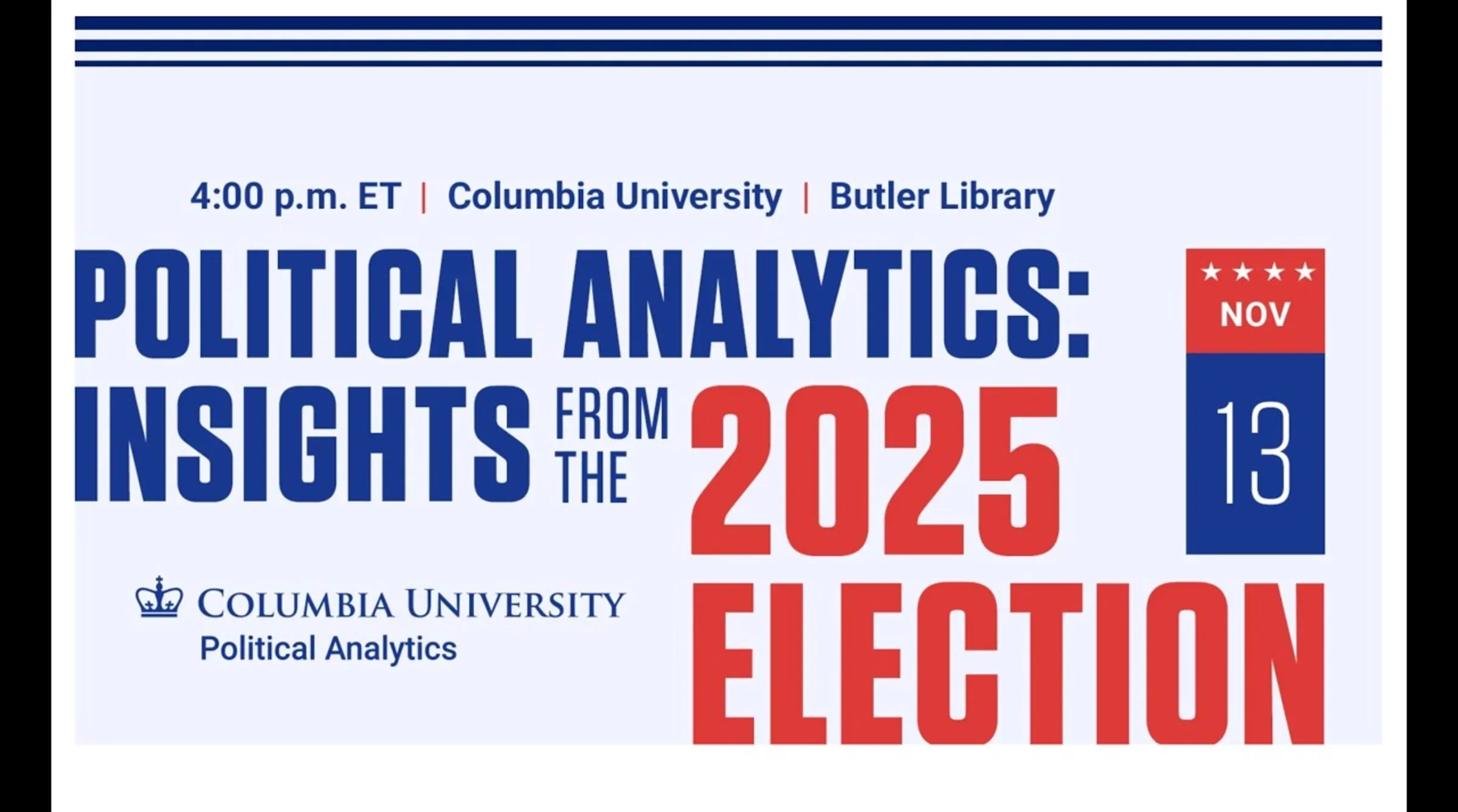
The strategy behind that messaging—and how data informs it—were the main themes of Insights from the 2025 Election, a recent event hosted by the M.S. in Political Analytics program at Columbia University School of Professional Studies (SPS). The event offered a breakdown of the 2025 U.S. election by three political operatives with extensive experience in the field: Jackie Burns, who helped lead Governor-Elect Mikie Sherrill to a 14-point victory in New Jersey; Morris Katz, the lead media strategist behind Zohran Mamdani’s campaign in the New York City mayoral race; and Bradley Honan, CEO of Honan Strategy Group, a recognized expert in public opinion research and data analytics.
Moderated by Greg Wawro, professor of political science and director of Columbia’s Political Analytics program, the discussion explores how analytics, narrative discipline, and strategic targeting came together to drive historic Democratic wins.
Beyond the Horse Race: The Limits and Power of Polling
Focusing on a topic at the heart of the Political Analytics program’s work, panelists addressed one of the most visible failures of the 2025 cycle: polling accuracy. Burns pointed to a poll showing her race as a one-point contest just days before Sherrill's 14-point win, and showing her Republican opponent winning Black voters 60–40 when Kamala Harris had won them 85% in New Jersey.
“Every reporter reached out to us about that poll,” Burns said. “I don't know how many times I said, come to New Jersey—the vibes on the ground are different than what you're reading on Twitter.”
Honan explained the technical failures behind such polling errors. Some firms fail to properly verify voter registration and oversample “socially desirable” respondents who answer amenably to surveyors but who don’t turn out to vote. The result is a sampling of people who don’t accurately represent the composition of the electorate. More fundamentally, many polls failed to model turnout correctly for an off-year election during a controversial Republican presidency.
“When a president is named Trump, he turbocharges that trend on steroids,” Honan said, describing how his firm correctly predicted a surge in Democratic turnout by analyzing historical patterns from previous Trump-era elections.
However, the panelists emphasized that good analytics goes far beyond avoiding bad polls. Both campaigns used sophisticated voter file analysis, targeted digital advertising, and continuous message testing to identify and mobilize their coalitions.

Micro-Targeting Meets the Macro Message
The campaigns demonstrated how modern analytics enables unprecedented personalization while maintaining message consistency. Katz described running different versions of the same ad with different endorsers—Alexandria Ocasio-Cortez (AOC) and Bernie Sanders for younger voters, Tish (Letitia) James and Hakeem Jeffries for Black voters, Jerry Nadler and Micah Lasher for Upper Manhattan—all delivered through voter-file-matched digital targeting.
“It's really almost lazy to not be using that as your digital strategy,” Katz said. “Why wouldn't you?” Sherrill's campaign took a similar approach, running targeted digital ads about online safety and youth mental health specifically to parents with children, an issue Sherrill heard about repeatedly on the campaign trail but that doesn't typically dominate political discourse.
Yet both strategists warned against over-reliance on data at the expense of narrative. Katz criticized the Harris presidential campaign for letting ad testing dictate strategy, running ads about capping insulin costs when the electorate was hungry for a broader change message.
“When you just get lost in these single-line messages—5,000 more cops, capped the cost of insulin—you lose a narrative,” Katz said. “And narrative is what allows all these other things to be possible.”
For Sherrill and Mamdani, a consistent narrative appeared to be an essential factor in their success. Rather than changing their campaign message to align with trends in the data, these teams gathered data that would help the campaigns play to their candidates’ strengths.
“I think one of the main things in my mind on the analytics piece in our race in particular is how unique a candidate Mikie Sherrill is and how much that informed how we looked at the data and how we looked at polling,” said Burns. For Mamdani’s campaign, Katz explained, “There was never a question of allowing our politics to be defined by research, but rather our politics was going to define our research.”

The Populist Moment
In stark contrast to the political environment of a decade ago, there was consensus on the panel that today’s candidates must embrace some elements of populism in order to stand a fighting chance. All three panelists agreed that voters across the spectrum are demanding candidates willing to name enemies and fight the status quo.
“Populism is going to be the electoral future of whoever controls power in this country,” Katz said. “It's just a matter of [whether] it's going to be our populism or their populism.”
For Sherrill, that meant running as a Democrat on lowering property taxes, winning an issue Republicans typically own, by “promising to take on landlords who are colluding to raise rents,” or “taking on the pharmaceutical benefit managers who are jacking up prescription drug costs,” or utility companies “as prices skyrocketed in New Jersey this summer.” For Mamdani, it meant laser-focusing on affordability and income inequality while rejecting pressure to moderate on social issues in a Democratic primary.
“There was so much anger against the system,” Katz explained. “There was literally a willingness to blow up the entire system because there was just that much anger there.” He added that people were looking for an ambitious and aggressive government.
Burns emphasized that successful candidates are likely going to be those individuals who address Americans’ deep frustration with the status quo. “I think that's going to be the dividing line, rather than whether you have a D or an R after your name.”
Future Challenges in Political Analytics
Looking ahead to the 2026 midterms and beyond, the panelists noted that there are challenges ahead if political consultants want to get their strategies right.
With traditional partisan coalitions in flux, Burns stressed the need for polling that presents multiple turnout scenarios rather than single horse-race numbers, and the need to focus on the situation on the ground rather than parrot what people are saying online. And Honan suggested that successful campaigns will need a crisp elevator pitch, pointing to the Mamdani and Sherrill campaigns as good examples for leaning into a few issues and finding creative ways to illustrate why those issues were important.
Taken together, the panelists’ insights underscored a campaign landscape where data and narrative are no longer separate worlds but mutually reinforcing tools. As voters become harder to reach—and quicker to disengage—the ability to marry analytics with authentic, resonant messaging will only grow more essential heading into 2026.

About the Program
The Columbia University M.S. in Political Analytics program provides students quantitative skills in an explicitly political context, facilitating crosswalk with nontechnical professionals and decision-makers—and empowers students to become decision-makers themselves.
The 36-credit program is available part-time and full-time, on-campus. Learn more about the program here.
For general information and admissions questions, please call 212-854-9666 or email politicalanalytics [[at]] sps [[dot]] columbia [[dot]] edu (politicalanalytics[at]sps[dot]columbia[dot]edu).


