The Technology Management concentration prepares students to lead projects at the intersection of innovation, digital transformation, and organizational strategy.
Designed for professionals in tech-driven environments, this curriculum builds applied skills in digital product development, technology roadmapping, and organizational leadership—grounded in research and industry insight.
Students in the Technology Management concentration in the M.S. in Project Management benefit from the resources of the M.S. in Technology Management program, a hands-on technology leadership development program designed to train professionals for equal fluency in tech fundamentals, business operations, and ethical leadership.
Course Requirements
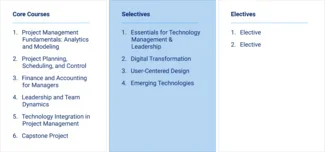
36 credits, consisting of:
Six core courses, including capstone (18 credits).
Four selective courses (12 credits) specific to the Technology Management concentration.
Two electives (6 credits).
Concentration Selectives
Full list of selectives for the Technology Management concentration are available below.
This course provides a foundational understanding of technology's role in modern organizations, exploring its evolution, strategic implementation, and governance. Students will examine leadership, ethics, financial considerations, and risk management in a technology-driven environment. The course emphasizes the integration of technology with organizational culture, communications, and compliance, preparing students to navigate complex technological landscapes effectively.
Course Number
TMGT 5128
Format
In Person
Points
3
This course explores the principles, strategies, and challenges of technology-driven transformation in organizations. Students will examine emerging technologies, digital disruption, and frameworks for implementing large-scale change. This course provides a comprehensive understanding of digital transformation, focusing on how businesses leverage technology to drive transformation based on various drivers including efficiency, productivity, competitive advantage, and compliance. Students will explore key topics such as product development, systems development lifecycle, enterprise architecture, IT capabilities, and automation. Through case studies, research, and hands-on projects, students will develop the skills needed to lead strategic and technical skills necessary to lead and manage digital transformation initiatives.