The Sustainability Management concentration equips students to develop and manage projects that balance organizational goals with more mindful management of projects and their impact on an organization’s personnel, its surrounding community, and the ecological environment.
Students gain the skills to plan, execute, and manage initiatives that align with sustainability targets, regulatory requirements, and stakeholder expectations. The concentration enables graduates to incorporate sustainability management into the organization of projects while meeting the operational and budget constraints of effective project management.
Collaborating with the M.S. in Sustainability Management program, students concentrating on Sustainability Management within the M.S. in Project Management program will learn to integrate sustainability targets, regulatory requirements, and stakeholder expectations, without compromising on operations or budgets.
Course Requirements
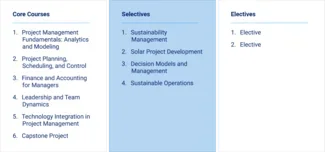
36 credits, consisting of:
Six core courses, including capstone (18 credits).
Four selective courses (12 credits) specific to the Sustainability Management concentration.
Two electives (6 credits).
Concentration Selectives
Full list of selectives for the Sustainability Management concentration are available below.
Sustainability management matters because we only have one planet and we must learn how to manage our organizations in a way that ensures that our planet is maintained. The course is designed to introduce you to the field of sustainability management. This is not an academic course that reviews the literature of the field and discusses how scholars think about the management of organizations that are environmentally sound. It is a practical, professional course organized around the core concepts of management and the core concepts of sustainability. The course will have a specific emphasis on urban sustainability as the planet’s urban population continues to expand.
Course Number
SUMA 4100
Format
In Person
Points
3
At the end of this course, students will be prepared to fully evaluate the technical and financial aspects of a solar project. They will be equipped with skills allowing them to either develop or rigorously vet solar project proposals. The course introduces and provides students with a holistic understanding of the end-to-end solar development process. The course has two goals:
To provide students a deep understanding of the dozens of critical interrelated steps critical to developing a successful operating solar project.
To equip the students with the tools and understanding of the skills necessary to develop a solar project beginning with site selection encompassing the entire process to commissioning and operations.
Course Number
SUMA 5650
Format
In Person
Points
3
This course provides an introduction to computer-based models for decision-making. The emphasis is on models that are widely used in diverse industries and functional areas, including finance, accounting, operations, and marketing. Applications will include advertising planning, revenue management, asset-liability management, environmental policy modeling, portfolio optimization, and corporate risk management, among others. The aim of the course is to help students become intelligent consumers of these methods. To this end, the course will cover the basic elements of modeling-- how to formulate a model and how to use and interpret the information a model produces. The course will attempt to instill a critical viewpoint towards decision models, recognizing that they are powerful but limited tools.
Course Number
SUMA 5033
Format
In Person
Points
3
Explores operational practices that minimize environmental impact while optimizing efficiency. Topics include supply chain sustainability, life cycle assessment, and resource management.