

Courses
The M.S. in Project Management builds core competencies in:
- Project management fundamentals.
- Planning and scheduling.
- Financial and risk management.
- Technology integration.
- Leadership and team dynamics.
The Project Management program is structured to offer both flexibility and specialization, comprising a total of 36 credits. All students complete six core courses, including a capstone (18 credits), which lay a strong foundation in project management.
Students may pair the core courses with six electives (18 credits) for maximum flexibility, or opt for a concentration, which includes the same six core courses, four selective courses (12 credits) tailored to their field, and two electives (6 credits).
Who Should Apply
Professionals in fields such as technology, architecture, construction, health care, urban studies, sustainability, environmental policy, and consulting, who are looking to level up their careers by taking a more active leadership role within their industry, or who would like to refine their skills and gain a competitive advantage with the support of an Ivy League degree should consider applying for the M.S. in Project Management program.
On this page
Core Courses
The core courses provides a rigorous foundation in the principles and practices of modern project management.
These six courses are designed to develop critical thinking, strategic planning, financial acumen, and leadership skills necessary to initiate, execute, and lead complex projects in any industry. The sequence culminates in a capstone project that integrates knowledge from across the program in a real-world application.
Core Courses (18 credits)
This course introduces the technical and analytical foundations of project management, focusing on how projects are structured, planned, and executed in complex, data-driven environments. Students examine core project components, including scope, time, cost, resources, and risk, and develop structured approaches for organizing and managing these interdependent elements. Through computational modeling, optimization methods, and scenario analysis, students explore how project decisions affect performance, constraints, and outcomes. The course also introduces predictive, adaptive, and hybrid project management methodologies, emphasizing when and how each approach is most appropriate. By integrating project management theory with quantitative methods, the course prepares students to plan, evaluate, and manage projects in technically demanding professional settings.
Course Number
PMGT5105Format
In PersonPoints
3This course provides a comprehensive foundation in planning, scheduling, and controlling projects across diverse industries. Students will learn the principles, methods, and quantitative tools used to develop work breakdown structures, establish project baselines, and apply critical path method (CPM) analysis to identify, sequence, and manage project activities. Emphasis is placed on integrating cost, schedule, and resource planning, as well as applying monitoring and control techniques to track progress and manage risks. Coursework includes hands-on experience with widely used project management platforms such as Microsoft Project and Oracle Primavera, alongside case studies that connect theory to practice. By the end of the course, students will be equipped to design and implement effective project schedules, analyze performance using earned value and related metrics, and apply control strategies to keep projects on time and within scope.
Course Number
PMGT5110Format
In PersonPoints
3This course provides a foundational understanding of accounting and finance principles essential for effective management and decision-making across industries. Students will explore core topics such as financial reporting, managerial accounting, budgeting, internal controls, and financial statement analysis, while also examining issues of taxation, investment, and risk. Emphasis is placed on interpreting financial information for strategic planning, resource allocation, and performance evaluation, with attention to ethical and regulatory considerations in financial decision-making. Through case studies, applied exercises, and guest lectures, students will develop the financial literacy and analytical skills necessary to lead projects and organizations with confidence and accountability.
Course Number
PMGT5120Format
In PersonPoints
3This course introduces students to the principles of effective leadership and collaborative team performance, emphasizing how leaders influence outcomes, foster engagement, and navigate challenges in dynamic, multidisciplinary environments. Students will examine leadership qualifications, ethical considerations, strategic decision-making, and performance development frameworks while gaining practical skills in multicultural collaboration, communication, conflict management, and high-performance team practices. By bridging technical project management competencies with interpersonal and strategic leadership skills, the course equips students to lead ethically, manage diverse teams, and contribute to organizational success across industries.
Course Number
PMGT5100Format
In PersonPoints
3This course examines the integration of digital technologies into modern project management through a highly experiential, hands-on learning environment. Structured around agile Scrum sprints, students engage in real-world project delivery while gaining proficiency in leading Project Management Information Systems (PMIS) such as Jira, Asana, Smartsheet, and Trello, as well as data analytics tools like Tableau and Power BI. The course explores the application of agile, waterfall, and hybrid methodologies within digitally enabled project environments and emphasizes the use of artificial intelligence and automation to enhance decision-making, collaboration, and project performance. By evaluating and integrating technology across project, program, and portfolio management, students develop the skills needed to lead projects with efficiency, adaptability, and innovation in digitally driven organizations.
Course Number
PMGT5115Format
In PersonPoints
3The Capstone Project serves as the final integrative experience of the M.S. in Project Management program, enabling students to integrate and apply the knowledge, skills, and methodologies acquired throughout their coursework. Working in teams, students design, analyze, and deliver a comprehensive project plan or applied research study that addresses a complex real-world challenge in project management. Projects may be developed in collaboration with industry partners, providing students with the opportunity to engage with real organizational contexts and professional stakeholders. Emphasis is placed on problem definition, stakeholder analysis, the application of quantitative and qualitative methods, and the use of project management frameworks to evaluate outcomes and propose actionable solutions. Faculty mentorship and peer collaboration guide students through the process, culminating in a final presentation and written deliverable that demonstrates professional readiness and thought leadership in the field.
Course Number
PMGT5125Format
In PersonPoints
3Concentration Options
Students who wish to specialize can choose from one of four concentrations tailored to high demand sectors.
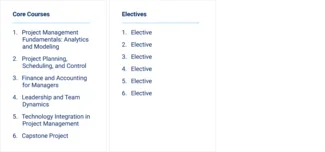
Course Requirements
36 credits, consisting of:
- Six core courses, including capstone (18 credits).
- Six general electives (18 credits).
Specialized Concentrations
View details for each available concentration in the Project Management program.
General Electives
Below is a sample of general electives that align with the program’s core themes and concentration areas:
This course is a seminar-based elective and is designed to expose and engage students on advanced topics in project and enterprise management. There will be invited guest speakers in addition to the main instructor of the course. The course will focus on critical discussions around advanced topics related to the management of large complex construction programs and projects. By drawing on organizational and management theory as well as case studies the course will going beyond means, methods, tools, and techniques and introduce power, politics, systems-dynamics, and risk management to the practice of project management. Students are expected to have a strong understanding of the fundamental competencies of construction management and are expected to have some experience in leadership roles. Ideally this experience would include having taken advanced or professional training courses in project-based leadership, field operations, planning and supply-chain management, and large scale infrastructure or complex project execution.
Course Number
TBDFormat
In PersonPoints
3With the advent of generative AI and the impending arrival of quantum computing, risks to organizations and individuals have grown exponentially. Innovation in offensive and defensive tools and technologies continues to increase. How does a leader keep up? Leaders must know how to work with internal experts and to manage these issues internally, with Boards, and for the public. Proficiency in strategies and principles, some of which date back to the ancient Greeks and Chinese, prevail over tools.
Course Number
TMGT 5136Format
In PersonPoints
3This class is a journey into the “fat edge” of technological innovations that could transform our economy and society over the coming years. We will tackle big questions: How do innovations redefine jobs and industries? What is the real impact of these changes from the C-suite to citizens? This course is about igniting a passion for change, a realization of its risks, and equipping you to lead with vision and principle.
Course Number
TMGT 5117Format
In PersonPoints
3Generative AI represents a pivotal technological evolution with profound implications for the global economy and modern society. This course delves into the decades-long development of AI and machine learning, emphasizing its emergence as a critical economic and strategic force. As we explore this technology, we will assess its potential to revolutionize industries, enhance capabilities, and introduce complex challenges related to security, identity, and ethical considerations.
In this dynamic landscape, both incumbent businesses and governmental bodies face the urgent need to adapt to this disruption and the transformative changes it heralds. This course seeks to unpack the catalysts of this technological surge, its foundational principles, and the critical knowledge required for modern leadership in the AI era.
Course Number
TMGT 5200Format
In PersonPoints
3The Pandemic made us all aware of the fragility of supply chains and how significant the consequences of failure of our supply chains can be. It is paramount to note that global and local economies can break down, and scarcity of essential resources can foment wars. Risk professionals must know what best practices bring security to supply chains and related companies, governments, and other institutions. Students taking this course are prohibited from taking Third-Party Risk Management (ERMC PS5575) at any time. Contact your advisor for more information.
Course Number
ERMC 5585Format
In PersonPoints
3Workshop-like course that addresses a variety of communication skills, including listening skills, presentation skills, leadership communications, conflict resolution, management interactions, and professional communication techniques.
Course Number
ERMC 5300Format
In PersonPoints
3Tools for Risk Management examines how risk technology platforms assess risks. These platforms gather, store, and analyze data; and transform that data to actionable information. This course explores how the platforms are implemented, customized, and evaluated. Topics include business requirements specification, data modeling, risk analytics and reporting, systems integration, regulatory issues, visualization, and change processes. Hands-on exercises using selected vendor tools will give students the opportunity to see what these tools can offer.
Course Number
ERMC 5540Format
In PersonPoints
3Review of the types of strategic risks, such as a flawed strategy, inability to execute the strategy, competitor risk, supply chain risk, governance risk, regulatory risk, M&A risk, international risk, etc. Includes case studies, research, and common mitigation techniques, such as strategic planning practices, management techniques, governance practices, supply-chain management, etc.
Course Number
ERMC 5320Format
In PersonPoints
3In this course, we will explore negotiation from several points of view and approaches. We will also look at characteristics that impact the quality of our negotiations and the outcomes, such as the role of emotions, cultural considerations, effectiveness of our communication, and opportunities to seek out negotiation to transform relationships. The course will be a blend of concepts and skills, theory and practice. On some occasions, you will be introduced to a concept and then asked to apply those concepts in an experiential activity. At other times, you will be asked to engage the activity or simulation and then the concepts will be elicited based on your experience. You will have several opportunities to practice developing your skills throughout the course, in terms of enhancing your practice and honing your analytical and conceptual understanding.
Course Number
NECR 5109Format
In PersonPoints
3Studies systems of infrastructure (water, waste, energy) supporting sustainable, resilient urban development.
Course Number
SUMA PS5690Format
In PersonPoints
3Transportation accounts for about 25% of global GHG emissions. Significantly reducing emissions in this sector is fundamental for addressing climate change. Historically, the technical and commercial tools for tackling emissions in this sector have lagged other sectors (for example, electricity production). But over the last several years, this dynamic has changed and there is now unprecedented capital and brainpower focused on transportation decarbonization. The course focuses on capturing the key elements that will speed the scale-up to low- and no- carbon transportation (“sustainable transportation”) across the breadth of transportation sectors. In doing so, this scale-up will create new industries and business models – and has the potential to benefit a wide group of people, including those who in the past have been disproportionally affected by poor air quality caused by existing transportation sources. The course is designed for any student who wishes to understand these elements in a deeper way. The course will explore the decarbonization opportunities and challenges across the various transportation sectors, including light duty, commercial fleets, public transportation, aviation, and marine sectors – as well as areas that cut across all sectors, such as battery adoption, the supply chain for materials, fueling/charging. and the impact of hydrogen. Because the carbon content of propulsion fuels is dependent on other sectors (for example, the transition to renewable electricity), the course will examine the energy transition in transportation in the context of broader decarbonization trends. In exploring each transportation sub-sector, the course will focus mainly from the commercial perspective, but will incorporate the external factors (e.g., innovation, policy, macro-factors) that affect commercial success.
The course is intended for anyone wishing to further their knowledge or their career in the areas of sustainable transportation – especially in areas related to electric transportation. The course will rely on lectures and discussions, both led by the professor and guest lecturers. There are no prerequisites for the course. The course assignments will include a combination of problem sets, financial modeling, and case studies/written assignments. No previous financial modeling experience is required; the professor and/or TA will provide any extra help sessions required for any financial modeling work.
Course Number
SUMA 5199Format
In PersonPoints
3The focus of Energy & Sustainable Development is the planning and implementation of energy projects, programs, businesses and policies (collectively "energy enterprises") in frontier markets; that is, smaller, less developed countries, as well as niche opportunities within larger settings and more developed economies. Students should consider this course if they wish to:
- Examine the interconnections of energy to the major issues that comprise sustainable development, such as health, poverty, economic opportunity, social and environmental conditions, climate and weather, and energy ethics and justice.
- Explore established and cutting-edge options for delivering modern energy in developing countries and other frontier markets; and,
- Prepare market analysis, and energy for development proposals. It is helpful but not essential for students to be comfortable with rudimentary financial analysis and feasibility tools.
Course Number
SUMA 5150Format
In PersonPoints
3The main topics covered in this course include generation of solid waste in municipal, commercial and industrial sectors with proper identification and characterization of various waste streams involved with emphasis on waste prevention in terms of mass, volume and toxicity at the source, along the processing phase and at the disposal facility, as well as waste minimization by waste reuse and recycling in major commercial and industrial sectors (such as paper, glass, plastics, metals, wood, tire, electronics and construction/demolition wastes) including analysis of state-of-art technologies. In addition, various collection and transport methods are covered along with all typical disposal methods, including incineration, sanitary landfill, composting, recovery and reutilization. Economic evaluations of factors affecting selection of disposal methods and its impact of reuse/recycling along with all applicable local, state and national legislative trends and regulatory requirements. Furthermore, examples of public and private reuse and recycling programs in New York City are covered.
Course Number
SUMA 5210Format
In PersonPoints
3The course provides an overview of the scenario analysis and climate risk modeling process for corporate issuers and government entities. There is a brief introduction to the climate models utilized by the IPCC, both global and regional. There is a description of the scenario generation and analysis process, with linkages to benchmark scenarios outlined by international bodies. This is followed by a review of the linkages between climate models and socio-economic variables in the form of integrated assessment models, Ricardian models and economic input-output analysis. There is one module on the information systems needed to ensure good adaptation and a review of best practices and guidelines for climate risk management strategies. Integrated examples of climate risk and opportunities for specific issuers are discussed in the last 2 classes. The problem sets and exercises are designed to provide practice in applying high-level guidelines and climate damage relationships to the strategies and operations of specific countries, industries and companies.
Course Number
SUMA 6132Format
In PersonPoints
3The purpose of this course is to prepare its students to understand, analyze, and develop policies and procedures to address the sustainability issues being faced by urban centers of developed and developing world, their decision-makers and inhabitants. Students in the course are assumed to have had no previous in-depth exposure to sustainable urban development. By the end of the course, students will have learned to develop strategies and related actions to enhance sustainability of cities covering the following areas:
- Sustainability enhancing practices in urban development management;
- Emerging policies, practices and technologies that promote efficient and low carbon delivery of urban services including transportation, energy, waste, water and sanitation;
- Approach to manage climate change risks and related adaptation actions; and
- Practices of sustainability management adopted by global cities.
Course Number
SUMA 4130Format
In PersonPoints
3One in three seems to be the indicative number. 30% of earth’s land area is covered by forests (5000 years ago it was 50%); one third of current total CO2 emissions are reabsorbed by forests; one third of humanity cooks with wood every day; agroforestry is the preferred system for these same 2 billion people. Hundreds of millions of indigenous peoples have their native land in forests. The biodiversity score is much higher: more than half of all of earth’s species are found in forests (about 25% are in the oceans); forests are the major system for fresh water conservation; and the traded value of global forest products is about $300 billion. Finally, to be in the forest (especially with your eyes open) makes life worth living. Forests are therefore intimately connected with climate, water, biodiversity, food production, global poverty, indigenous people, and human spiritual well-being; not to mention the major global industries based on them. They are best understood when considered holistically, and that is the approach of this course.
We will examine all the issues mentioned above and their connections with forests to develop a comprehensive understanding of them. We will study both forest ecology, economics and business. We will examine indigenous peoples’ vision and view of forests and nature. We will delve deeply into the role of forests in climate change; forests both absorb and produce CO2 emissions. We will consider temperate, tropical and boreal forests. On Saturday field trips we will learn to measure forest biomass, commercial volume and carbon content. We will learn to financially analyze forest business ventures. Students will produce reports at the end of the course on one of the connections outlined above or on a country of interest. Mid semester, students will develop analytical work products on measurement and financial analysis. Without an understanding of forests, one’s grasp of all the issues mentioned above is incomplete. Also forests provide a rather straight-forward context for understanding and analyzing many issues that are critical to all areas of sustainability. We will utilize the forest context to better understand, for example, management of water, biodiversity, poverty alleviation, environmental justice, forest industries and the global carbon cycle and climate. In other words, skills acquired here will be useful in other fields of study.
Course Number
SUMA 5770Format
In PersonPoints
3This course is an introduction to how Global Agriculture and Sustainability issues are at the intersection of natural resource management and business. The course will devote a significant of time covering the fundamental principles of agribusiness and how sustainability issues are key factors in business decision making today and in the future. The course will consider that agricultural production will need to double over the next three decades in order to meet growing demand. Demand for increased food, feed, fuel, and fiber is driven by increased population and an increase in the middle class in emerging economies. Coupled with a shift in dietary preferences from grains and staple carbohydrates to more protein-based diets including pork and beef (and perhaps fish), and biofuel production, more grains will be used to feed animals and fuel our automobiles. As an energy intensive sector, agriculture is closely linked to energy markets, with crop production and demand potentially adversely affected by higher oil prices, while crop inputs (such as fertilizer) may benefit from lower natural gas prices. These shifting dynamics will affect profit margins in different segments of the agricultural supply chain. In addition to energy prices, likely constraints to the productivity growth of agriculture include climate change, water resources, infrastructure, education and training of producers, and social / governmental policy that distort agricultural markets. New technologies, product platforms and innovative business models in agriculture technology and food systems will dominate the shift from industrial agriculture to a more socially just and environmentally sustainable food production and distribution system. The agricultural technology sector is large, comprising over 8,500 companies generating over $1.3 trillion of revenue per year, in the US alone. Moreover, the volume of transactions in the agricultural sector is greater than $15 billion per year with an estimated peak of over $70 billion in 2007.
Course Number
SUMA 5240Format
In PersonPoints
3Biodiversity, a term popularized in the 1980s, refers to the variety of life at the genetic, species, and ecosystem levels. It is crucial for sustainability, as it supports ecosystems that underpin human life, economic activities, and ecological stability. The loss of biodiversity threatens essential ecosystem services like clean air, water filtration, climate regulation, and food security. This course explores how climate change, both current and projected, impacts biodiversity and how natural ecosystems influence greenhouse gas concentrations. Human survival depends on these ecosystems, yet there is uncertainty about how much biodiversity loss can be tolerated. Climate change now poses as serious a threat to biodiversity as direct development activities. Understanding the science behind these threats is essential for sustainability students, and this course aims to provide that knowledge. Uniquely, this course is taught through collaboration among the SUMA professors who otherwise teach biodiversity classes of their own. Indeed, this course has incorporated several SUMA faculty as guest lecturers partly to ensure full compatibility and complementarity of different courses. We will study biodiversity and climate change in both terrestrial, aquatic, and marine ecosystems, including urban and agricultural landscapes. There is great biodiversity, and great threats to it, in all these ecosystems. Sustainable management of all these different ecosystems can help conserve biodiversity and reduce the rate of climate change. In fact, natural ecosystems have a very significant role in both emissions and sequestration of carbon. Over half of current emissions are absorbed by the forests and oceans rather than remaining in the atmosphere.
Course Number
SUMA 4238Format
In PersonPoints
3This onsite course takes students on a virtual journey through the world’s leading innovation hubs across North America, Latin America, Europe, the Middle East, Asia-Pacific, and Africa. Students will analyze the structures, dynamics, and key stakeholders that shape entrepreneurial ecosystems worldwide, including entrepreneurs, corporations, investors, policymakers, universities, accelerators, incubators, and industry associations.
Course Number
TMGT PS5130Format
In PersonPoints
3This course provides a comprehensive examination of modern software product development, focusing on creating solutions that address clear user needs and challenges. A “product” in this context refers to a software program that instructs computer hardware to operate, solve problems, and manage tasks effectively.
Modern product development benefits from systematic practices that enhance efficiency, sustainability, and continuity. These practices, including flexibility, iterative development, customer feedback, and efficient project management, are essential for adapting quickly to rapidly evolving market and technology landscapes.
Course Number
TMGT PS5119Format
In PersonPoints
3This class explores the unique challenges faced by the construction and design industries, which are particularly prone to frequent and diverse disputes. These conflicts often arise during active projects that require progress and timely completion. The course provides a comprehensive overview of the various dispute resolution methods available to these industries, emphasizing strategies to manage and resolve conflicts efficiently while minimizing disruptions to ongoing work. Topics covered include mediation, arbitration, litigation, dispute boards, alliance, neutral evaluation, the participation of experts, and third-party expert evaluation. By understanding these mechanisms, industry professionals can better navigate disputes, ensuring projects stay on track and disputes are handled effectively. Through this course, you will learn how to identify potential conflicts early on and introduce fundamental strategies for effectively managing disputes in a manner favorable to all parties involved. The aim of this course is to equip you with the tools to resolve disputes amicably before they escalate into conflicts that could jeopardize the project’s success and schedule.
Course Number
CIEN E4132Format
In PersonPoints
3Most engineers will assume some type of management responsibility over the course of their careers, whether it is managing a design project, a construction site, a regional office or an entire firm. While there is no shortage of training at project level, less attention is focused on leadership and management within a project framework in the architecture, engineering and construction (AEC) space. To plan an organization’s future, leaders must first understand its current organizational and operational framework.
This course provides a comprehensive overview of the business side of an AEC company by covering key business concepts, including financial management, risk management and knowledge management. We utilize case studies to illustrate how to anticipate and respond to industry trends through strategic planning and management. While the course predominantly focuses on the consulting engineering firm environment, it is designed for students and practitioners working in all fields within AEC. Upon completing the course, you will be able to evaluate different ownership structures, analyze industry trends, assess new technologies and utilize strategic management tools for strategic analysis, formation and implementation.
Course Number
CIEN E4135Format
In PersonPoints
3This course offers a deep dive into the startup ecosystem within the built environment. It will train you to identify real-world challenges and develop business solutions grounded in the realities of this industry. Through a practical capstone project, you will work in teams to develop and present a full business model tailored to the unique constraints and opportunities of the architecture, engineering, and construction (AEC) industry. From customer segmentation to market-fit and value proposition design, the course will develop your understanding of both the entrepreneurial process and the particular nuances of starting a venture in a field shaped by complex stakeholders, long project timelines, and increasing digitization.
The curriculum blends theory and practice through lectures, business case discussions, guest talks from leading entrepreneurs, and group projects. Guest lecturers include a variety of startup founders, investors, intrapreneurs, and enterprise customers. Their firsthand accounts offer expert insight into both the broader trends and the complex realities that define the business. This course fosters a multidisciplinary skill set vital for future leaders in the AEC sector. You will learn how to effectively pitch ideas, conduct stakeholder interviews, analyze competitors, and forecast go-to-market strategies—all within a collaborative, feedback-rich environment. The course responds to urgent societal needs such as improving infrastructure, boosting productivity in construction, and fostering inclusive innovation. As a graduate, you will have the strategic mindset and tools to launch impactful ventures that respond to the pressing challenges facing the built environment today.
Course Number
CIEN E4136Format
In PersonPoints
3Balance and inspiration are at the heart of leadership. In the Architecture, Engineering, and Construction (AEC) industry, successful leaders motivate and empower others to achieve a shared vision, creating the supportive environments where ideas become reality.
This course examines the attributes of inspirational leaders across both public and private sectors of the AEC industry and explores how their vision, values, and decision-making shape the success of the agencies and enterprises they lead. Alongside case studies, you will analyze the critical distinction between strategic management and leadership. How do leaders discern the difference, and how does this awareness connect to personal success and societal benefit?
Six core objectives guide the course:
Understanding the power of a motivating vision
Communicating values that drive action
Examining behaviors that foster unity
Shaping a positive organizational climate
Developing skills that support others
Orchestrating team performance beyond individual ambition
Through tools, concepts, and frameworks, you will strengthen your ability to define and analyze leadership challenges, applying lessons to both organizational contexts and personal growth.
As Yogi Berra—who led both the Yankees and the Mets—once quipped, “When you come to a fork in the road, take it.” In this spirit, our exploration of leadership and decision-making will not only influence how you navigate your professional career but also how you contribute to shaping the future of our cities.
Course Number
CIEN E4150Format
In PersonPoints
3The American Society of Civil Engineers estimates that the amount of investment gap in US infrastructure will be approximately $3.6 trillion over the next ten years. Public Private Partnerships (PPP) will fill a significant portion of that investment gap with private capital. PPPs do not fit every infrastructure need in the United States for many reasons. Engineers, constructors, designers, environmental experts and industry experts must know how PPPs work.
This course explores how public-private partnerships (PPPs) succeed or fail, with a particular focus on the interplay between engineering, financial investment, and analysis. You will examine how PPPs serve the interests of both public and private sector stakeholders. You will also look at the use of digital twins, financial controls and monitoring, and software employed by international PPP players. By the end of this course, you will have a solid understanding of the advantages and limitations of PPPs, and how they influence the investment gap in funding infrastructure modernization in the U.S. and globally.
Course Number
CIEN E4141Format
In PersonPoints
3Studies systems of infrastructure (water, waste, energy) supporting sustainable, resilient urban development.
Course Number
SUMA PS5690Format
In PersonPoints
3Agriculture is at a pivotal point in addressing climate change, facing the dual challenge of being both a victim and a contributor to it. As other sectors reduce their carbon footprints, agriculture's emissions could rise without intervention. This sector must now embrace transformative actions, including regenerative practices and smart technologies, to adapt and mitigate climate impacts. This urgency was highlighted in global discussions, like at the COP28 meetings in the UAE, focusing on Climate Smart Agriculture (CSA) - an approach integrating cropland, livestock, forests, and fisheries to tackle food security and climate change.
This course is tailored for future sustainability leaders, offering a deep dive into the intersection of climate change and agriculture. With climate change threatening to reduce global crop yields significantly, understanding and addressing these challenges is critical. The course explores CSA solutions, from AI and IOT to hydroponics and urban agriculture, emphasizing adaptive strategies for diverse environments. Students will analyze key agricultural regions and crops, assess real-world challenges, and discuss successful adaptation strategies.
The course demands analytical thinking and practical application of climate-smart solutions in assignments reflecting real-world challenges. Through this, students will enhance their ability to convert theory into actionable strategies, preparing them for roles in the $1+ trillion US agriculture sector or the global sustainable agriculture industry.
Course Number
SUMA PS5245Format
In PersonPoints
3This asynchronous, 3-credit elective provides an immersive, supervised professional internship experience paired with structured reflection and applied academic work. Students integrate theory with practice while assessing organizational culture, ethical decision-making, feedback practices, and professional competencies. Through guided analysis and reflective assignments, students deepen self-awareness, strengthen career readiness, and clarify how their internship experience shapes future professional goals.
Course Number
PMGT5995Format
In PersonPoints
3This asynchronous, 1.5-credit elective integrates a supervised professional internship with structured reflection and applied coursework to help students connect academic learning to real-world practice. Through career design, goal setting, and reflective exercises, students clarify professional interests, build adaptability, and articulate the impact of their internship on future career pathways.
Course Number
PMGT5996Format
In PersonPoints
1.5This asynchronous, 1.5-credit elective combines a supervised professional internship with guided analysis of workplace culture, ethics, and feedback practices. Students evaluate organizational values, inclusivity, and ethical decision-making while developing the skills needed to navigate professional environments and identify the workplace cultures in which they will thrive.
Course Number
PMGT5997Format
In PersonPoints
1.5In this course, students will explore the full product lifecycle from discovery and user research to agile execution, stakeholder engagement, and go-to-market planning. But beyond the tools and tactics, this course invites students to step into the mindset of a product leader: someone who doesn’t just manage ideas, but brings them to life with courage, conviction, and collaboration. Whether you’re refining an existing solution, launching something new, or championing someone else’s vision, you’ll learn how to lead from wherever you are navigating complexity, earning influence without authority, and making impactful decisions even when the destination is unclear.
Course Number
TMGT PS5143Format
Online, In PersonPoints
3Students interested in taking electives not listed above should consult with their academic advisor to explore additional options and ensure course alignment with program requirements. The University reserves the right to withdraw or modify courses of instruction or to change instructors as necessary.