

“Education is not a transaction, it's transformation.” So said Tiffany Hughes, associate dean of graduate programs at Columbia's School of Professional Studies, at a recent event.
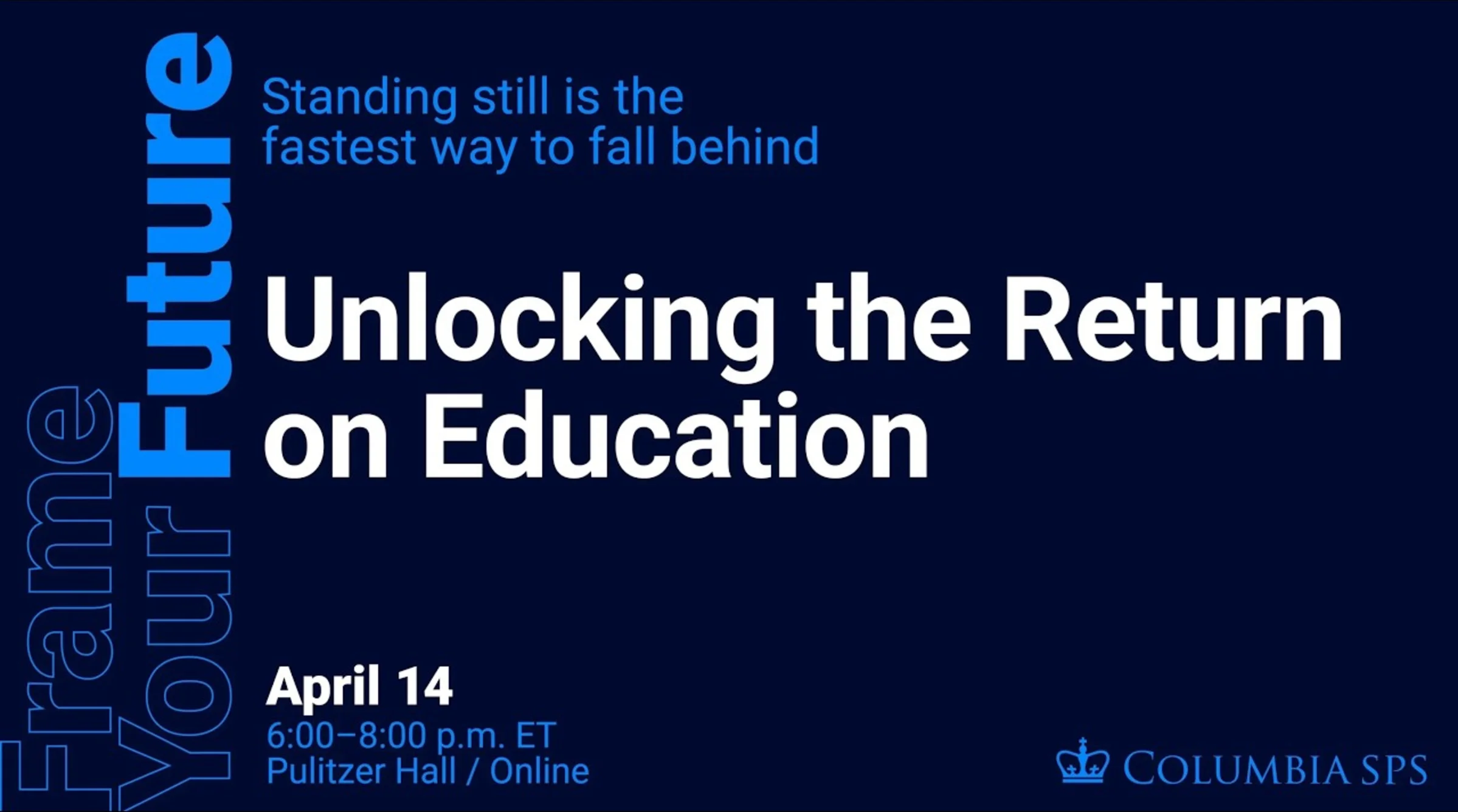
The event, Unlocking the Return on Education, was the second installment in the School of Professional Studies’ Frame Your Future public series, designed to spotlight the forces redefining leadership and professional advantage in an era of constant change. The signature series features industry leaders, faculty, and alumni who share insightful perspectives and practical solutions to support professional advancement, with thought leaders drawn from organizations such as NASA, IBM, Deloitte, and Paramount Global. Across conversations spanning sustainability, technology, biodiversity, and project management, the series is designed to help professionals navigate a rapidly changing world.
Moderator Louise A. Rosen, senior associate dean of administrative affairs and communications, recently explored a similar question in her SPS article, "Why the Return on Education Outweighs the Return on Investment": How should professionals assess the value of education in an era defined by technological disruption and constant change?
This panel convened faculty and alumni to share insights on leadership, learning, and what professional advantage looks like as AI collapses the cost of producing work. In this market, Hughes argued, the real return from a degree is no longer a credential or a salary bump. It is the capacity to keep evolving: to ask better questions, to navigate ambiguity, to recognize opportunity where others see uncertainty. Returns compound, she added, in ways you can't predict at the start.
The case for why that compounding matters more, not less, in the AI era was made by Eli Cohen, founder of the marketing firm Osmos and an SPS student. “The chessboard was wiped clean,” he said. “Technology used to gatekeep. Now it accelerates.” The internet, he argued, democratized knowledge; AI is now doing the same for execution. “Anyone can prototype, write, design, ship. We need to see this collapse in friction as an opportunity.”
Mark Ritzmann, executive director of SPS’s Analytics and Information Systems Lab, brings nearly three decades in AI and machine learning to the conversation. He sees the same friction collapse Cohen described, but he is focused on what fills the vacuum it leaves behind. “If this is all changing and the friction is being reduced, then what replaces that friction—it’s those skillsets and that type of liberal arts education.” When anyone can produce a draft, he argues, the differentiator is no longer output. The skills that used to feel like overhead are now the actual job. As Ritzmann puts it, “How do you evaluate an answer? How do you put guardrails around an answer? And how do you act in a responsible manner?” In Ritzmann’s frame, a liberal arts sensibility—the habit of interrogating an idea before accepting it, has gone from soft skill to core competency.
Jessica Thurston, VP for ESG at Paramount Skydance, an SPS lecturer, and an alumna of the M.S. in Sustainability Management program, made the case for education directly: “I wouldn't have my job without this degree.” Sustainability, she said, touches almost every part of a business. That forces her into a posture of constant learning, one she encourages on her team. The professionals who thrive in volatile markets, she argued, carry both breadth across domains and real depth in one. They treat continuing to learn as a job requirement, not a perk.
That premium on judgment is exactly what SPS’s scholar-practitioner model is built to develop. Faculty are leaders running things in sustainability, sports, AI, nonprofits, and media. Their courses pull from this week’s cases, not last edition’s textbook. Cohen described the SPS classroom as his “test kitchen,” somewhere to try ideas, fail in front of people who have failed before, and walk out with critique that actually moves the work. The peers around him are operators in adjacent industries, and the cross-sector friction is the point. A nonprofit director, an ESG lead, a sports executive, and an AI founder will pressure-test an idea in ways no single industry seminar can.
Dr. Basil A. Smikle Jr., professor of practice and director of the M.S. in Nonprofit Management program, named the stakes for his sector. With nonprofits under attack and funding threatened, he argued this moment of disruption carries within it a rare and serious opportunity. “Given all of the guardrails that have been taken down, all of the norms that have been broken,” he said, “we really have an opportunity to rethink what we want this country to be.” That is one return on education, the capacity to stay in the fight when the ground is shifting, and the mindset to think clearly about what should come next.
Len Elmore, senior lecturer in the M.S. in Sports Management, summed up the return on education simply. Higher education, he said, is "the license to be in the room with folks who are going to have an impact.” It is the equipment to do something useful once you’re in the room.
About Columbia University School of Professional Studies
The Columbia University School of Professional Studies (SPS) was founded in 1995 with a mission to provide innovative—and flexible—programs that help students reach their educational and professional goals. The School offers 19 accredited master’s degrees, 13 certificate and certification programs, and more than 100 areas of study through its Postbaccalaureate Studies and Visiting Students programs—all available on a part-time basis. Explore Columbia SPS’s part-time offerings, including master’s degrees, certificates, and other non-degree programs.


