By Dr. Laura Dannels, Lecturer, M.S. in Human Capital Management, Columbia University School of Professional Studies; Chief Human Resources Officer, UCSF Health
HR leaders across industries are exploring the parts of the HR function’s workload that agentic AI can and should take on. In most teams, headcount has always capped or limited how much work gets done, and AI agents are starting to lift that cap. In fact, how teams use the time they free up will shape HR roles for years. For example, saving a day of a recruiter’s week could allow them to focus on harder-to-fill roles and to build stronger relationships with candidates and hiring managers.
A particular industry where a capped recruiting team means a great deal of cost is healthcare because, when hiring falls behind in a hospital, the problem doesn’t stay inside HR. Units run short, and managers cover the gaps with overtime and travel clinicians. A service line that can’t be staffed doesn’t open on time, and a bed that can’t be staffed stays closed. Some of this is due to talent scarcity, but much of it comes down to a hiring function that can only handle so much volume, and the limits on capacity have little to do with effort.
Here’s what that cap looks like in practice. Most health systems have a live conversation with only 3–4% of their job applicants. Nobody set that number as a target; it’s simply what fits into a recruiter’s week. A recruiter carrying 60–100 requisitions works down the stack until the day ends, and the stack is always longer than the day. So, the candidates who get a call tend to be the ones who applied first, whose resumes cleared a keyword filter, or who happened to pick up the phone.
Most hires a hospital makes come out of that sample, driven by application timing and recruiter availability rather than by anyone’s judgment. The best candidate for the ICU may well have applied; however, that person wasn’t hired because the recruiters never got the chance to speak to them.
The research on AI adoption is further along than most people realize
Researchers at the University of Chicago Booth School of Business and Erasmus University Rotterdam ran a field experiment across 43 client firms and roughly 70,000 applicants, randomly assigning each applicant to one of three groups: those serviced by a human recruiter, an AI voice agent, or a choice between the two. [1]
Candidates interviewed by the AI agent were 12% more likely to receive an offer. They also showed a 17–18% increase in retention, a benefit that lasted at least 120 days post-hire. Because assignment into the three groups was random, motivation doesn’t explain either result. [1]
The authors point to consistency rather than selection. AI interviews followed the firm’s structured guidelines more closely, covered more of the intended topics, and asked more comparable questions from one candidate to the next, which the researchers call “controlled variance.” Human interviewers, on the other hand, showed more variance in their interview approach. And, when candidates were given the choice, 78% chose to interview with the AI agent. [1]
However, in considering these results, two caveats must be taken into account: the jobs in this study were customer service roles, not clinical ones, and the paper in which the study was reported hasn’t yet been peer reviewed.
Most of a recruiter’s week goes to processing work
A recruiter’s activities often involve a lot of repetitive work: reading resumes that all converge on the same certifications and the same two-page format and repetitive activities, playing phone tag to book a screen, then rescheduling it; running the same fifteen-minute qualifying call several hundred times; typing license numbers into state board websites; chasing three references who don’t call back. And then doing all of it again the next week for the same requisition, because the first hire took another offer.
For a long time, this processing work was the only way to get a candidate from application to hiring manager, and it set a hard ceiling. The size of the recruiting team decided how many candidates the organization could consider, and with it how long a vacancy stayed open and a unit ran short.
That ceiling has always had a cost, and it has never shown up on a recruiting budget line. For example, NSI Nursing Solutions, a firm focused on high-volume recruitment of experienced American registered nurses, puts the average hospital’s annual loss to registered nurse turnover at $5.19 million, with about $295,000 riding on each percentage point of turnover, and an experienced nurse taking roughly 78 days to hire. [2]
AI agents take the processing work off the recruiter’s desk
In contrast to a human recruiter, an AI agent is an autonomous system, trained on healthcare hiring data, that completes recruiting tasks from start to finish. In healthcare that takes more than a chat interface layered onto an applicant tracking system (ATS). Licensure, specialty, shifts, location, credentialing, and clinical experience all affect whether someone can fill a role, and an agent has to understand each of them to move a candidate forward.
In its “recruiter” role, an AI agent can screen. It can text and call a candidate within 60 seconds of an application, walk through a structured conversation about licensure, availability, shift preference, and relevant experience, adapt its questions to the answers it hears, and return a scorecard, transcript, and recording to the hospital’s ATS, around the clock.
An AI agent can source for scarce talent. It can search applicant databases, build a list from criteria a recruiter describes in plain conversation, and run the outreach on the recruiter’s behalf.
An AI agent can verify. It can check a clinical license directly against the issuing state board and create a complete, standardized verification record every time.
And an AI agent can handle references. It can request them from the candidate, follow up when they don’t arrive, and run the routine reference call itself, so the human recruiter reads a summary instead of leaving another voicemail.
None of the AI agents decide who gets hired. Each one takes a manual, time-consuming task that used to require a recruiter and completes it without one.
What changes when the ceiling comes off
You reach everyone who applies. As one example of AI’s impact on recruiting, Take2 AI is a provider that builds healthcare-specific AI agents, and its deployments across large health systems show what this looks like in practice.
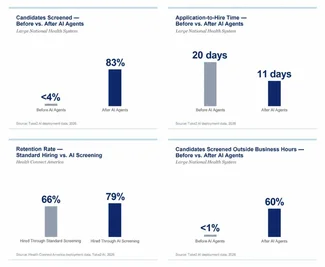
Take2’s AI agents have processed over 1,000,000 interviews. At one of the largest U.S. health systems that works with Take2, fewer than 4% of applicants had the benefit of a conversation before the AI agents were deployed. Today, 83% of applicants complete a full structured AI interview, and fewer than 1% drop out once they start. [3] UCHealth, a Colorado academic system with 15 hospitals and roughly 37,000 employees, has published its own results and reported that 81% of its candidates completed the full Take2 AI interview. [4] Prior to the use of AI, the 4% of applicants who had the benefit of a conversation likely reflected how little time recruiters had.
The same reach extends to past applicants. A hospital’s applicant tracking system maintains records of people it already paid to acquire, many of them qualified candidates who simply applied at the wrong moment. When Take2’s AI agents run sourcing campaigns for hard-to-fill provider roles, roughly 20% of candidates they contact become leads, well above the 1–2% response rate typical of templated outreach, and with no job board spend or agency fee.
Candidates appreciate the use of the AI system, and they say so. Satisfaction ratings score 4.8 out of 5 at the health systems using these agents. [3] One perceived benefit involves timing. With AI agents, roughly 60% of screening interviews happen outside business hours because recruiting can run on the candidate’s schedule instead of the organization’s. For example, a nurse coming off a Friday shift at 7 p.m. doesn’t want to wait until Monday for a recruiter to begin work, especially when the nurse may be considering working at any of a number of hospitals. For a candidate used to applications that go unanswered, a 10 p.m. Saturday screening is the first sign someone is paying attention.
You learn more about candidates than a resume can tell you. Resumes are written to persuade, and these days they are often written and polished by AI. [5] In high-volume hiring, resumes can look alike and say almost nothing about shift fit, commute reality, unit preference, or what someone actually did in a room with a patient. A structured interview, on the other hand, asks every candidate the same questions, scores them against the same rubric, and produces a full transcript and recording. Licensure is a simple example. At the large national health system, 75% of RN candidates give their license number in the first interview, about seven times what resume review used to produce. [3] And you can only search a database on active licensure if the database holds it.
A critical question is whether the AI can help to predict job fit. In the study, every AI interview ends with a score from 0 to 100, which reflects how well the candidate’s answers meet the criteria the hospital set for that role, such as licensure, relevant experience, shift availability, and responses to behavioral questions about patient care. At the large national health system, hired candidates’ average interview scores were 20% higher than those of candidates who weren’t hired. [3] At UCHealth, candidates who received offers scored 5 points higher on the same 100-point scale than candidates who weren’t moved forward, a statistically significant finding. [4] Recruiters couldn’t see these scores when deciding whom to advance, so the gap shows the AI’s assessment and the hiring team’s judgment pointing in the same direction. The findings indicate the AI assessment score is indeed predictive of job fit.
Beyond job performance, retention is a critical measure because of hiring and turnover costs. Turnover within 90 days in high-volume healthcare roles can run close to 10%. At Health Connect America, a behavioral health organization operating across ten states, candidates hired through AI screening showed 79% retention, against 66% for everyone else. [6]
Recruiters now get to be talent strategists. Recruiters working alongside AI agents report saving up to 20 hours per week. [7] For example, Dental Care Alliance, one of the nation’s largest dental services organizations, with more than 400 affiliated practices, automated about 75% of its end-to-end recruiting process with Take2’s AI agents and saved 30% of its annual recruiting budget. [8] Healthcare talent acquisition is already leaner than most industries, though, because margins are thin and the money goes to care. For a growing health system, those numbers are better read as capacity: room to take on more volume without adding headcount in proportion.
The job itself changes, too. Recruiters move from “inside the process,” where every candidate needs a human touch to advance, to “above the process,” where they set the criteria, review the exceptions, and spend their time where they can contribute most meaningfully. This can mean matching a candidate with the needs of a specific unit, aligning particular candidates who have development needs with hiring managers who are good at developing people, and landing a clinician who is in high demand and who is holding three job offers.
Good healthcare recruiters have those skills. What they’ve been missing is time to build relationships with scarce talent and cultivate pipelines, sometimes over months, for roles where the shortage is national. Giving them that time back is the real opportunity here.
Why this stopped being a recruiting story
The hiring metrics are the measured part. For example, at UCHealth and the top national healthcare system, the time it took from application to hire fell from 20 days to 11 for roles where the AI agent was deployed. [3] Hires completed within two weeks rose from 48% to 79%, and fourth-week hires, previously the largest group, dropped to about 5%. [3] The time from application to a clinical interview fell from weeks to roughly five days. [4]
And, while patient outcomes were not reported, the AI agents’ benefits seem apparent: every day saved used to be a day a unit ran short, covered by overtime, travel labor, or a nurse caring for one too many patients. Moreover, teams carried by traveling nurses and PRNs often don’t feel stable, and a permanent hire in the seat is what the unit is really asking HR for. Shorter vacancies mean fewer of those potentially short-staffed days, and better assessment means fewer hires who leave inside 90 days and restart the cycle.
In summary, for decades the operating question in hospital recruiting has been how many requisitions one recruiter can manage, and the question HR leaders in every industry are asking is, “Which parts of the workload should AI agents take on?” The better question, and one AI agents can significantly address, is how many candidates the organization can meaningfully reach, and how quickly it can get to an offer.
In healthcare recruiting, the early answer is the processing work. Once this is off their desks, recruiters can put their time into the hardest roles and the relationships that matter, and help hospitals fill open roles sooner.
About the Program
The Columbia University M.S. in Human Capital Management program prepares graduates to be world-class HCM strategists able to address changing needs in building and motivating talented, engaged workforces in the private, public, academic, and not-for-profit sectors.
Learn more about the program here. The program is available part-time, full-time, on-campus, and online.
Sources
- Jabarian, B. & Henkel, L. (2025). Voice AI in Firms: A Natural Field Experiment on Automated Job Interviews. University of Chicago Booth School of Business & Erasmus University Rotterdam. Working paper.
- NSI Nursing Solutions, Inc. (2026). 2026 NSI National Health Care Retention & RN Staffing Report.
- Take2 AI deployment data, 2026.
- UCHealth deployment data, Take2 AI, 2026.
- Novorésumé, "Resume Statistics" (2026).
- Health Connect America deployment data, Take2 AI, 2026.
- Midi Health deployment data, Take2 AI, 2026.
Dental Care Alliance deployment data, Take2 AI, 2026.