
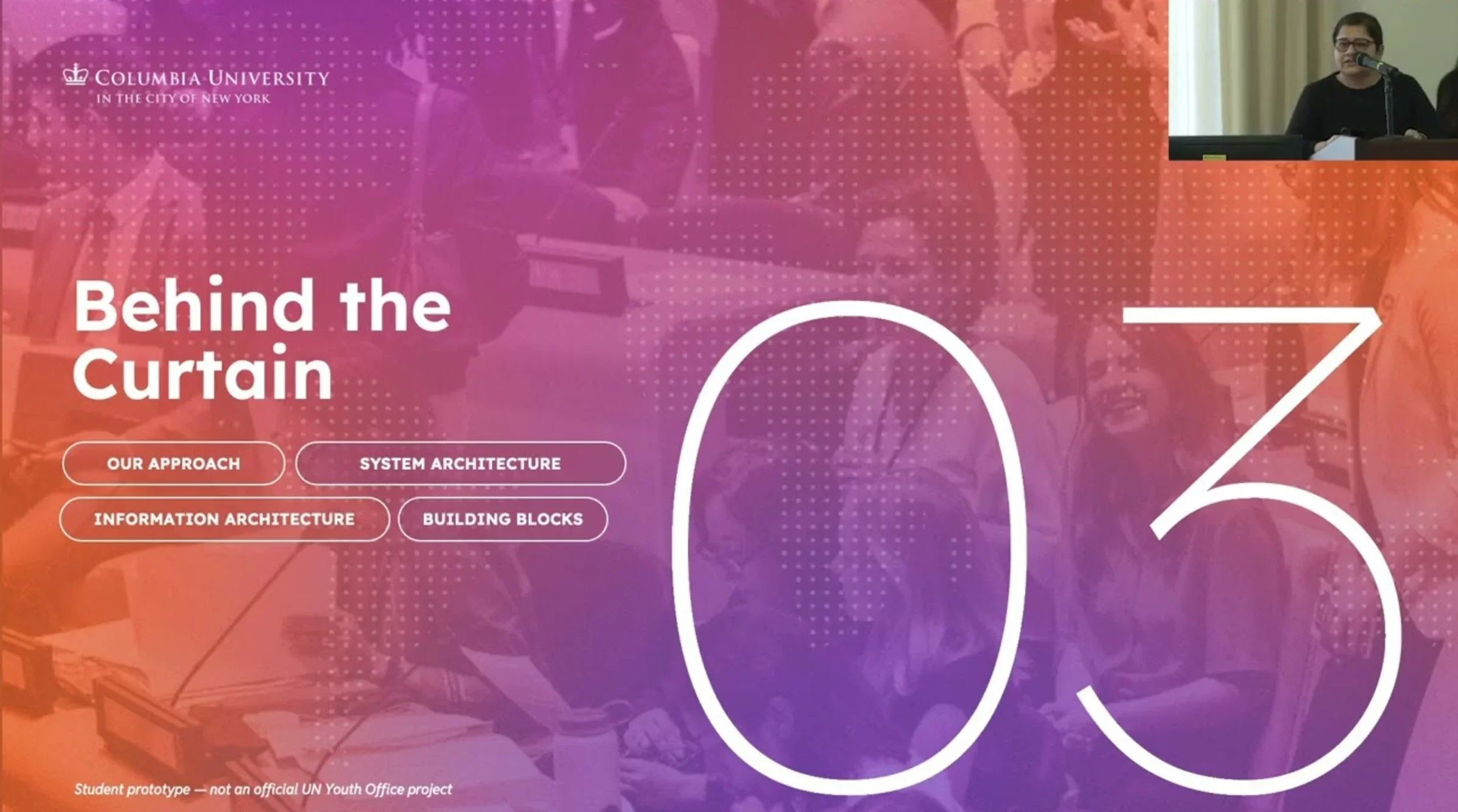
Watch IKNS capstone presentations to their sponsors to get a feel for the variety of projects delivered by the program; presentations include those delivered to The United Nations, NYC Vision Zero Task Force, The Microsoft Garage, and Gilead Sciences, among others.
Sign-up for the IKNS newsletter
For students in the M.S. in Information & Knowledge Strategy (IKNS) program at Columbia University School of Professional Studies (SPS), the hands-on experience of the capstone course offers an incredible advantage in adjusting to the demands of the real world. But that impact goes both ways.
“The IKNS capstone is designed to be mutually beneficial,” said Professor Blake DiCosola, who runs the IKNS capstone course. “Students benefit from getting to tackle a real problem with a leading organization; sponsors benefit from getting assistance on a problem that they perhaps do not have the bandwidth or resources to solve at the time.”
Over the years, IKNS students have worked with sponsors like Nike, NASA, Boeing, EY, Amgen, Gilead, The Microsoft Garage, The United Nations, Verité, and Town+Gown:NYC at the NYC Department of Design & Construction to solve challenging, cutting-edge problems at the intersection of data, people, and strategy.
Students in the IKNS program take a common foundation of six required courses and choose six electives tied to data, people, and strategy to customize their degree. The culminating project of the degree program, the capstone course, allows students to collaborate in groups, where they apply their skills, technical knowledge, and range of perspectives to real-world challenges for capstone sponsors. Each student has the opportunity to impact real change within sponsoring organizations and bring that experience to their own future work.
Recent IKNS capstone projects have helped:
- L’Oreal Luxe better leverage AI and data to inform more rapid and profitable product marketing decisions.
- The United Nations build a Youth Knowledge Hub for children and young adults all over the world to help discover new ways to engage with their communities and society more broadly.
- Oscar Health improve their People Analytics functions with more accessible data through a custom Google Gem to enable more strategic decision-making.
Capstone sponsors Jorge Martinez Navarrete, information technology officer at the United Nations Office of Information and Communications Technology; Christine McLane, senior director of people tech and operations at Oscar Health; and Terri Matthews, director of Town+Gown within the NYC Department of Design and Construction, spoke with IKNS about their experiences working with students on the projects.

The IKNS capstone team for the United Nations Youth Office built a customized knowledge management system leveraging human-centered design to craft differentiated front-end experiences for youth as well as back-end solutions for UN staff and collaborators.
The IKNS capstone team for the United Nations Youth Office built a customized knowledge management system leveraging human-centered design to craft differentiated front-end experiences for youth as well as back-end solutions for UN staff and collaborators.
What made IKNS an appealing partner to work with? And how was your experience working with IKNS this year for the first time?
Martinez Navarette: We collaborate with a range of universities, but Columbia’s IKNS program stood out because of its strong interdisciplinary approach and its focus on practical, real-world problem solving. We were especially impressed by the quality of the students’ work, the faculty’s guidance, and the program’s commitment to producing actionable ideas with public impact.
It was a very positive experience. The IKNS student teams were professional and highly engaged throughout the process. They brought strong research and fresh perspectives. The feedback from colleagues across the organization was also highly positive. Several colleagues appreciated the students’ preparation and quality of analysis. The collaboration was seen as both valuable and rewarding.
Matthews: IKNS focused on issues of knowledge management and knowledge transfer that other capstone programs are not specifically aimed at addressing. The IKNS program embeds traditional management concepts and looks at them through a knowledge lens, which is unique and can address especially complex cross-agency initiatives or complex data technology issues either within an agency or across agencies.
How would you characterize your experiences working with IKNS students across several years, and what keeps bringing you back to IKNS?
McLane: While every project is unique, the experience has been incredibly consistent. Each year, I’ve been impressed by how quickly the teams integrate into our workflow and adopt our organizational framework. What stays the same is the level of curiosity and the quality of the final output. The faculty play a vital role here as well—they act as a safety net, providing the necessary 'course correction' and coaching to ensure the students navigate the ambiguity of a real-world corporate environment successfully.
The IKNS capstone provides incredible value through its versatility. As an alum and repeat sponsor, I have seen how that rigor translates into results. The students come together with different skillsets and backgrounds to transform problem statements into actionable solutions. They operate as a team of consultants who understand how to make complex data accessible and unlock change in organizations.

IKNS capstone projects always result in deliverables that enable their sponsoring organization to take action on the problem they came to IKNS with. Deliverables might include strategic recommendations, prototypes and MVPs, dashboards, deployment guides, or other innovations that are designed for impact.
IKNS capstone projects always result in deliverables that enable their sponsoring organization to take action on the problem they came to IKNS with. Deliverables might include strategic recommendations, prototypes and MVPs, dashboards, deployment guides, or other innovations that are designed for impact.
What is an outcome from an IKNS capstone that you are most proud of and why?
McLane: One outcome I am particularly proud of was the development of a Google Gem for our People Analytics team. This project perfectly showcases the IKNS pillars: it took complex data, applied a strategy for how that data should be used, and focused on the people by making the insights accessible to non-technical leaders. Beyond the tool itself, this collaboration allowed us to pilot new AI technology in a controlled, highly focused way. Seeing a student-led prototype move from a mere concept to a real-life tool that actively improves our internal decision-making is incredibly rewarding. It proved that the students don't just understand the theory—they can build the future of work.
How were the outputs you received from your IKNS student teams?
Matthews: Absolutely excellent teams on both projects [Vision Zero Task Force and the E.O. 23/2022 “Clean Construction” initiative]. Implementing aspects of the students’ work may come into play over time.
Martinez Navarette: For me, one of the most valuable aspects of this collaboration was how practical the outputs were. One team helped develop a new design for a platform that we are now implementing at the UN, which is very exciting. The other produced a blueprint for how to better organize our information, and that is already influencing our internal next steps. This capstone was an excellent investment of our time. I would be very happy to work with IKNS again on new problem statements.

IKNS students and sponsors from the New York City Vision Zero Task Force and E.O. 23/2022 “Clean Construction" teams.
IKNS students and sponsors from the New York City Vision Zero Task Force and E.O. 23/2022 “Clean Construction" teams.
IKNS Capstones: The Student Experience
While capstone sponsors benefitted from the students’ perspectives and the outputs of their projects, students were also grateful for the opportunity to—as student Gunther Schneider put it—“apply what we learned throughout the program to a real-world scenario,” and receive support from experts in the field.
“I was really happy with the organization I was paired with for my capstone, the UN Youth Office,” said IKNS student Neha Tewari. “It also meant working through real-world complexity and fragmented information sources, which I found especially rewarding, as it allowed me to bring structure and clarity to something that initially felt quite overwhelming.”
Tewari noted that she was able to directly apply her classroom learnings, especially in knowledge management and taxonomy design, and she also drew from her coursework in semantic systems. The support she received along the way, “made the entire experience very collaborative and rewarding, while also giving me a deeper appreciation for how such solutions need to be sustained and governed over time.”
For Valeria Estrella, “Applying everything we learned in the program to a real project exceeded every expectation, and collaborating with the UN Youth Office on a real solution that lives at the intersection of access, design, and real human impact is exactly the kind of work I came to IKNS to do.”
The capstone was challenging, Estrella said, but seeing the quality of the end result and receiving positive feedback from users, stakeholders, and faculty made the experience wholly worthwhile. “I could not have asked for a better way to close this chapter,” she said.
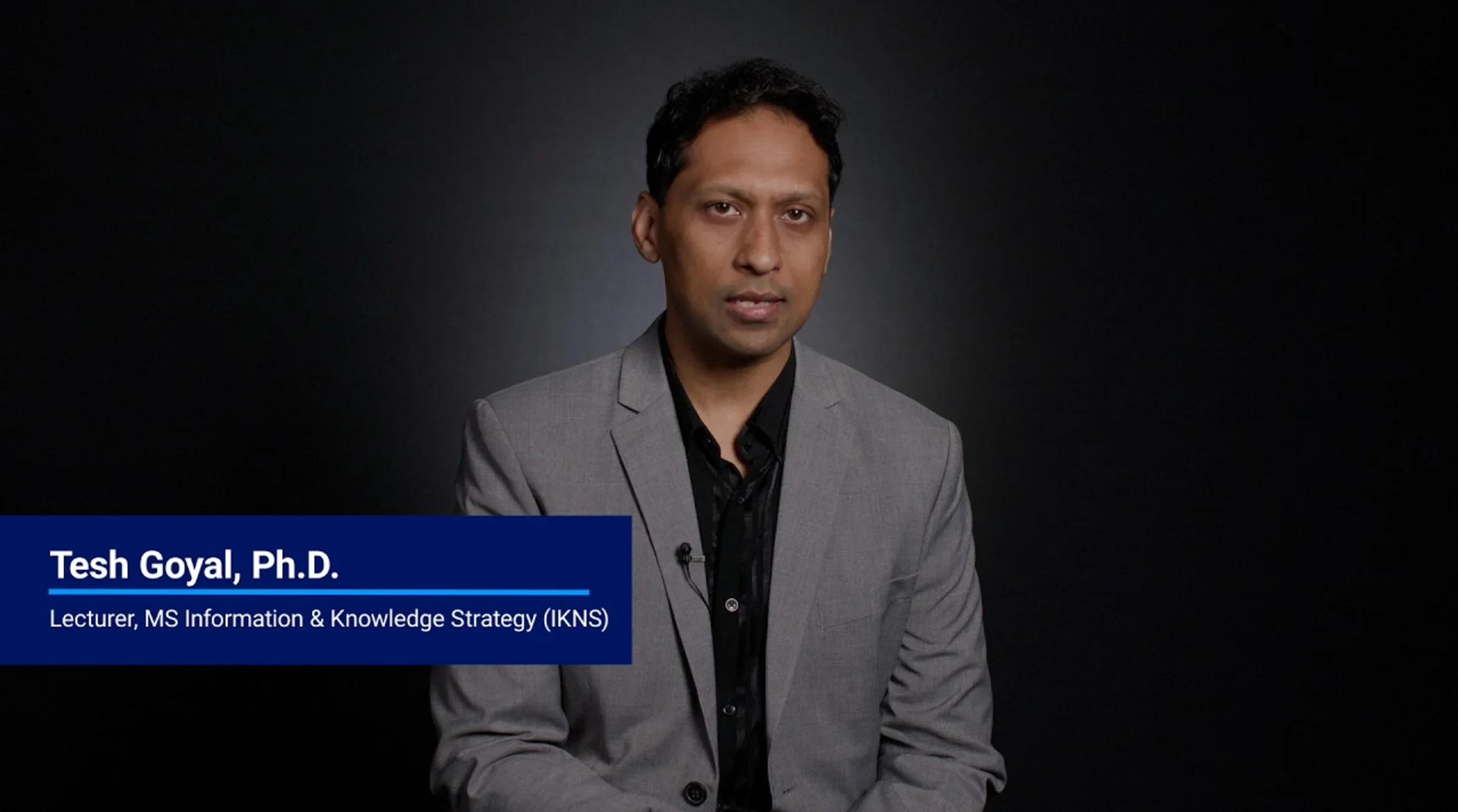
AI is one of the core components of the Information & Knowledge Strategy (IKNS) degree. Hear from Tesh Goyal, PhD, Research Lead at Google DeepMind and Lecturer in IKNS, to learn more about how IKNS approaches AI in this short video clip.
About Columbia’s IKNS Degree
Columbia University’s M.S. in Information & Knowledge Strategy (IKNS) degree integrates data, people, and strategy skills for the AI age. The flexible and interdisciplinary curriculum trains leaders across the entire value chain of data-driven management: Getting the data and analytics right (e.g., AI adoption, business analytics), creating a high performing, people-centric culture (collaboration, team/project management, organizational psychology), and finally the right change management to turn your strategy into reality.
IKNS is available full-time or part-time, online or in-person on Columbia’s landmarked campus right here in New York City. To maximize opportunities for networking and community building, our online students join our New York-based students on Columbia’s campus for three in-person Residencies during their studies. The M.S. in IKNS is a STEM-designated degree.
Students train under world-class faculty, including former and current executives from Google, IBM, NASA, and Oliver Wyman, and join a powerful global alumni network in coveted positions, including at Alphabet, Goldman Sachs, Nike, Pfizer, and the World Bank.
For more IKNS insights, news, and events, please go to our website, connect with us on LinkedIn, or attend one of our online info sessions. Visit the School of Professional Studies website to learn more about the SPS Student Experience.


