By Camryn Louder, Master of Science in Sustainability Science Alumna (’26SPS, Sustainability Science), School of Professional Studies
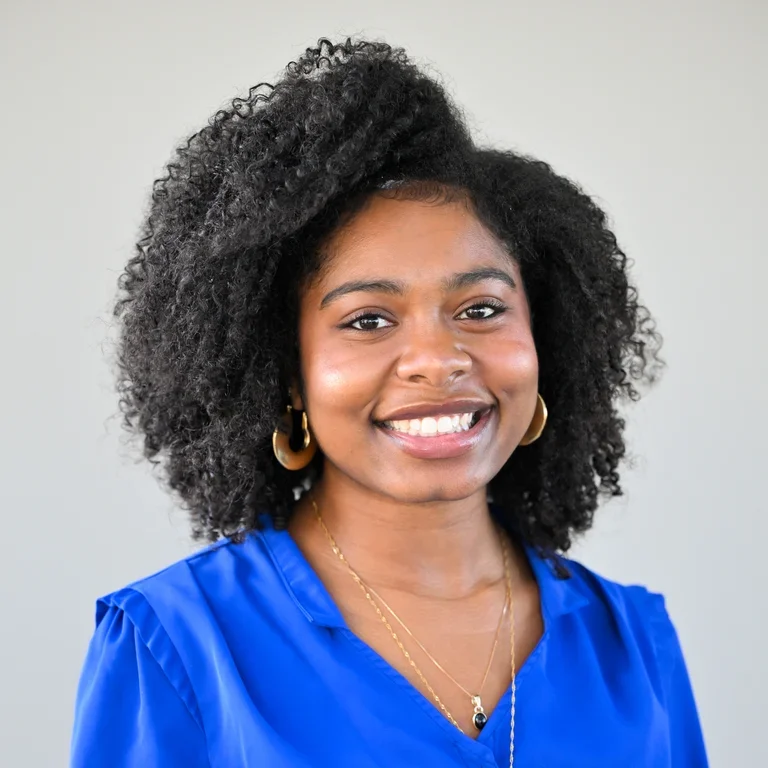
Reagan Russell is a Howard University graduate and a 2025 Columbia HBCU Fellow currently enrolled in Columbia’s M.S. in Sustainability Management (SUMA) program. With a strong emphasis on climate and energy equity, Russell brings a unique, multifaceted perspective to the Columbia School of Professional Studies (SPS) experience. She draws on her identity as a Bahamian-American to explore how climate change, energy systems, and policy decisions disproportionately impact Black and Brown communities globally.
Here, she reflects on how her experiences thus far have shaped both her academic journey and the impact she hopes to make in her career.
How have your experiences as an international student and an HBCU graduate shaped the values you bring to your work in sustainability?
Growing up in The Bahamas, I experienced firsthand both the impacts of climate change and the unequal burdens that nations like mine face. A binding reality among communities disproportionately impacted by climate change is that they are mostly composed of Black and Brown people. From communities of color in the United States to countries across the Caribbean and Oceania, Black and Brown people's land and health suffer at the hands of colonial powers and their past influence. My dual identity as a Bahamian-American has given me the skills to bridge ideas globally and think at a level that addresses the causes and impacts of climate change, as well as technology focused on addressing it.
What experiences in the SUMA program have most pushed you to rethink or broaden your perspective?
In the fall, I took the Geographic Information Systems (GIS) for Sustainability Management course, which expanded my thinking in the program the most so far. I had not had much experience with a program as cumbersome as ArcGIS Pro. However, my professor was very supportive and did an amazing job of breaking down complex concepts. She was also always willing to meet with me during office hours outside of class, and I ended up doing well! Although the course was challenging, it has opened my eyes to a new way to use geography to analyze spatial patterns.
Is there a particular sustainability issue, technology, or innovation that you’re particularly excited about right now?
At the moment, I am particularly interested in energy equity. More specifically, striking a balance between decarbonization and ensuring energy access for all people. As many are aware, the global energy system must undergo a significant shift from its reliance on fossil fuels to one based on renewable sources. However, many people still lack access to a reliable electricity supply—both in the United States and throughout the Global South. I am particularly interested in how energy leaders, governments, and private companies plan to rapidly scale renewable energy in fossil fuel-dependent economies while also providing energy access to many communities for the first time. I believe the term used to describe this phenomenon in developing countries is “technology leapfrogging.” However, there is much debate about how governments and private companies can best implement these changes.
What are your career goals?
My past experience has been in energy justice and data policy research and advocacy. I am interested in exploring philanthropy and nonprofit development, specifically through a sustainability lens. While I am still figuring out my career goals, I know that promoting equity, justice, and sustainability will be a part of my future.
What advice would you share with someone considering applying for the HBCU Fellowship or the SUMA program?
My advice is to explain in your application how the fellowship and experience at Columbia will directly impact your future. It is important that the admissions officer(s) reading your application directly see how your experience at Columbia and their investment in you as a student will transform your trajectory.
About the Sustainability Management Program
The Columbia University M.S. in Sustainability Management program, offered by the School of Professional Studies in partnership with the Climate School, provides students with cutting-edge policy and management tools to help public and private organizations and governments address environmental impacts and risks, pollution control, and remediation to achieve sustainability. The program is customized for working professionals and is offered as a full-time and part-time course of study.
The program fosters creativity and adaptability by equipping students with the skills to tackle real-world sustainability challenges through an interdisciplinary approach from the world’s premier sustainability academics, researchers, and practitioners. The up-to-the-minute curriculum and flexibility prepare graduates for careers in the dynamic and rapidly changing field of sustainability.
Learn more about the program here.