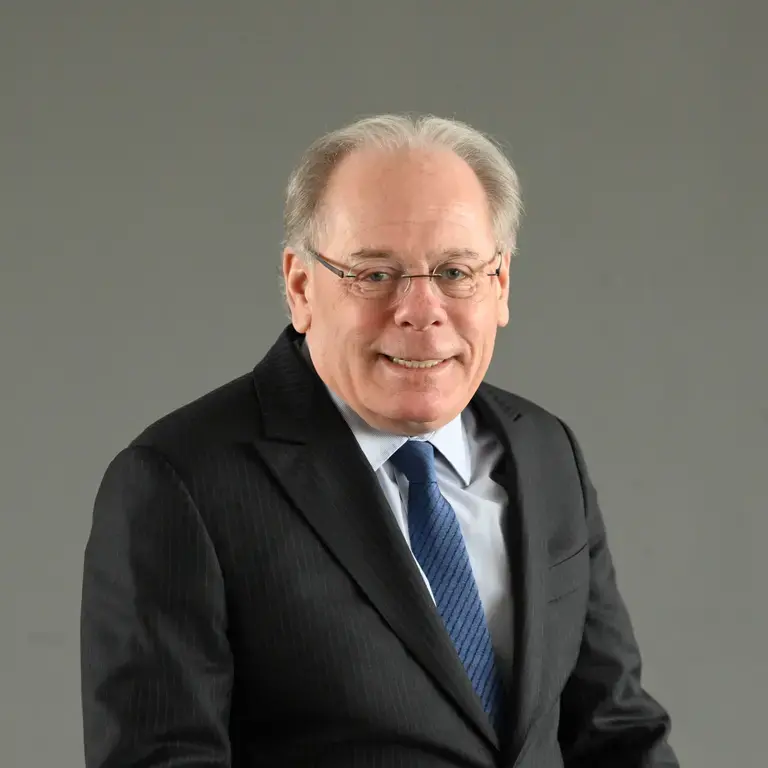
By Steven Cohen, Ph.D., Director of the M.S. in Sustainability Management program, School of Professional Studies
In the fall of 1975, I walked into Professor Lester Milbrath’s graduate seminar in Environmental Policy and Politics at SUNY/Buffalo and began a transformative journey that continues in 2026. Les believed that the way to protect the environment was to change people’s values. He wanted people to value consumption less and care more about the planet’s ecology. As a social scientist, he believed that the first step in that process of value change was to measure and understand the public’s environmental values. Once we understood those values, we could then try to influence them. I never really bought that argument, but I was curious about how the public perceived the environment. In graduate school, I worked on a team that studied public and elite attitudes toward water pollution, which was part of an effort to use survey research as a method of citizen participation in water management planning in Erie and Niagara counties of western New York. That led me to look at representation theory and my dissertation on the use of surveys as a way of representing the public in complex, technical, bureaucratic decision-making. My goal in the late 1970s and consistently since that time has been to understand what caused and what could prevent the destruction of our natural environment.
The study of water policy and public participation eventually led me to work for my management professor and mentor, Marc Tipermas, in 1977, when I went to Washington D.C. and staffed a working group on public participation in EPA’s water programs. Later, Marc was put in charge of Superfund’s policy shop, where in 1980 and 1981, he hired me to develop a program for community relations in the Superfund program. I also staffed a proposed reorganization of Superfund’s headquarters operation. At this stage in my journey, I thought pollution was a crime that needed to be regulated by law and enforced aggressively. I came to learn that some polluting behavior was deliberate, but much was due to ignorance and deeply ingrained organizational habits. I also learned that some pollution was an indirect impact of beneficial technologies like motor vehicles and industrial agriculture. I understood that pollution was a cost of technologies we benefited from. Environmental protection was far from simple and would require more than laws to achieve.
At about that time, I also developed a deep interest in public management as I saw how difficult it was for government to do anything at all. I spent many lunch times with Marc, where he continued to teach me as he explained government management and mismanagement. Dr. Tipermas had been my organization theory professor in graduate school, and he was a genius at understanding and explaining organizational management. In 1985, my combined interest in environment and management led to a consultancy with Ron Brand, then-Director of EPA’s Leaking Underground Storage program. Ron was trying to bring the principles of Total Quality Management into a federal regulatory program. We flow-charted the regulatory process and somehow managed to eliminate a number of dysfunctional tasks. I learned from the inside the convoluted and complicated process of developing and eventually implementing an environmental regulation. By the late 1980s, I was also paying more attention to public management as part of my responsibilities in Columbia’s Master of Public Administration program, and in 1988, I wrote the first of five editions of The Effective Public Manager.
My concern with influencing corporate behavior by augmenting command and control regulation started a stream of work with my long-time colleague Sheldon Kamieniecki on using regulation as only one element of a set of strategic initiatives to influence corporate environmental behavior. In the late 1980s and 1990s, our work on regulatory strategy discussed alternatives to regulation, such as tax incentives, developing market solutions, and a range of other methods to influence corporations. We published two books on regulatory strategy in 1991 and 2005. Later, in a 2006 book entitled Understanding Environmental Policy, I tried to develop a way to understand the causes of environmental problems and the various ways these problems were defined and understood. In other books on public management, management innovation, contract management, and the fundamentals of management, largely co-authored with another longtime colleague, Bill Eimicke, I worked to understand organizations and how they were managed. My interest in management and environmental policy were two themes of my half-century evolution of learning how to develop the organizational capacity needed to protect the environment.
Eventually, in 2009 and 2010, I wrote a book entitled Sustainability Management, where I tried to define environmental protection as a fundamental element of organizational management. In this work, I was finally able to combine my interests in environmental protection and organizational effectiveness. I began to see environmental pollution as a form of organizational waste and a symptom of mismanagement. This concept was stimulated by the work being done in New York City by Mayor Michael Bloomberg and his colleagues in a path-breaking initiative called PlaNYC 2030. Mike Bloomberg, Dan Doctoroff, and many other brilliant colleagues planned a city that integrated environmental protection into its economic development. They brought real estate developers together with environmental advocates to help design a sustainable city.
The underlying concept was simple. Cities were now in a global competition for people and business. This required cities to ensure effective mass transit and uncongested traffic, ample and accessible parkland, and clean air and water. To compete, cities also needed low crime, great nightlife, accessible health care, and an excellent education system. The Bloomberg team rejected the tradeoff between environmental protection and economic growth, declaring that a clean environment was a prerequisite for economic growth. Through their work and an economic transformation already underway, I was able to see that the transition to a more sustainable city was underway. Studying PlaNYC 2030 led to my book, The Sustainable City in 2017, and in 2021, a more global 2nd edition co-authored with my colleague, Professor Guo Dong. What I learned through this work was that economic transitions are constant, based largely on technological, cultural, and social change. Early on, New York City was a trading city due to its port and the construction of the Erie Canal. In the 19th century, it became a manufacturing city, and by the turn of the 21st century, it became a service city with finance, fashion, education, media, health care, and over 60 million tourists each year. Today, it is implementing congestion pricing, slowly decarbonizing, promoting biking, expanding parks, and transitioning to become a sustainable city.
In my view, what is true at the level of a city is equally true for organizations: private, nonprofit, and public. On a more crowded, interconnected, and resource-strained planet, organizations that paid attention to their use of natural resources, disposal of waste, and pollution impact on their neighbors were better managed than those that wasted resources, paid more to dispose of waste, and incurred environmental liabilities by poisoning their neighbors.
This led me to focus my attention on private management, and about a decade and a half ago, I started to examine energy efficiency in the private sector. Coincidentally, my EPA and SUNY/Buffalo mentor Marc Tipermas was central in helping me understand private sector management. Marc was helping to lead a California-based company called Willdan, which had just acquired an energy efficiency firm that worked with utilities and energy consumers to promote energy efficiency. Willdan was trying to expand in New York, and I signed on as a consultant to help them do that. Marc and his colleagues won a contract with Con Edison to work with customers on energy-efficiency methods, and I began to give a great deal of thought to sustainability as a management principle. I started to learn more about private, publicly traded corporations and learned even more when, in 2015, I was asked to join Willdan’s Board of Directors, where today I serve as their lead independent director. Over the past decade, I learned a great deal about the role of the Securities and Exchange Commission (SEC) in the management of publicly traded corporations.
That examination of the private sector led to a book published in 2023 entitled Environmentally Sustainable Growth: A Pragmatic Approach. This work discusses why our current environmental problems emerged and how governments and businesses are partnering to build a renewable resource-based circular economy. The book articulates two key ideas: 1. Private corporations must take the lead in developing production and waste management efforts that generate wealth without destroying the planet; 2. The public sector must provide the resources for infrastructure and basic scientific research to advance the technology required for sustainable economic growth. I also argue for an environmental politics that is less confrontational and more based on consensus. In the book, I define sustainability as a central management concept, not an ideological form of woke management. I should mention that despite my focus on private management, I never gave up on the importance of the public sector playing a key role in partnership with the private sector. In 2014, Bill Eimicke, Alison Miller, and I co-authored a book entitled Sustainability Policy, which detailed the role of federal, state, and local governments in partnering with private organizations to promote environmental sustainability.
Nevertheless, the bottom line remains the bottom line: If the planet is to be protected while economic production increases, corporations must internalize sustainability and connect it to making money. A belief in the environment-economic growth trade-off originated when environmental protection was an expensive add-on to existing technology. Catalytic converters and stack scrubbers added to the cost of cars and electricity. This led to a widely held view that environmental protection might be a nice thing, but it was a frill: You can’t grow a company and protect the environment at the same time. I believe that this old way of thinking, while it resides in the U.S. national government and its President, is gradually fading away everywhere else. Young people in organizations want to produce goods and services without damaging the environment. For example, young staffers at Amazon spent months experimenting with paper packaging to replace plastic bubbles and developed paper packaging that was cheaper and stronger than plastic. This project reflected their environmental values. Energy efficiency saves money. Renewable energy is cheaper than fossil fuels. Waste reduction and reuse reduce the company’s waste disposal bill. The value change that Les Milbrath was hoping for did not take the shape he thought it would, but it is present in young people who know the planet they will inherit is in danger from pollution, toxics, biodiversity loss, and climate change. They do not want to sacrifice their lifestyle to protect the planet, but they think that with creativity and technology, they can produce goods and services that minimize their destructive impact on the environment.
This, in turn, leads to my new work on sustainability management and an effort to internalize its practice in routine organizational management. The book I recently co-authored with Bill Eimicke and Guo Dong is an in-depth discussion of the movement of sustainability management into routine organizational management. It is entitled Sustainability Metrics and Management: The Path from Innovation to Routine. In this book, we move beyond environmental sustainability to a comprehensive definition of sustainability management. We consider measures of environmental sustainability, measures of workplace equity, and measures of corporate community impact as distinct but routine measures of corporate performance. Our argument is that these measures are central to corporate performance and that investors are demanding to see these measures as they assess the financial risk of their investments.
An organization that pollutes, emits greenhouse gases, and wastes energy and other resources is an organization that is likely to be poorly managed in other ways and, in any case, is at risk of incurring damage charges due to environmental liabilities. An organization that treats its workers poorly poses risks to investors in an increasingly global, brain-based economy. An organization that neglects or damages its home community will find its expansion constrained and its brand degraded.
Organizations that have incorporated sustainability into their management routines tend to be careful and conscious of their actions. Sustainability is a means toward the goals of organizations, not self-justifying principles of an ideology of “correct behavior.” Environmental sustainability should now be seen as a subfield of sustainability management, which includes issues such as management and staff diversity, transparent organizational governance, and the organization’s impact on its surrounding community or communities. All these factors need to be added to traditional management concerns because successful modern organizations must navigate a more crowded, resource-strained, and interconnected organizational environment. Environmental sustainability is a goal of effective management similar to efforts to ensure that an organization’s financial management system is free of fraud. It is part of mindful management. After half a century of trying, I’ve concluded that the best way of protecting the planet is by integrating environmental sustainability into routine organizational management. Just as laws against conflict of interest and fraud reinforce the organizational norm of financial honesty, so too are environmental laws and regulations needed to reinforce correct behavior. But the main action is integrating mindful, thoughtful, careful sustainability management into organizational culture and behavior.
Views and opinions expressed here are those of the authors, and do not necessarily reflect the official position of Columbia School of Professional Studies or Columbia University.
About the Program
The Columbia University M.S. in Sustainability Management program offered by the School of Professional Studies in partnership with the Climate School provides students cutting-edge policy and management tools they can use to help public and private organizations and governments address environmental impacts and risks, pollution control, and remediation to achieve sustainability. The program is customized for working professionals and is offered as both a full- and part-time course of study.