
Biodiversity loss has enormous repercussions for the ecosystems that sustain equilibrium and, by extension, for all human activity that depends on nature. After years on the back burner—with the focus instead on climate as the cornerstone of sustainability policy—the world’s decision-makers seem to finally be waking up to the importance of biodiversity.
“Over the past few years, biodiversity has truly moved from the margins of sustainability conversations into the center of decision-making,” said Viorel Popescu, lecturer and director of the M.S. in Biodiversity Data Analytics (BIDO) program at Columbia University School of Professional Studies. “This broadens the scope and the burden of addressing biodiversity targets from governments and NGOs to all sectors of the economy.”
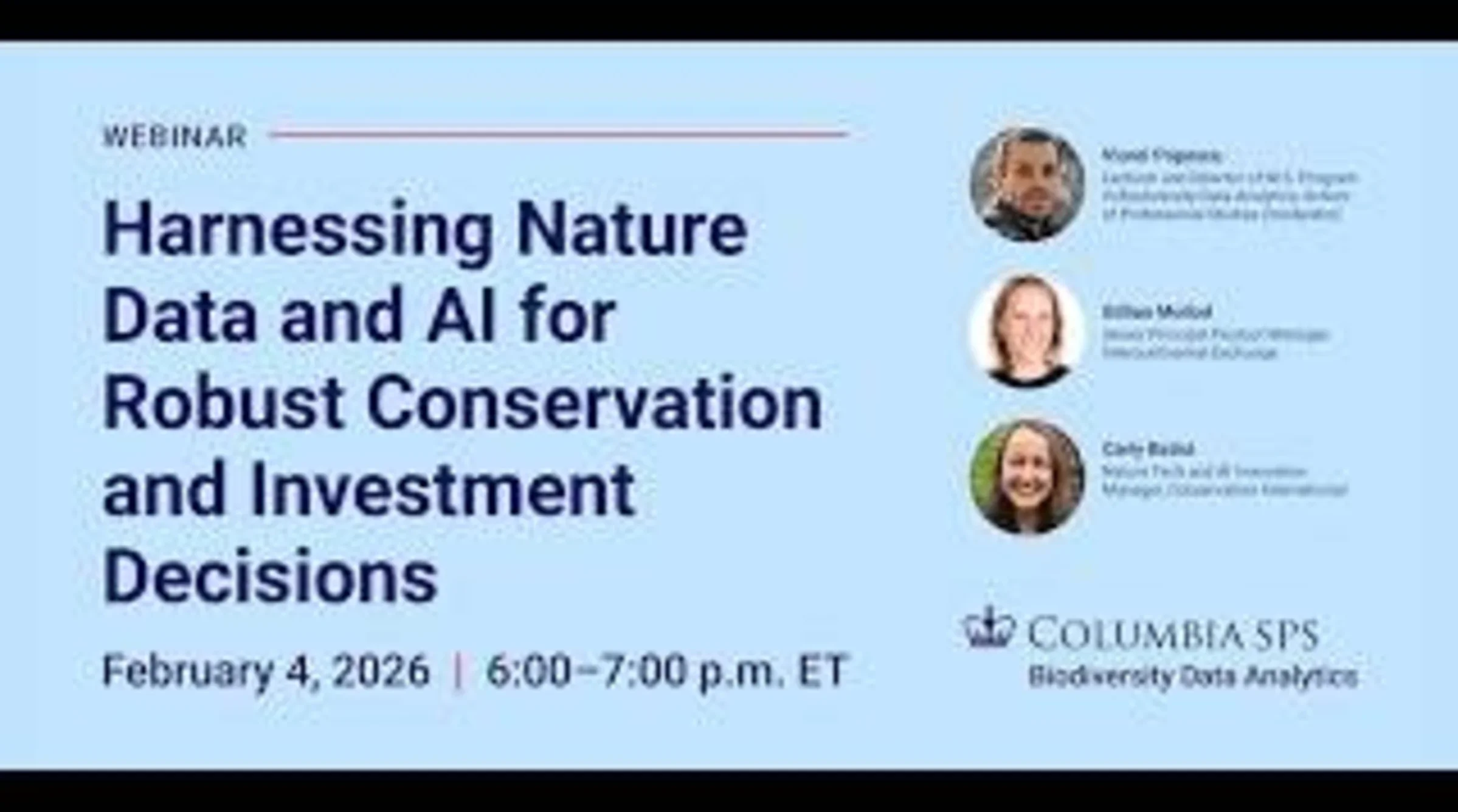
A recent virtual panel discussion convened by BIDO and moderated by Popescu brought together Carly Batist, nature tech and AI innovation manager at Conservation International, and Gillian Mollod, senior principal product manager at Intercontinental Exchange, to consider the implications of recent innovations in nature data collection and analysis.
In Popescu’s words, “While technological advances have dramatically improved our ability to collect and analyze biodiversity data, the real challenge now is translating that data into information that actually changes decisions, whether those are made in the boardroom and ministries, conservation field sites, [or] local communities.” That means harnessing biodiversity data “not just for reporting or compliance, but for better, credible decisions” across sectors.
Where Biodiversity Meets Business
Gillian Mollod, a Barnard and Columbia grad whose career trajectory took her from environmental science and geospatial analysis to land conservation and ultimately the financial sector, emphasized the growing urgency around nature-related financial risk. She works on a climate team developing asset-level metrics for financial institutions, including nature and biodiversity solutions that helps investors understand their portfolios’ dependencies on and impacts to natural systems.
“We need healthy ecosystems and a biodiverse planet to support all forms of life—and that includes human life,” Mollod explained. “And I think we really experienced firsthand how human encroachment on natural systems can go completely awry during the global pandemic.”
The financial sector’s interest in nature stems from two types of risk. Companies may depend on nature for revenue—agricultural businesses rely on pollinators, water, and healthy soils—or they may be liable for negatively impacting biodiversity through operations like mining or deforestation. The international Taskforce for Nature-Related Financial Disclosures, established around the time of the pandemic to align with climate disclosure frameworks, now asks companies to report on both types of exposure.
“Climate and nature are very interconnected,” Mollod noted. “Most of the ways we will solve the climate crisis are through nature, but climate change is also accelerating biodiversity loss. We need to tackle both together.”
Applying New Technology in Conservation Practice
Carly Batist offered perspective from the conservation side, describing her work supporting Conservation International’s global operations across more than 100 countries. She helps the organization determine which biodiversity monitoring technologies and data are needed for different project types, from policy work with governments to corporate supply chain initiatives to marine protected-area management.
“Figuring out how we get the data we need to support nature-positive action is incredibly crucial and drives all of our decision-making to make sure we’re prioritizing resources appropriately and showing quantitatively that we’re having the outcomes we say we are,” she said.
In recent years, the technological tool kit has expanded dramatically. It is now easier than ever for conservation practitioners to deploy camera traps and acoustic sensors, use environmental DNA sampling, and access satellite imagery. AI models also contribute to the data collection and analysis process and can identify species from images or sounds and detect events like wildfires or floods.
Translating Data into Decisions
But while data can be gathered more efficiently and remains in high demand, both panelists acknowledged a challenge in ensuring that it is used effectively. To state it simply, more information doesn’t automatically translate into changed behavior.
Without a concerted effort and experts behind the wheel, Popescu warned, the new momentum toward biodiversity protection could lead to “greenwashing narratives”—situations where a company commits to environmentalism in name only. The risk is that biodiversity becomes another compliance exercise rather than a driver of genuine impact.
Mollod explained that many of the clients she works with are seeking a single metric to measure their biodiversity impact in the way that CO₂ emissions are the standard for climate impact. Intercontinental Exchange offers a “nature risk” metric, a composite of many different metrics, she said, noting that truly measuring climate impact involves more than just carbon emissions. Still, work continues to find an equivalent or a set of metrics that businesses can use to gauge their biodiversity “footprint” and that could raise important awareness for the cause.
Batist expressed optimism even without a single metric to latch on to. “How you go from data to actionable information kind of depends on the type of project it is. But if you can do that, then there are really powerful outcomes possible,” she said.
Rather than seeking a one-size-fits-all metric, she said, it’s necessary to find a balance between standardization and an ecosystem-specific approach, noting that what applies to the mountains is not necessarily going to work in a marine setting.
“It really is [about] making sure that we’re starting from the problem and the key audience and working back from there to figure out what’s best,” Batist said.
Harnessing Nature Data for Humanity
The conversation reflected a broader transformation in how society approaches environmental challenges and who is involved with addressing them. The panelists agreed that biodiversity data is an increasingly essential component of financial risk management, corporate social responsibility, and the climate policy discussions where it was once an afterthought.
As the panel concluded, the future of conservation and sustainable finance depends on professionals who can navigate this complex field to deliver measurable, positive outcomes for both nature and the communities that depend on it.
Batist praised the M.S. in Biodiversity Data Analytics program, suggesting that “its very practical, hands-on approach is critical to shaping the workforce that we need for the future in conservation.” She wished that the program had existed when she was a grad student.
Because when it comes to biodiversity, everyone is a stakeholder.
“We need nature. It is the food that we eat, the water we drink, the clothes we wear, the houses we live in. It is fundamental to our human existence,” Batist said. “And so it is incredibly important to be able to understand the impacts that we have on nature, the dependencies that we have, and how we can mitigate those impacts so that humans can live alongside the rest of this amazing natural world.”
About the Program
The Master of Science in Biodiversity Data Analytics program at Columbia University equips a new generation of leaders with the data literacy, analytical tools, and interdisciplinary expertise to design evidence-based solutions that benefit both people and nature.
Designed for both working professionals and early-career changemakers, this online program allows students to learn from anywhere while gaining the skills to collect, analyze, and translate biodiversity data into meaningful action. Coursework prepares students to take on nature data applications across industries, from ESG finance to urban planning to environmental consulting, and culminates in a hands-on capstone with industry partners that provides practical experience, valuable networks, and the tools to make an immediate impact.
The application deadline for the M.S. in Biodiversity Data Analytics program is June 1. Learn more about the program here.


