

When Clinical Judgement and AI Diverge
Overview
Hosted by the Data Science Institute, Columbia University Irving Medical Center, and School of Professional Studies
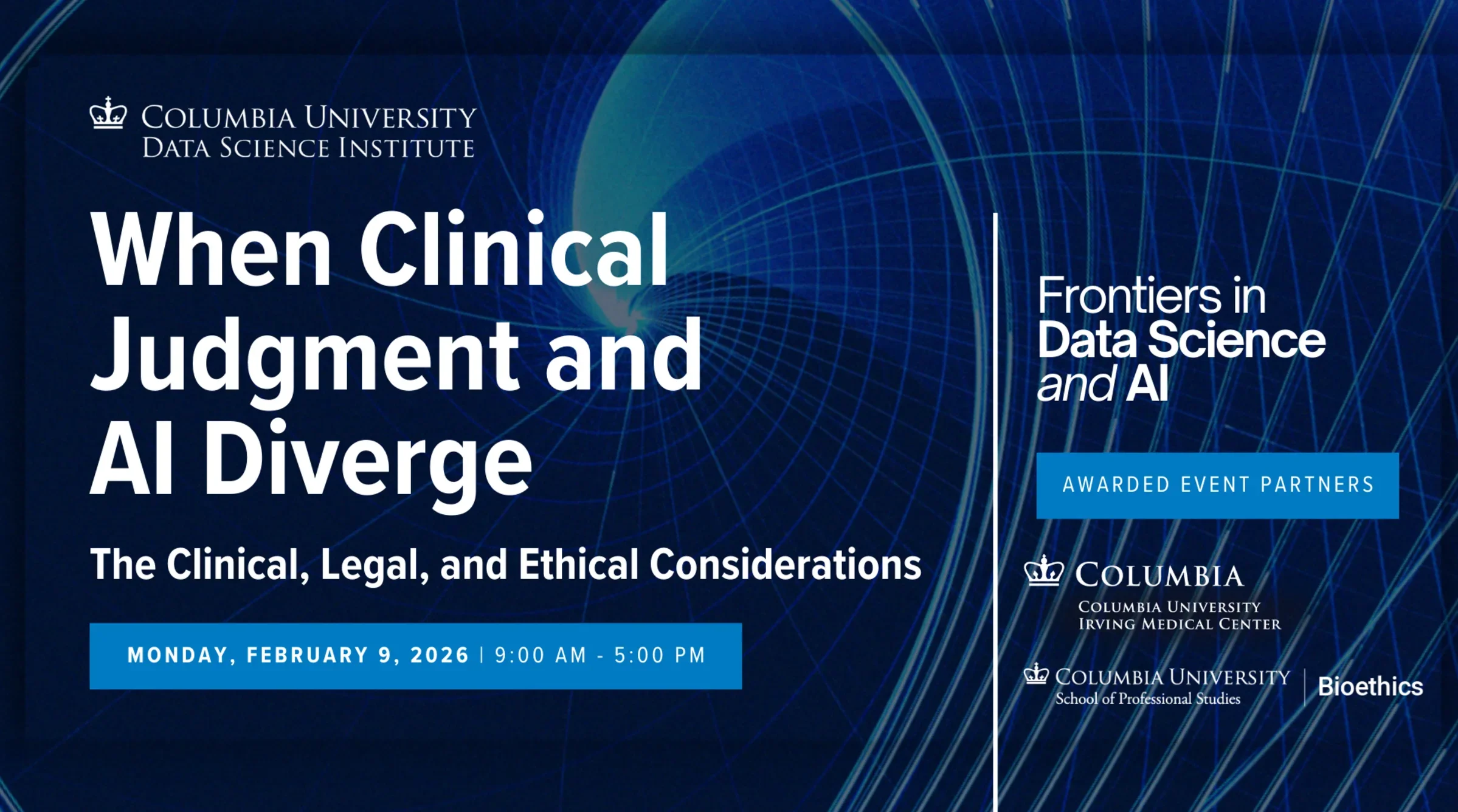
When Clinical Judgement and AI Diverge: The Clinical, Legal, and Ethical Considerations
When clinical judgment and AI predictions point in different directions, what happens next? This event will address instances where artificial intelligence and human clinical judgment do not agree, and why these moments of “human–AI dissonance” may become one of the most consequential frontiers in modern medicine.
Through case-based perspectives from radiology, surgery, and nursing, the program explores how clinicians are responding to AI-driven recommendations in real clinical environments. Legal, regulatory, and ethical experts will also address emerging questions of documentation, liability, patient transparency, and shared decision-making. The conversation will look ahead to emerging tools such as digital twins and next-generation clinical infrastructures, exploring how disagreement, accountability, and trust may be intentionally designed into the future of AI-enabled care.
This event is part of the Frontiers in Data Science and AI initiative at the Data Science Institute, Columbia University.
Hosts:
- Charles E. Binkley, Director of AI Ethics and Quality, Hackensack Meridian Health; and Lecturer in Bioethics, School of Professional Studies, Columbia University
- Robert Klitzman, Professor of Psychiatry (in Sociomedical Sciences), Columbia University Irving Medical Center; Program Director, Bioethics Program, School of Professional Studies, Columbia University
____________
Agenda
Details below subject to change:
8:30 AM - 9:00 AM: Doors Open for Check-In (50 Haven Avenue, New York, NY 10032)
9:00 AM - 9:15 AM: Welcome and overview (15 min)
9:15 AM - 9:45 AM: What is AI and how is it being used for clinical decision-making? (30 min)
- Beth Percha, Chief Data and Analytics Officer at NewYork-Presbyterian Hospital; and Adjunct Assistant Professor, Biomedical Informatics, Vagelos College of Physicians and Surgeons, Columbia University
9:45 AM - 10:15 AM: What is human-AI dissonance and why is it important? (30 min)
- Charles E. Binkley, Director of AI Ethics and Quality, Hackensack Meridian Health; and Lecturer in Bioethics, School of Professional Studies, Columbia University
10:15 AM - 10:30 AM: Break (15 min)
10:30 AM - 11:30 AM: How should human-AI dissonance be addressed clinically? (60 min)
- Radiology: Florence Doo, Assistant Professor, Diagnostic Radiology & Nuclear Medicine, University of Maryland School of Medicine; Director of Innovation, University of Maryland Medical Intelligent Imaging (UM2ii) Center; and Faculty, University of Maryland-Institute for Health Computing (UM-IHC) (20 min)
- Surgery: Gabriel Brat, Assistant Professor of Surgery, Beth Israel Deaconess Medical Center; and Assistant Professor of Biomedical Informatics, Harvard Medical School (20 min)
- Nursing: Sarah Collins Rossetti, Associate Professor of Biomedical Informatics and Nursing, Columbia University Irving Medical Center (20 min)
11:30 AM - 12:00 PM: Q&A (30 min)
12:00 PM - 1:00 PM: Lunch (60 min)
1:00 PM - 1:45 PM: How should human-AI dissonance be addressed legally? (45 min)
- Nicholson Price, Professor of Law, University of Michigan
1:45 PM - 2:15 PM: Q&A (30 min)
2:15 PM - 3:00 PM: How should human-AI dissonance be addressed ethically? (45 min)
- Nancy Berlinger, Senior Research Scholar, The Hastings Center for Bioethics
- Charles E. Binkley, Director of AI Ethics and Quality, Hackensack Meridian Health; and Lecturer in Bioethics, School of Professional Studies, Columbia University
3:00 PM - 3:30 PM: Q&A (30 min)
3:30 PM - 4:00 PM: Summary of key points and conclusion
4:00 PM - 5:00 PM: Networking reception (in-person - 60 min)