
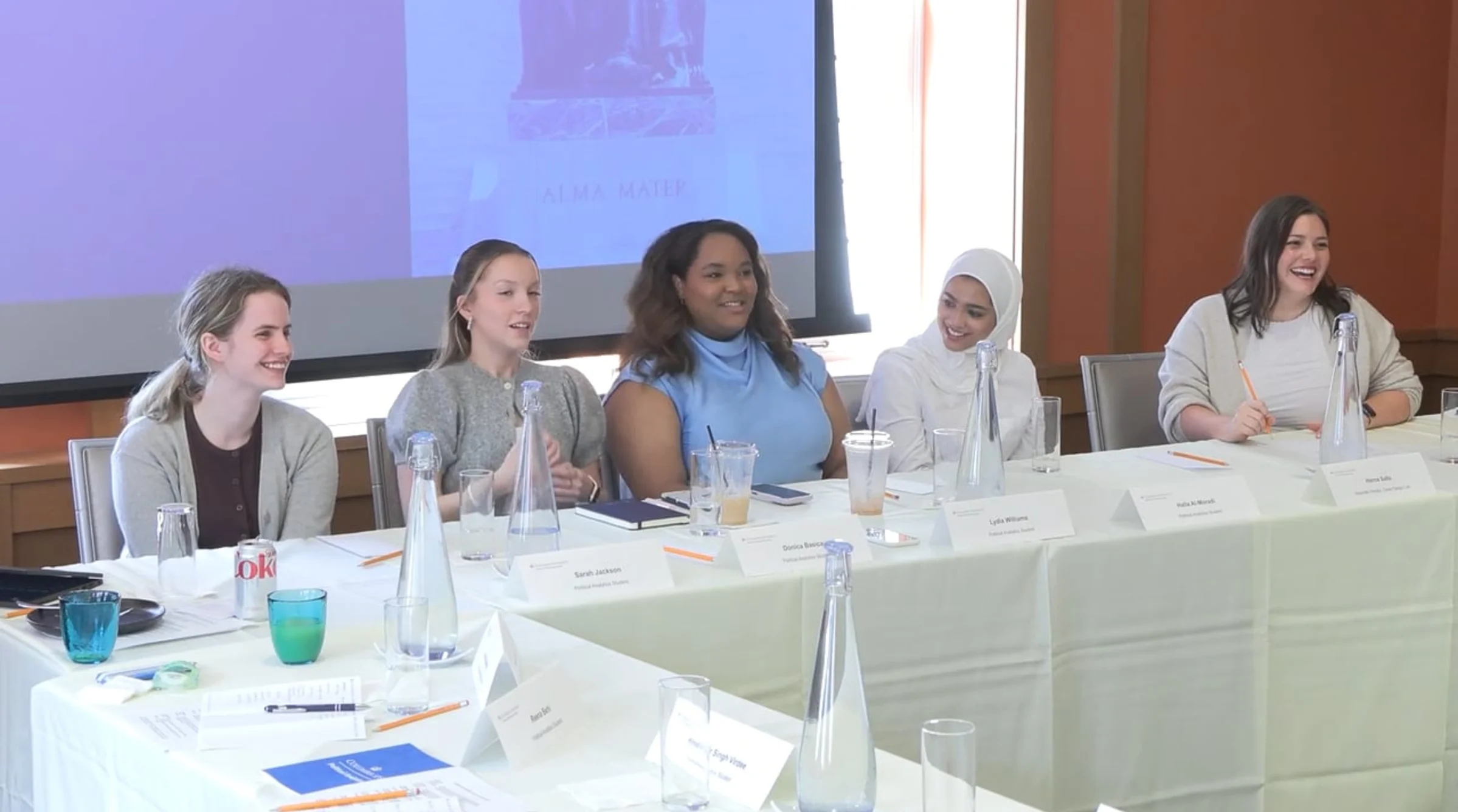
What does it take to turn an interest in data and politics into a career? Students in Columbia University’s M.S. in Political Analytics program recently explored that question during a career panel featuring four current students who shared how they translated their academic experiences into professional opportunities.
The panel highlighted the range of paths available in political analytics. Lydia Williams discussed her experience in political fundraising, including work with the American Civil Liberties Union (ACLU) and Congresswoman Jasmine Crockett’s Senate campaign. Donica Basica shared her experience with Bully Pulpit International, working on strategic communications with nonprofit and advocacy clients. Sarah Jackson described moving from a New York State Assembly campaign to Analyst Institute, where she applies experimental methods to political and nonprofit work. Halla Al-Moradi offered an international perspective through her work with the United Nations Electoral Assistance Division supporting elections abroad.
Together, their experiences highlight the wide range of professional pathways available to Political Analytics students and the many ways data and analytical skills can be applied across the political field.
A recurring theme was the opportunity to use coursework to explore different areas of the field. The Political Analytics curriculum combines substantive knowledge of politics with quantitative and analytical training, including coursework in strategic thinking, experiments, surveys and polling, predictive modeling and other quantitative methods.
Students discussed how coursework, from political communications and campaign strategy to predictive modeling and experiments, helped them identify professional interests and prepare for their roles. They also shared examples of applying technical skills from the classroom to real-world work, such as mapping voter populations and modeling fundraising patterns.
Building connections and finding opportunities
The discussion also emphasized that career development extends beyond the classroom. Students highlighted faculty connections and practitioner events, along with job postings and the program’s Washington, D.C., trip, as ways to learn about career paths and secure professional opportunities.
Networking was another important takeaway, but students encouraged their peers to think broadly about what networking means. In addition to connecting with established professionals, they emphasized the value of building relationships with classmates and other early-career professionals who can become an ongoing source of opportunities and support. As one student reflected, relationships formed within the cohort can extend well beyond the classroom.
Developing skills and starting early
When discussing skills used on the job, students highlighted technical tools such as R, SQL and GIS, along with professional skills such as communicating findings and advocating for oneself. The conversation reinforced the importance of developing both quantitative expertise and the ability to translate analysis for different audiences.
Looking back on their first semester, students encouraged classmates to begin exploring career opportunities early, gain hands-on experience through campaigns and volunteer work, participate actively in class, and remain open to unexpected opportunities. They also emphasized taking advantage of the guidance, professional network and broader academic opportunities available through the program and across Columbia.
Together, their experiences demonstrated that there is no single pathway into political analytics. From campaigns and strategic communications to fundraising and international elections, the panel showed how Columbia University’s M.S. in Political Analytics program can help students discover and prepare for careers across the field.
About the Program
The Columbia University M.S. in Political Analytics program provides students quantitative skills in an explicitly political context, facilitating crosswalk with nontechnical professionals and decision-makers — and empowers students to become decision-makers themselves.
The 36-credit program is available part-time and full-time, on-campus and online. Learn more about the program here.
For general information and admissions questions, please call 212-854-9666 or email politicalanalytics [[at]] sps [[dot]] columbia [[dot]] edu (politicalanalytics[at]sps[dot]columbia[dot]edu).


