
By Yumi W. Kimura, student in the M.S. in Information & Knowledge Strategy (IKNS) program, Columbia University School of Professional Studies
This year, I created the Silicon Valley AI Leadership Map, an interactive map of 473 people and 1,794 documented connections across AI labs, infrastructure companies, universities, investors, founders and other parts of the industry. I later turned the research into a companion book.
The project grew out of questions I was already exploring through my startup and Columbia’s M.S. in Information & Knowledge Strategy (IKNS) program: How do people, knowledge and resources move through networks? Who holds influence? And how do relationships shape what gets built?
The map lets you explore individual people and relationships. The book looks at the larger patterns: how research becomes companies, how talent and capital move, how companies depend on one another and where influential people in AI disagree.
How the project started
In 2024, I moved from San Francisco to New York to be closer to many of our startup's East Coast customers, and I also began the IKNS program at Columbia.
My startup, LEAD, originally built software that connected coworkers for one-on-one conversations. The goal was to support knowledge sharing and build relationships across an organization.
Over time, we became more interested in what those interactions could tell us about how organizations actually work. Using anonymized metadata, we studied how relationships formed, how repeated interactions changed organizational networks, and where patterns of influence differed from the formal org chart.
By March 2026, I was using OpenClaw to build agent workflows on my laptop. Before long, a small group of agents was handling much of our company's marketing research, monitoring, drafting and repeat work, while I set the goals and reviewed the output.
When I returned to San Francisco for a month in May, I kept hearing startup ideas that sounded surprisingly similar to things my own agents were already doing. What interested me more was how differently those ideas were received. Some companies raised large rounds quickly, while others attracted little attention.
At the same time, our company was beginning to design its own model based on years of research on organizational behavior, knowledge and collaboration. I wanted a clearer picture of the industry around us: who was building what, where resources were flowing and how the people and companies were connected. That investigation became the Silicon Valley AI Leadership Map.
From a private map to a book
The first private version covered about 180 people and expanded quickly as the agents researched in parallel.
But a line between two names can mean very different things. They may have worked together, written a paper, founded a company, invested, advised, or simply worked at the same institution. The map was useful for exploration, but I needed the book to explain what those relationships meant.
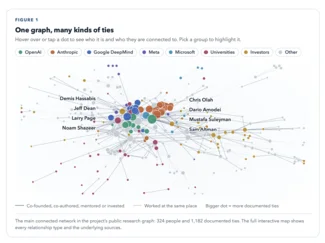
Figure 1: The main connected network in the public research graph: 324 people and 1,182 documented ties across AI labs, companies, universities, and investors.
One example is the 2017 paper “Attention Is All You Need.” The paper had eight authors and introduced the transformer architecture behind modern language models. By 2023, all eight authors had left Google. Their later paths spread across companies and labs including Character.AI, OpenAI, Adept, Essential AI, NVIDIA, Sakana AI and Cohere.
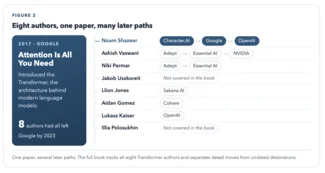
Figure 2: The eight authors of Attention Is All You Need and their later paths after leaving Google.
The research also complicated a common assumption that successful AI founders are usually very young. Among 159 founders with a recorded age at founding, the median was 33, and 70 founded their companies at age 35 or older. These figures describe the selected group in the map, not all AI founders, but they show a wider range of career stages than the familiar young-founder narrative might suggest.
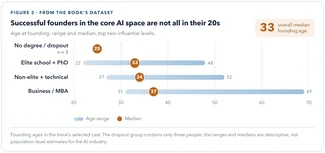
Figure 3: Age at founding among 159 selected founders, showing an overall median of 33 and variation by background
The map also made disagreements more interesting when I could see the shared history behind them. Geoffrey Hinton, Yoshua Bengio, and Yann LeCun share decades of work in deep learning and received the 2018 ACM A.M. Turing Award together, yet they reached very different conclusions about catastrophic AI risk.
Another pattern became difficult to miss: The AI industry does not divide neatly into partners and competitors. Microsoft has invested in OpenAI and supplied Azure infrastructure while also selling Copilot in markets where OpenAI sells ChatGPT. Google Cloud has provided infrastructure to Anthropic while Gemini competes with Claude. The industry is full of overlapping dependencies.
How AI agents helped me build it
The AI agents did not write the book from beginning to end. I split the work into different jobs. Agents researched in parallel, organized people, relationships, sources, and confidence labels in structured data, and helped check sources, statistics, legal risks, translation and publishing. I set the questions, decided what counted as evidence and made the final editorial decisions.
Using several models did not make a claim true. If two models repeated the same statement, I still needed a real source. Automated reviews caught problems that human and reader review sometimes missed, and vice versa. Reader feedback eventually led me to cut the book from about 70,000 words to 11,500.
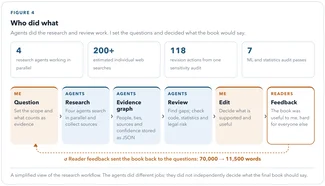
Figure 4: Research workflow: Agents supported parallel research and review; the author set the questions and made the final editorial decisions.
That process also reinforced something central to my work in IKNS: Access to information is not the same as useful knowledge. An agent may find a document, but it still needs to know whether it is current, who owns the decision, what it is allowed to do and when a person should step in. Search, context, authority and action are different problems, and agents increasingly have to deal with all of them inside real workflows.
Why I made it public
As the project grew, I realized that the questions I was trying to answer were not unique to me. People trying to learn AI or enter the industry already have endless information about models, startups, funding rounds and new tools. What is harder to find is the context that explains how those pieces fit together.
That is why I decided to make the project public. The map lets you follow individual people, companies, relationships and sources, while the book offers a shorter way to understand the larger patterns.
One question I keep returning to is why people working on similar ideas can end up with very different levels of support. Some start with strong networks, recognizable institutions, access to capital or a track record that already makes others willing to bet on them. Others start with much less.
There is no formula for success in these paths. But putting hundreds of them next to one another makes it easier to see patterns, possibilities and differences that are harder to notice one profile at a time.
What the project taught me about IKNS
When I started IKNS, it felt like a relatively niche field sitting between several parts of an organization. For example, HR thinks about people and culture. IT thinks about systems and access. Knowledge Management thinks about how information is organized and shared. Leaders think about decision rights and how work gets done. Each sees part of the same problem, but no single function fully owns it.
Enterprise AI is making that overlap much harder to ignore. An agent can retrieve a document, but that does not tell it whether the document is current, who has authority to act on it, which exception matters, or when a person should step in. Ideas that once lived primarily in knowledge management and enterprise architecture, such as ontologies and structured knowledge representations, now sit alongside approaches such as GraphRAG, LLM wikis, agent memory and context engineering.
Building the map changed how I think about IKNS and how it approaches AI, which is just one of the many IKNS curriculum elements: You do not have to come from language-model research to have an important role in AI. As AI moves from answering questions to acting inside organizations, knowledge architecture, governance, context, workflow design and human oversight become part of whether an enterprise AI system can actually work. For people coming from IKNS, that creates a very different entry point into the AI industry.
Explore the interactive map and companion book here.
Views and opinions expressed here are those of the author and do not necessarily reflect the official position of Columbia University School of Professional Studies or Columbia University.
About Columbia’s IKNS Degree
Columbia University’s M.S. in Information & Knowledge Strategy (IKNS) degree integrates data, people, and strategy skills for superior organizational intelligence. The flexible and interdisciplinary curriculum trains leaders across the entire value chain of data-driven management: Getting the data and analytics right (e.g., AI adoption, business analytics), creating a high performing, people-centric culture (collaboration, team/project management, organizational psychology), and finally the right change management to turn your strategy into reality.
IKNS is STEM-designated and available full-time or part-time. Study online or in-person on Columbia’s landmarked campus right here in New York City. To maximize opportunities for networking and community building, our online students join our New York-based students for three in-person Residencies on Columbia’s campus during their studies.
Students train under world-class faculty, including former and current executives from Amazon, Deloitte, Google DeepMind and NASA, and join a powerful global alumni network in coveted positions, including at Alphabet, Goldman Sachs, Nike, Pfizer, and the World Bank.
For more IKNS insights, news, and events, please visit our website, connect with us on LinkedIn, or attend one of our online info sessions. Visit the School of Professional Studies website to learn more about the SPS Student Experience.


