
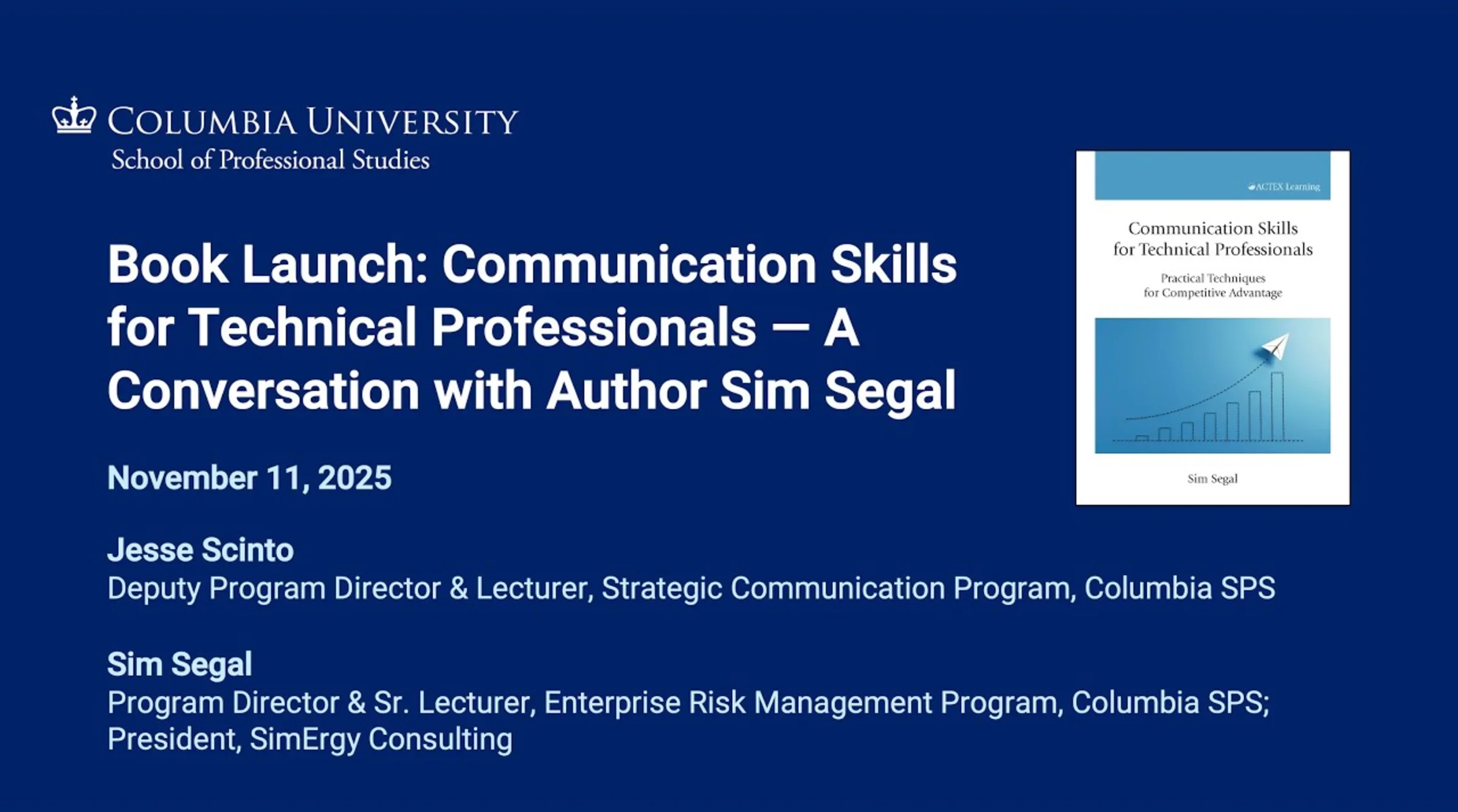
In a recent Author Spotlight hosted by Columbia University’s M.S. in Enterprise Risk Management (ERM) program, ERM Program Director Sim Segal, author of the new book Communication Skills for Technical Professionals, shared practical tips on key communication skills.
In conversation with Deputy Program Director Jesse Scinto, Segal emphasized that most technical professionals share a common issue: a resistance to developing communication skills. Segal explained part of this resistance is because there is so much technical content to master, we tend to de-prioritize communication skills. In addition, technical professionals often characterize these as “soft skills,” implying less importance. Segal counters this, saying, “These skills are ‘soft’ like cash money is soft, because those at the top of any organization have technical skills as table stakes, but it is their outstanding communication skills that elevated their career trajectory.”
Segal said that the motivation for his book was to provide a curated set of communication skills that technical professionals will find accessible and relevant to their work.
Segal introduced the discussion by saying, “Success as a technical professional is not just about having the right answers … it is also about better understanding others and presenting clearly and persuasively.”
Better Understanding Others
Segal began by explaining why listening skills are so important and why this is the first skills taught in the Columbia ERM Program. “The only thing of real value in life is the interchange between people. The only way to get anything of value done is with and through other people. Communication is the key connective tissue of relationships and listening is the key to true communication.”
After sharing examples of listening techniques, Segal discussed the importance of also reading body language. “In a video conference, if an attendee has a poor internet connection where you only hear part of what they are saying, you never assume this is enough to understand them. Yet, only listening to the words spoken and failing to read body language is an analogous situation, because you are only getting half the message.”
Presenting Effectively and Persuasively
Segal shared insights on creating content, preparing to present, and making the presentation. One of the issues highlighted was brevity. Segal said, “The biggest complaint of technical professionals is that we share too much detail.” To overcome this, Segal posed four questions to consider:
- “Is it necessary?” We often over-complicate, yet simplifying enhances comprehension.
- “Is it appreciated?” We are fascinated by our details, yet others see this as an inability to prioritize.
- “Is it understandable?” We can absorb a lot, yet there is a limit to what others can absorb.
- “Is there time?” Our presentations tend to run over; we need to trim content to fit the time slot.
The session underscored a crucial takeaway: Effective communication isn’t just a complement to technical skill—it’s a central driver of influence, leadership, and professional success.
Watch a video recording of the full Communication Skills for Technical Professionals event:
About the Program
The Master of Science in Enterprise Risk Management (ERM) program at Columbia University prepares graduates to inform better risk-reward decisions by providing a complete, robust, and integrated picture of both upside and downside volatility across an entire enterprise. For both the full-time and part-time options, students may take all their courses on Columbia’s New York City campus or choose the synchronous online class experience.
The priority application deadline for the M.S. in Enterprise Risk Management program is January 15, with a final deadline of May 1. Learn more about the program here.


