

By Evangelia Ieronymaki, Ph.D., P.E., Director and Senior Lecturer in the M.S. in Project Management, Columbia School of Professional Studies
This past April, students from Columbia University's M.S. in Project Management and M.S. in Construction Administration programs had the opportunity to visit one of the most significant transportation infrastructure projects currently under construction in New York City: the Second Avenue Subway Phase 2 project in East Harlem.
Initiated by Program Director Dr. Evangelia Ieronymaki in collaboration with Columbia alumnus Matt Zettwoch, project director for the Second Avenue Subway Phase 2 project, the visit provided students with direct exposure to the realities of managing large-scale urban infrastructure in one of the world's most complex construction environments. Dr. Ieronymaki leveraged her background in tunneling and underground infrastructure to identify this as a highly meaningful experiential learning opportunity for students pursuing careers in construction and project management.
The Second Avenue Subway expansion represents far more than a transportation project. Once completed, Phase 2 will extend the Q line north into East Harlem, adding new stations at 106th Street, 116th Street, and 125th Street while creating critical connections to the 4, 5, and 6 subway lines and Metro-North Railroad. For decades, East Harlem has faced limited rapid transit access compared to other parts of Manhattan. This expansion is expected to improve mobility, reduce congestion, shorten commute times, and strengthen access to jobs, healthcare, education, and economic opportunity for thousands of residents. Beyond the immediate community, expanding public transportation infrastructure reduces reliance on automobiles, supports economic growth, and strengthens the city's ability to accommodate future population and workforce demands.
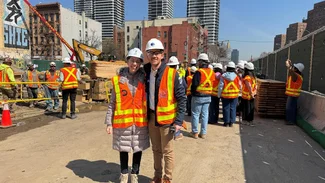
Evangelia Ieronymaki, director of Columbia's M.S. in Project Management program, with Matt Zettwoch, project director of Second Avenue Subway Phase 2, in front of the construction site on 120th Street and Second Avenue.
For students pursuing careers in construction project management, the site tour offered an invaluable opportunity to observe how the challenges of urban infrastructure are managed in practice. Following a comprehensive safety briefing and project overview, students visited active construction areas, including secant pile operations at the Lexington Avenue Yard and demolition activities along Second Avenue and 120th Street. Throughout the tour, the project team discussed construction sequencing, risk mitigation, stakeholder coordination, safety management, and the realities of maintaining construction progress within highly constrained urban conditions.
Large infrastructure projects require far more than technical construction knowledge. They demand coordination among contractors, agencies, engineers, community stakeholders, utility systems, and public operations, all while balancing competing demands across every phase of delivery. Observing these dynamics in the field gave students a deeper understanding of the interdisciplinary nature of modern project management. For several students working on capstone projects focused on project management planning of water infrastructure and microtunneling applications, seeing excavation support systems, staging constraints, and tunneling-related activities in person provided additional context that strengthened their grasp of complex underground construction methods.

Students received PPE and a site safety briefing at the MTA offices before the tour.
The visit also reflected the strong and ongoing relationship between Columbia's academic programs and its alumni network. Matt Zettwoch, a proud Columbia alumnus who now leads this landmark project, welcomed students into an active construction environment and shared insights drawn from years of industry experience. His participation is a compelling example of the role alumni play in mentoring the next generation and bridging academia with professional practice. It is precisely the kind of collaboration that defines the educational experience we strive to offer.
The programs extend their sincere appreciation to Matt Zettwoch and the entire Second Avenue Subway Phase 2 project team for their time, generosity, and continued support of Columbia students.
About the Program
The Columbia University Master of Science in Project Management program equips individuals with the strategic, analytical, and leadership skills essential for a successful career managing complex projects across industries and borders.
Available full-time or part-time, the M.S. in Project Management is designed for professionals who want to advance into leadership roles or formalize their project management experience with a strong academic and practical foundation. Students can opt for the general Project Management program or choose from one of the four specialized concentrations: Construction, Sports Management, Sustainability Management, and Technology Management.
Taught by scholar-practitioners and enhanced by Columbia’s location in New York City, the curriculum integrates emerging digital tools and AI-driven practices to help graduates make data-informed decisions and improve operational efficiency. Graduates will be prepared to lead high-stakes projects with confidence and clarity, and return to the job market with a competitive edge.