
The Columbia University School of Professional Studies and the Luksic Foundation are pleased to announce that Gustavo Hunter and Francisco Loyola have been awarded the 2026–2027 Luksic Scholarship for Sustainability at Columbia University.
Now in its third year, the scholarship supports talented students enrolled in the Master of Science in Sustainability Management (SUMA) program at Columbia’s School of Professional Studies (SPS). The scholarship covers the full cost of attendance, including tuition and living expenses, for students who have lived or worked in Chile and demonstrate a commitment to advancing sustainability in the region.
Since the program’s first cohort, the Luksic Scholarship has brought together students with backgrounds spanning environmental policy, energy, corporate sustainability, engineering, and other fields critical to Chile’s sustainable development. Hunter and Loyola continue that tradition, arriving at Columbia with established careers and a shared ambition to deepen their expertise, gain new perspectives, and build connections they can carry back to Chile.
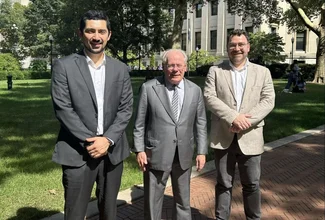
From left: Gustavo Hunter; Steve Cohen, Senior Vice Dean, Columbia University School of Professional Studies and Director of the M.S. in Sustainability Management program; Francisco Loyola.
“Over the past three years, the Luksic Scholarship for Sustainability at Columbia University has supported an extraordinary group of Chilean professionals whose experiences reflect the interdisciplinary nature of sustainability itself,” said Trinidad García, director of international education programs. “Gustavo and Francisco bring distinct perspectives to this year’s cohort, and we are proud to support their opportunity to deepen their knowledge, build new connections, and ultimately contribute those experiences to Chile.”
The scholarship reflects the Luksic Foundation’s longstanding commitment to expanding educational opportunities for Chilean students, providing them with tools and opportunities to expand their knowledge, and connecting emerging leaders with global academic communities. Since the early 2000s, Luksic-supported initiatives have provided scholarships to more than 2,200 students from Chile, including at Columbia University.
For SPS, the scholarship has also strengthened the global perspectives represented within the Sustainability Management program.
“Gustavo and Francisco are wonderful examples of the talented, experienced, and mission-driven professionals who enrich the Sustainability Management community,” said Steve Cohen, Senior Vice Dean of SPS and director of the M.S. in Sustainability Management program. “They arrive at Columbia having already worked on consequential sustainability challenges in Chile, and they bring perspectives that will be valuable to their classmates and faculty. We look forward to seeing how their time at Columbia further equips them to advance this work in their careers.”
From Clean Energy to Sustainable Mobility
Gustavo Hunter comes to Columbia after building a career at the intersection of engineering, clean energy, transportation, and public policy.
Since 2023, Hunter has led the sustainable mobility department at the National Automotive Association of Chile (ANAC), the principal trade organization representing Chile’s automotive industry. Before joining ANAC, he worked in government on public policy related to electric vehicles. A trained electrical engineer, Hunter began his career as a technician working on solar power plants before recognizing that he was particularly drawn to the policy and systems-level questions surrounding renewable energy and sustainability.
His work has given him a firsthand view of both the possibilities and complexities of Chile’s energy transition. At Columbia, he hopes to complement his technical and policy background with a deeper understanding of the financial and economic dimensions of sustainability.
One area of particular interest is the circular economy for electric vehicles, including what happens to vehicles and batteries at the end of their useful lives as electric mobility becomes increasingly widespread.
“I think that will be one of the most important challenges in Chile—what will happen with all these electric cars when they are discarded,” Hunter said. “But I also want to learn about what is happening in the United States in the field of sustainability right now and discuss that with my peers from other parts of the world.”
Hunter plans to bring the insights he gains at Columbia back to Chile, applying them to the evolving intersection of transportation, energy, technology, and sustainability.
Bringing an Interdisciplinary Lens to Corporate Sustainability
For Francisco Loyola, the path to sustainability began through law and public policy.
Before coming to Columbia, Loyola served as deputy director of the Corporate Sustainability Program at Pontifical Catholic University of Chile (UC Chile) in Santiago. Initially intending to pursue a career in administrative or migration law, he entered the sustainability field shortly after earning his undergraduate law degree in 2019, when UC Chile hired him to lead an eight-month evaluation of the Chilean government’s National Business and Human Rights Action Plan.
The project became a turning point for Loyola, showing him how his legal background could contribute to broader sustainability challenges and setting the course for his work in corporate sustainability.
“I have a strong background in law and social sciences, which has made it very easy and natural for me to work on the social pillar of sustainability,” Loyola said. “But sustainability requires interdisciplinary collaboration and integration of different areas. Columbia’s SUMA program is very strong in the financial and scientific aspects of sustainability, and my main focus will be to reinforce those two areas of my education.”
Beyond the classroom, Loyola is eager to learn from the practitioners, faculty members, and fellow students who make up Columbia’s sustainability community.
“Chile is very far from the United States, so we do not usually receive many visits from people who are leaders in corporate sustainability, many of whom are here in New York City,” Loyola said. “I want to make good use of my time while I am here and get to know them.”
Following his studies, Loyola plans to return to his work at UC Chile and apply what he has learned to the university’s Corporate Sustainability program.
“I am very grateful to the Luksic Foundation and Columbia for this opportunity,” he added. “These kinds of programs would not be accessible if there were no scholarships like this one.”
For Sonal Pande, associate dean of Alumni Relations and Development at SPS, the arrival of Hunter and Loyola also represents an opportunity to reflect on what the scholarship has made possible since its launch.
“Over three cohorts, we have had the privilege of welcoming Luksic Scholars who bring distinct perspectives to the complex challenges facing Chile,” Pande said. “Gustavo’s path from engineering and clean energy to sustainable mobility and Francisco’s journey from law and human rights to corporate sustainability illustrate the range of disciplines that must come together to address complex sustainability challenges. We are deeply grateful to the Luksic Foundation for allowing talented professionals like Gustavo and Francisco to build on what they have already accomplished and bring new knowledge and connections back to Chile.”
Hunter and Loyola join previous Luksic Scholars Brenda Rain and Roberto Beltrán, recipients of the 2024–2025 scholarship, and Camilo Avilés and Victoria Escribano Piazza, recipients of the 2025–2026 scholarship.
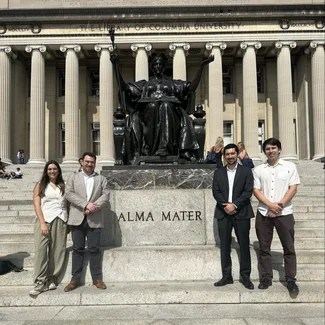
From left: Luksic Scholarship for Sustainability Fellowship recipients Victoria Escribano Piazza, Francisco Loyola, Gustavo Hunter and Camilo Avilés.
Together, the three cohorts reflect a range of professional pathways into sustainability—from energy and environmental assessment to corporate ESG strategy, data, public policy, law, and sustainable mobility—while sharing a commitment to applying their expertise to challenges facing Chile and the broader region.
About the Program
The Columbia University M.S. in Sustainability Management program, offered by the School of Professional Studies in partnership with the Climate School, provides students with cutting-edge policy and management tools to help public and private organizations and governments address environmental impacts and risks, pollution control, and remediation to achieve sustainability. The program is customized for working professionals and is offered as a full-time and part-time course of study.
The program fosters creativity and adaptability by equipping students with the skills to tackle real-world sustainability challenges through an interdisciplinary approach that draws on leading sustainability academics, researchers, and practitioners. The curriculum and flexibility prepare graduates for careers in the dynamic and rapidly changing field of sustainability.
Learn more about the M.S. in Sustainability Management program.
About the Scholarship
Columbia University School of Professional Studies offers the Luksic Scholarship for Sustainability at Columbia University to students in the Master of Science in Sustainability Management program. Supported by the Luksic Foundation, the scholarship covers the full cost of attendance, including tuition and living expenses. Students who have lived or worked in Chile and who are committed to advancing sustainability efforts in the region are eligible for the scholarship.