
When Olga Puntus (’15SPS, Sustainability Management) enrolled at Columbia University, she was hardly starting from scratch.
She had already spent more than a decade building an international career spanning environmental law, renewable energy, and sustainable development. Her work and education had taken her from her native Belarus to Berlin, Moscow, Hong Kong, and eventually New York, with experience that included work in the World Bank Group and renewable energy programs in Russia.
“I had always wanted to do exactly what I am doing now,” she said.
Today, Puntus is Executive Director, Environmental and Social Risk at J.P. Morgan.
She wanted to move beyond primarily legal work and become the kind of technical environmental and social specialist who could evaluate complex projects firsthand: examining pollution and emissions, understanding impacts on communities, assessing environmental risks, and helping organizations determine how those risks should be managed.
“I wanted to be on the technical side instead of drafting somebody’s conditions for an agreement,” she said.
Despite her extensive international experience, making that transition proved difficult. Puntus found that employers continued to see her primarily as a lawyer.
She realized she needed to add something specific to an already impressive résumé: deeper environmental science expertise and a U.S. education that could complement her international credentials.
Then she discovered Columbia University’s M.S. in Sustainability Management.
“Columbia University — that’s a no-brainer,” she remembered thinking. “You want to get exposed to Columbia University.”
Building the Education Around the Career
For Puntus, one of the program’s greatest advantages was its flexibility.
She could continue working full time while pursuing the degree part time, but flexibility meant more than scheduling. Puntus was able to intentionally shape her Columbia education around the expertise she knew she needed for the career she wanted.
She studied climate science. She took a course through Columbia Business School. She sought out technical knowledge that complemented her background in law, policy, and international development.
That ability to move across disciplines became one of the most valuable aspects of her Columbia experience.
“There is a lot of flexibility in the program, so take advantage of that and study with professors from other schools,” Puntus said, speaking to prospective students of the program. “You can choose to be intellectually stimulated all of the time. There is an incredible culture of diversity and intellectual curiosity at Columbia that I have never seen anywhere else.”
For prospective students, her experience offers an important lesson: graduate education can be most powerful when students know where they want to grow and deliberately use the university’s resources to get there.
“It is a school of professional studies, so you have to know what you want,” she said. “Whatever you have a question about, or something you need to learn about, you can find it. Don’t just come to network and get the degree; yes, do all of that, but also learn.”
“The Missing Piece in the Puzzle”
For Puntus, that strategy paid off.
“My Columbia education was the missing piece in the puzzle of what I wanted to do with my career,” she said. “It filled the gap beautifully in both my education and on my résumé.”
After earning her degree in 2015, Puntus successfully made the transition she had envisioned: from international organizations into the U.S. commercial banking sector.
She joined Wells Fargo, where she ultimately led the environmental and social risk team for more than five years. She later moved to J.P. Morgan, where she is now executive director of environmental and social risk and leads the practice across the Americas — including Canada, the United States, and Latin America.
For someone who arrived in the United States in 2010 after building a career across Europe and Asia, the scale of that trajectory can still surprise her.
“I am an immigrant born and raised in Belarus,” Puntus said. “I only moved to the U.S. in 2010, and now I am leading the environmental and social risk practice for J.P. Morgan for all of the Americas. That part still feels a little bit unreal!”
Sustainability at the Center of Global Finance
Today, Puntus operates at the intersection of sustainability, finance, business, and risk — exactly the kind of interdisciplinary space she had hoped to enter.
“Banks are all about managing risk,” she explained. “Market risk, liquidity risk, country risk, credit risk. Environmental and social risk is one of those risks.”
Her team evaluates the potential environmental and social consequences of projects and clients that J.P. Morgan may finance.
The questions can be extraordinarily complex: How can pollution be reduced? How might a mining project affect vulnerable communities? How should an oil and gas company engage with communities affected by exploration and production? What environmental or social conditions should be addressed before financing moves forward?
The scale of a global financial institution gives those questions enormous significance.
“Banks finance everything from the coffee shop we are sitting in right now to gold mines in Latin America,” Puntus said. “If there are any issues with communities or the environment, my team gets involved.”
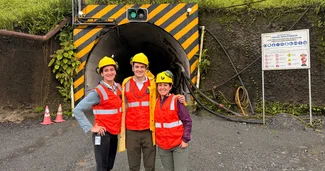
Olga Puntus (left) on a site visit in Latin America for J.P. Morgan.
One day her work might involve a pipeline in Argentina; a power and utilities company in Mexico tomorrow; the next, a salt recovery plant in Brazil.
“There is always a different landscape, a different community, a different history, a different cultural heritage to learn about,” she said. “It is always intellectually and technically interesting. I love what I do.”
Preparing for What's Next
Puntus also believes the sustainability profession is entering another period of transformation, particularly because of artificial intelligence.
She already uses AI regularly to synthesize large amounts of information and make aspects of environmental and social risk analysis more efficient.
But rather than eliminating the need for emerging professionals, she believes technology will change what makes human expertise valuable.
Junior professionals, for example, may spend less time reviewing hundreds of pages of documents and more time visiting project sites, engaging with communities, interpreting complex situations, and bringing insights back to senior decision-makers.
“The need for junior analysts is not going to go away,” she said. “The role is just going to be different and probably more interesting.”
It is another reason Puntus encourages students to approach Columbia with curiosity and intention.
“Definitely apply and then you will gain the unforgettable learning and engaging experience for life,” she said. “I loved everything about my time at SUMA.”
Her own career illustrates what can happen when an experienced professional identifies the expertise needed for the next stage of a career—and deliberately goes after it.
“I had always wanted to do exactly what I am doing now,” Puntus said.
For Puntus, Columbia helped turn that ambition into a career.
About the Program
The Columbia University M.S. in Sustainability Management program, offered by the School of Professional Studies in partnership with the Climate School, provides students with cutting-edge policy and management tools to help public- and private-sector organizations and governments address environmental impacts and risks, pollution control, and remediation to achieve sustainability. The program is customized for working professionals and is offered as a full-time and part-time course of study.
The program fosters creativity and adaptability by equipping students with the skills to tackle real-world sustainability challenges through an interdisciplinary approach from the world’s premier sustainability academics, researchers, and practitioners. The up-to-the-minute curriculum and flexibility prepare graduates for careers in the dynamic and rapidly changing field of sustainability.
Learn more about the program here.


