
The Columbia University School of Professional Studies (SPS) Frame Your Future series recently brought together faculty and industry practitioners for a webinar to examine how artificial intelligence is reshaping the workplace and what professionals can do to adapt. As suggested by the panel’s title, Nobody Knows: How AI Is Changing the Workplace and What to Do About It, no one has a definitive playbook for AI. Rather than trying to predict exactly where the technology is headed, the discussion focused on how professionals can remain adaptable amid continual change.
The conversation was hosted by Mark Ritzmann, lecturer in the M.S. in Technology Management program, co-director of the SPS AI Lab, and associate dean of analytics and strategic communications. He was joined by Katja Schroeder, associate program director of the M.S. in Technology Management program and senior lecturer in the discipline of technology management; Hsing-Hsing Li, lecturer in the M.S. in Technology Management program and chief operating officer at Accelerate AI; Joe Hao, head of energy and AI at Aspen Power and lecturer in professional studies in the M.S. in Sustainability Management professor; and David Hoffman, professor of bioethics and a healthcare lawyer.
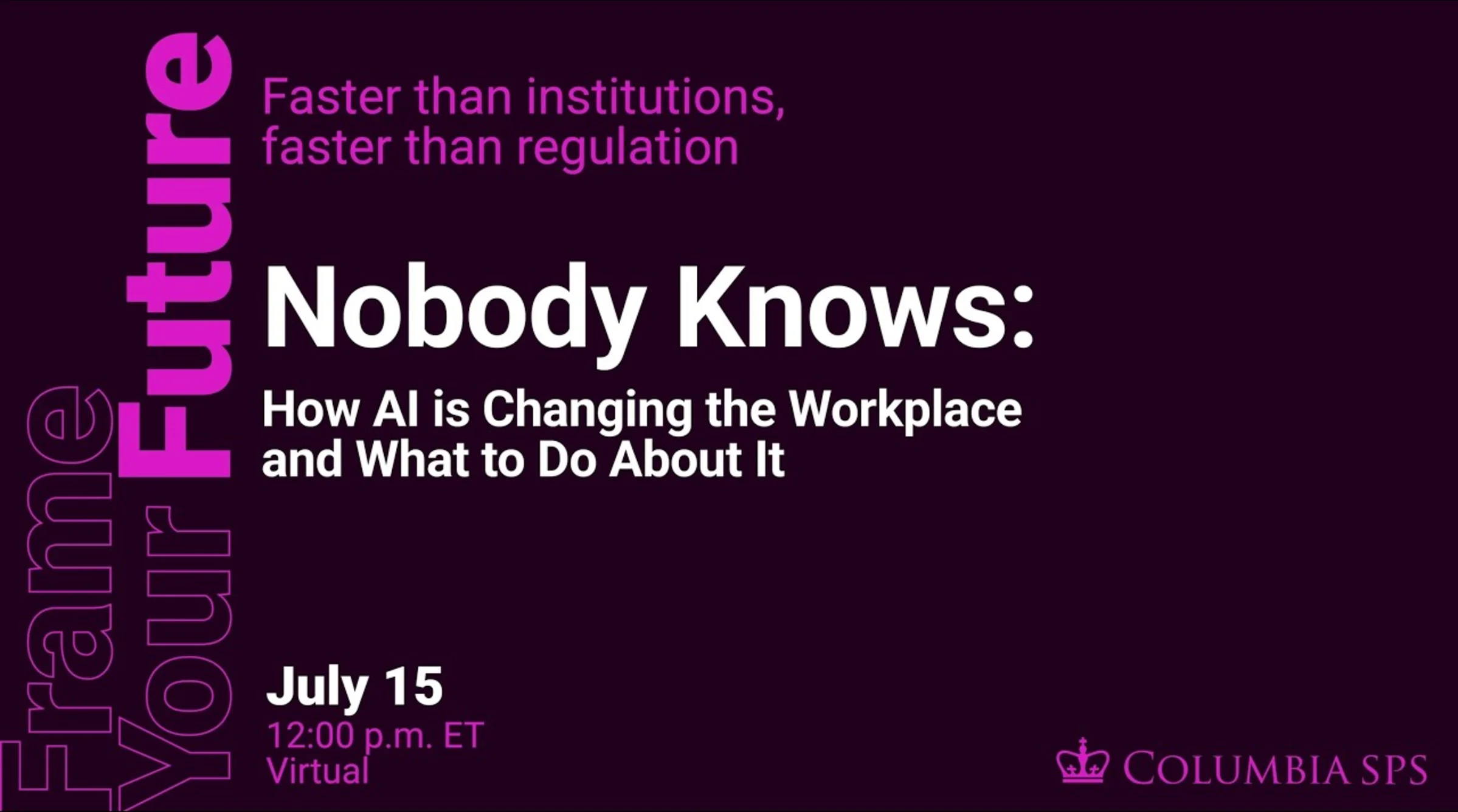
A question driving much of the public anxiety kicked off the conversation: Will AI cause mass unemployment? The panel probed the topic without dismissing the stakes, acknowledging that AI is already an unprecedented disruptor of work. Schroeder noted that adoption remains uneven across industries and functions, and cited a World Economic Forum projection of net job creation alongside the displacement of repetitive roles. “We've seen these agents coming into the workplace, now you have to either create them or you have to manage them. And that is a new type of leadership challenge that we're facing,” Schroeder said.
Ritzmann suggested that the economics remain unsettled—from the cost of tokens to the difficulty of measuring AI’s return on investment.
The clearest message from the panel was that professionals should not hang back. Rather than wait for the picture to resolve, the speakers said people should actively explore, experiment, and learn to build with AI. “It’s not really a moment to wait and see. It is a moment to move forward, and it's a moment to dive in,” Ritzmann said. Hao agreed that the shift has already begun: “It’s unevenly arrived, but it’s already changed.”
The discussion also explored how AI is changing higher education and how SPS faculty are incorporating it into their classrooms. Ritzmann said students with no prior building experience produced working prototypes, ranging from wildlife tracking to sailing-route optimization. Li said her classroom uses real case studies to help students cut through the hype and defend the return on investment of their work to executives. “AI is really everywhere and touches everything. It is a tool and not the actual goal,” she said. Hao has students design their own problems before turning to AI, reserving low grades for work that simply hands a prompt to a model.
That approach reflects a shared view of where human value now sits. Hao urged attendees not to invest in skills that AI will soon perform far better, and instead to build the competencies that remain scarce. “When generating results becomes easy and cheap, the value creation is more reliant on judgment,” he said, “and what I normally call taste.” Creativity, judgment, and taste, the panel agreed, are the skills to develop now. Hsing-Hsing Li echoed this sentiment saying, “We dance around this term soft skills, but I actually think of them as management skills, where in the School of Professional Studies, management skills like strategy, people and process management, those are often actually cited as keys to AI implementation success.”
Beyond technical skills, Schroeder and Hoffman argued that AI governance and oversight will become increasingly important as organizations adopt AI more widely. Schroeder said regulation is uneven by territory and that “it is urgent that we create a framework for how AI moves forward.” Hoffman cited a survey in which 78% of executives said they lacked confidence they could pass an independent AI governance audit, and argued that human oversight, not automation, defines the opportunity. He called industry self-governance “the best protection” against inconsistent regulation.
While the future of AI remains uncertain, the panelists all agreed: Waiting is not a strategy. Professionals should experiment with AI, continue learning, and remain flexible as the technology and the workplace continue to evolve. Joe Hao summed it up by saying, “This technology will free up our time to do the things our curiosity leads us to. I hope everyone can embrace this and figure out the best way it can work for them.”
View the full series here.
About the Programs
Columbia University’s Master of Science in Technology Management is a hands-on technology leadership development program designed to train professionals for equal fluency in tech fundamentals, business operations, and ethical leadership.
The program is available for part-time or full-time enrollment. Learn more about the program here.
The Columbia University M.S. in Sustainability Management program, offered by the School of Professional Studies in partnership with the Climate School, provides students with cutting-edge policy and management tools to help public and private organizations and governments address environmental impacts and risks, pollution control, and remediation to achieve sustainability. The program is customized for working professionals and is offered as a full-time and part-time course of study.
The program fosters creativity and adaptability by equipping students with the skills to tackle real-world sustainability challenges through an interdisciplinary approach from the world’s premier sustainability academics, researchers, and practitioners. The up-to-the-minute curriculum and flexibility prepare graduates for careers in the dynamic and rapidly changing field of sustainability.
Learn more about the program here.
Columbia University’s Master of Science in Bioethics grounds students in interdisciplinary approaches and models to address pressing bioethical challenges such as stem cell research and health-care reform. The program prepares students to act as responsible and responsive leaders in this new and ever-growing field. It also includes a concentration in global bioethics—the first of its kind in the U.S. Columbia's Bioethics program offers a range of degrees and courses.
The spring 2026 application deadline for the M.S. in Bioethics program is November 1. Learn more about the program here. The program is available full-time and part-time, online and on-campus.


