
By Sushmita Dhekne, Student in the M.S. in Sustainability Management Program, School of Professional Studies
On New Year’s Day, I boarded a flight for a two-week graduate fieldwork course that would reshape how I thought about sustainability: as something lived and deeply local.
Offered by Columbia University’s M.S. in Sustainability Science (MoSSS) program, the Sustainability and Resilience of Tropical Highland Ecosystems course taught by Dr. Brendan Buckley—co-director of the MoSSS program, Lamont Research Professor, and longtime member of the Tree Ring Lab at the Lamont-Doherty Earth Observatory (LDEO)—took us from the dense urban energies of Ho Chi Minh City and Da Lat to the cooler elevations of Vietnam’s Central Highlands. The learning objectives were to understand the ecological linkages in tropical lowland and highland ecosystems, engage with local indigenous peoples to understand their perspectives, and uncover the unique challenges of conservation in this region.

After adjusting to the new time zone in Ho Chi Minh City, we hit the road. The bulk of the course unfolded in the highlands and the stretches between them, landscapes shifting around us as we traveled deeper into Vietnam’s interior. With the guidance of SIE, we spent a couple of days in Núi Chúa National Park and Bidoup Nui Ba National Park, collecting data on tree species, measuring circumference, estimating height, and calculating carbon storage. Making our way up and down and through the forests, identifying trees by their characteristics and tags that SIE’s team placed in previous censuses, dodging branches and roots that seemed to spring up from nowhere, gave me a real appreciation and respect for the work that researchers do day after day.
Lectures were interspersed with hands-on learning, covering paleoclimatology, the biodiversity of Vietnam’s highlands, and marine ecosystems—each session adding context to what we were seeing in the field. Victoria Escribano Piazza, a student in the M.S. in Sustainability Management (SUMA) program at SPS, valued this balance.
“I've had theoretical classes before, but this class was a good balance to get that experience in ecology-related work,” she said. She also appreciated learning from multiple professors simultaneously, calling it “a unique experience because it provided different expertise and perspectives.” Learning from people who are actually doing the work on the ground, and being where they're doing it, added a dimension that no classroom could replicate. “It's important to see how things are done and question it,” Escribano Piazza said. “That's how things are improved.”
The course’s interdisciplinary approach was one of its greatest strengths. Over meals, during hikes, and in evening lectures, students from different programs brought entirely different questions to the same experience. It was a manifestation of the kind of cross-disciplinary collaboration that true sustainability work demands in the real world, where scientists, policymakers, business owners, and community leaders have to find a common language. The bonds formed on the trip surprised even us.
“It was different from regular classes because we got to know each other on a more profound level,” Escribano Piazza said. “This is a specific class that requires deep interest and effort, so you meet people who are passionate about the same things as you.”
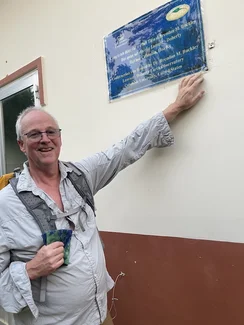
Professor Brendan Buckley
A major highlight was using an increment borer to core the trunk of a tree, collecting samples for Professor Brendan Buckley's research on regional climate stability, with an emphasis on major droughts and wet episodes of the past. We passed samples around, taking a whiff of the fresh scent of wood and observing the rings—each one a record of the climate conditions the tree had weathered over its lifetime.

Hand-woven bamboo baskets, made by the Cham (an indigenous group).
An unexpected highlight of the day was lunch. We carried our meals in hand-woven bamboo baskets, made by the Cham (an indigenous group). Each basket included rice, vegetables, and meat neatly packed in banana leaves, accompanied by steel cutlery to minimize waste. Throughout the trip, we indulged in freshly made local meals that told us something about where we were. A particular highlight was a meal prepared by villagers: large, flat baskets filled with fresh herbs, vegetables, meat, and rice crisped to perfection. The food was a clear window into how intertwined nature is with people's livelihoods in Vietnam.
Beyond the research, some of the most meaningful moments came through the people we met. We met the first woman in her community to start a business—a coffee farm—who candidly shared the challenges she faced building something from the ground up. We learned from the farmers working with her, hearing about their lives and the land they depend on. On evenings at the Bidoup Nui Ba National Park, bonfire nights brought our group together with our hosts to learn about indigenous culture and unwind after long days in the field. These were genuine moments of connection that reminded us why this work matters beyond the data.
At the end of the two weeks, I boarded my flight back home, carrying the little bamboo basket tucked into my carry-on—a souvenir from the trip that felt more meaningful than anything I bought. During this course, sustainability was something I was doing and actively experiencing: measuring trees, speaking with locals, and eating meals that left little waste. Vietnam gave me a fresh perspective on how sustainability affects every aspect of daily life. Most importantly, it gave me the conviction that I’m in the right field.
About the Program
The Columbia University M.S. in Sustainability Science program, offered by the School of Professional Studies in partnership with the Climate School, prepares students for management and leadership positions in which they help organizations address environmental impacts. Students learn strategies to respond to the ever-changing environment and predict future environmental changes—and the impact on corporations, not-for-profits, and the public.
Designed by Research Faculty at the Lamont-Doherty Earth Observatory in collaboration with Columbia’s Earth Institute, the program develops a new generation of scientific leaders through a cutting-edge curriculum led by the world’s top sustainability scientists, the majority of whom are Lamont Research Professors. Graduates are well prepared for management and leadership positions, armed with the scientific expertise to drive meaningful environmental change and lead organizations in a rapidly evolving sustainability landscape. With the flexibility to choose from a variety of courses, students can tailor their education to career goals, while New York City serves as a living laboratory for sustainability innovations and connects them with employers actively seeking program graduates.
Learn more about the program here.