
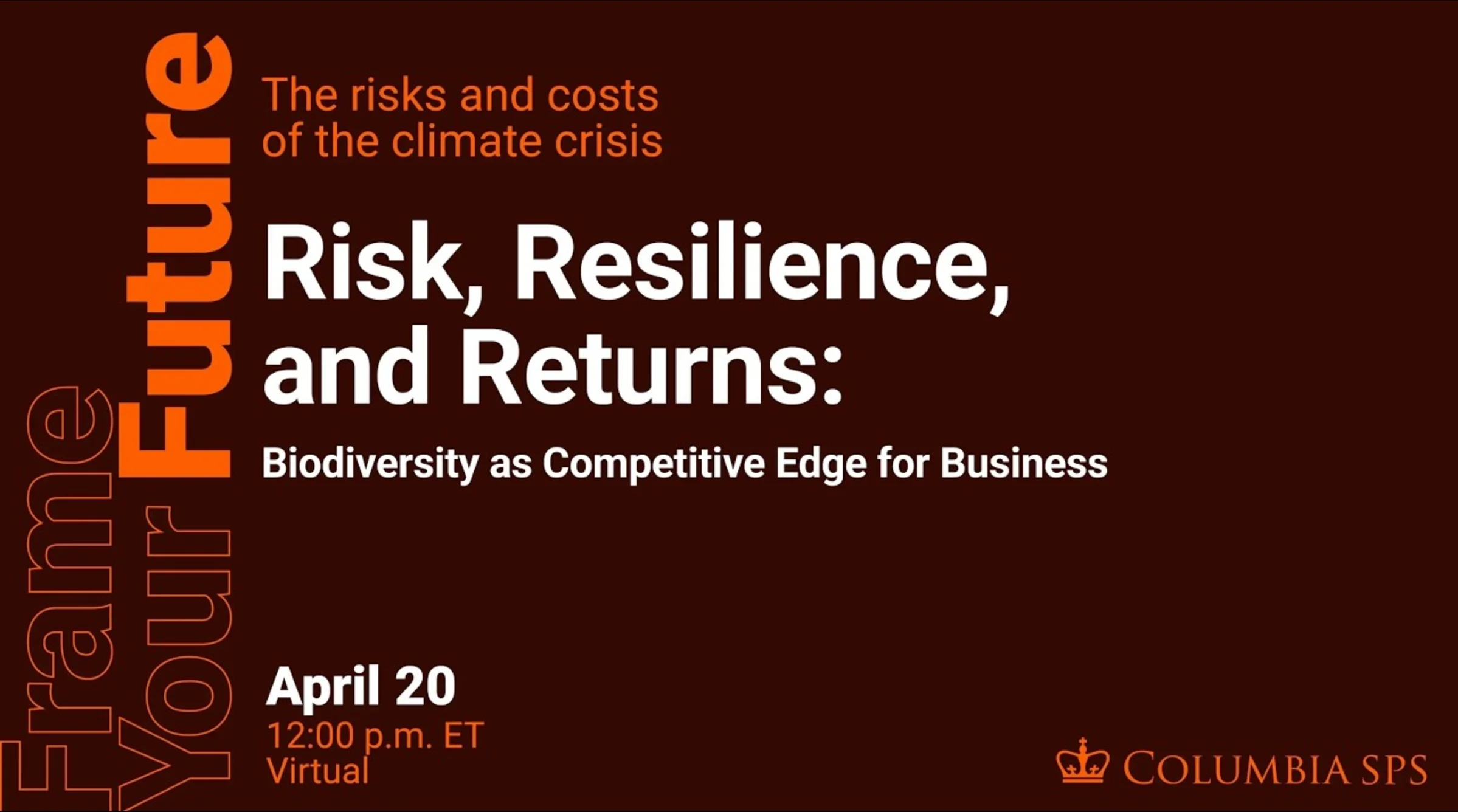
Climate change has won its place in boardroom strategy. Biodiversity has not, at least not yet. Speakers at a recent Columbia School of Professional Studies’ “Frame Your Future” Biodiversity Analytics webinar called that gap untenable and outlined what it will take to close it.
Moderator Viorel Popescu, director of the new Master’s Degree in Biodiversity Data Analytics, named the stakes, noting that the world has lost 73% of its wildlife since 1970, while the private sector still pours over $5 trillion a year into activities driving that loss. The problem, as Maria Uriarte, chair of Columbia's Department of Ecology, Evolution and Environmental Biology, explained, is that biodiversity resists simple measurement. Unlike climate, there is no single 1.5°C dial. It is a dashboard of extinction risk, ecosystem integrity, habitat, and resilience to shocks. That complexity has let business off the hook. That is now changing.
Inside the private sector, awareness is approaching a tipping point. Edward Pollard, founder of Positive By Nature, described a confectionery giant whose board only recently grasped that it depends on functioning ecosystems for cocoa and sugar, and that West African deforestation, not climate alone, was driving its rising input costs. Dependency is becoming visible, and with it, the risks of inaction.
Capital is following, slowly. Caroline Flammer, the A. Barton Hepburn Professor of Economics at Columbia's School of International and Public Affairs, was direct. “Once the last holdouts finally price biodiversity risk, it will be too late for the planet,” she said, pointing to where returns are already materializing: regenerative agriculture, ecotourism revenue, flood mitigation that protects insurers and real estate, and an emerging biodiversity credit market.
Kevin Webb, co-founder of Superorganism and an alum of the School of Professional Studies’ Sustainability Science program, suggested that venture capital is moving too. His venture capital company, which grew out of his studies at SPS, is the first fund dedicated entirely to biodiversity, and backs companies that profitably reverse nature loss, as well as enabling technologies: AI, remote sensing, and eDNA. "I think policy and tech can reinforce each other in unexpected ways”, he argued. “It's starting to be possible to look at biodiversity through a number of different technologies, and I think that’s what gets us excited.”
The missing link remains measurement, and the gap is significant. Without standardized metrics, companies cannot see their nature dependencies clearly, let alone manage or disclose them. Joshua Berger of BioInt warned against cherry-picking from thousands of possible indicators. The path forward is harmonization, anchoring metrics to common categories: ecosystem condition, extent, and species risk, so that companies, investors, and ecologists can compare like with like.
The demand for professionals who can do this work is already outpacing supply. As risks mount and companies move from awareness to action, the need for people who can translate ecological complexity into business intelligence will only grow. This is not a niche skillset on the horizon; it is an emerging career pipeline with real urgency behind it.
When asked what is still missing, every panelist named the same gap in the talent pipeline: rigorous polymaths fluent in ecology, data and finance - people who can sit with complexity rather than oversimplify it. Caroline Flammer described the need as "folks who are fluent in different languages, meaning ecology and finance — those who can bridge those two worlds." Joshua Berger named the temperament behind that fluency: "rigorous curiosity… the willingness to sit with complexity and not be discouraged whenever it gets too complicated." That is precisely the professional the SPS MS in Biodiversity Data Analytics is designed to produce.
With analytics finally catching up to ambition, biodiversity is ready to take its place at the boardroom table, and when it does, both the planet and the private sector stand to gain.
About the Program
The Master of Science in Biodiversity Data Analytics program at Columbia University equips a new generation of leaders with the data literacy, analytical tools, and interdisciplinary expertise to design evidence-based solutions that benefit both people and nature.
Designed for both working professionals and early-career changemakers, this online program allows students to learn from anywhere while gaining the skills to collect, analyze, and translate biodiversity data into meaningful action. Coursework prepares students to take on nature data applications across industries, from ESG finance to urban planning to environmental consulting, and culminates in a hands-on capstone with industry partners that provides practical experience, valuable networks, and the tools to make an immediate impact.
The application deadline for the M.S. in Biodiversity Data Analytics program is June 1. Learn more about the program here.


