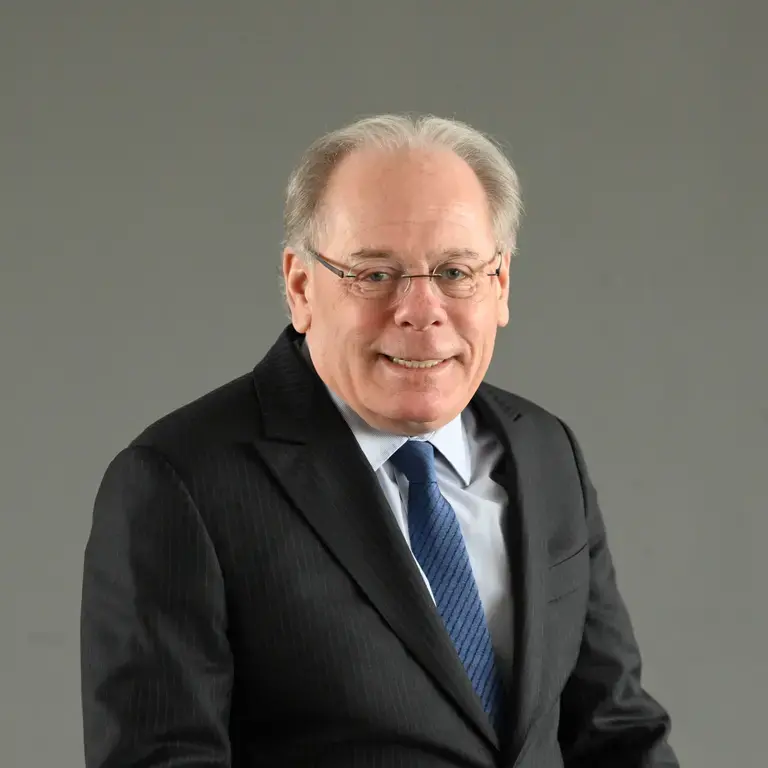
By Steven Cohen, Ph.D., Director of the M.S. in Sustainability Management program, School of Professional Studies
I’ve been directing graduate programs at Columbia University since September of 1985, and for over forty years, I’ve attended many “class day graduation ceremonies” at Columbia. It’s a time of year I look forward to, and as ceremonies become more professionally produced, I am increasingly impressed by them. This past Friday, I spent the day on stage for two graduation ceremonies at Columbia’s School of Professional Studies. This coming Thursday, I will spend a few hours at a similar event at the School of International and Public Affairs. The School of Professional Studies events feature brief talks by two members of the faculty and by two students. My faculty colleagues last Friday were insightful, articulate, and inspirational. One even managed to share the stage for a time with Roar-ee, the Columbia Lion mascot. But the student speakers were even more remarkable: They inspired, impressed, and thrilled me. They spoke about their professional and personal journeys with humility and gratitude. The production values at these events now include many high-definition video screens and crystal-clear sound, and as the students spoke, the video cameras focused on their families, and I was able to see their pride and sheer joy. These two student speeches were the high point of my day.
Graduation days are both celebrations and rites of passage. We celebrate the accomplishments and the determination of our graduating students, while we confer on them the status of their hard-earned degrees. For many, their time at the university has been transformative. They are different people than they were when they arrived. They have learned what they needed in order to graduate, but more importantly, they have engaged in a set of experiences that lead them to see the world differently. At Columbia, they will have worked in project teams with students from many places all over our nation and all over the world. They will have attended events with experienced practitioners and renowned scholars and will subsequently share perceptions of those events with colleagues who bring diverse perspectives and lived experiences to their views of what they have seen.
This is not the first time I’ve written about the meaning of graduation ceremonies. Commencement ceremonies provide me with time to listen and learn. In 2023, I expressed a post-COVID perspective, looking back on two years of virtual ceremonies and at my relief of the return to normalcy. As I wrote then:
“In both 2020 and 2021, Columbia’s graduation ceremonies were held virtually and while it was better than nothing, it was more than a little sad to see. Last year, we were back in person and in three dimensions, and we held two ceremonies—one for last year’s graduates and a second ceremony for those that graduated without an in-person ceremony. I remember that with face-to-face graduation in 2022, it seemed as if we could all finally exhale. People were so happy to be together, and nearly everyone sensed the arrival of the long-awaited return to normalcy that took so long to show up. The pandemic was a time of misery, of sick and dying people, missed family events, and forgone opportunities to connect. As we returned last year, I gained a deeper appreciation for these rites of passage and their importance to our way of life. Graduation ceremonies are a time to step back, reflect, and savor progress and accomplishments... While education in the modern world must remain constant and intense, graduation ceremonies provide us with an opportunity to pause and reflect. Sitting on the stage in my cap and gown, I look at the graduates in their medieval garb smiling and cheering, but I also look at their families and friends, and I may be projecting a bit, but along with their joy I think I also see pride and a little bit of amazement. For a parent, one can’t help remembering a child’s first sounds and first steps, and suddenly, in what seems like a nanosecond later, a parent sees that child is now an adult, on their own, shaking hands with professors and deans. In a world of strife and struggle and in a nation of partisan polarization, these moments are precious and meant to be treasured.”
This is a time when universities, and particularly elite universities, are under attack. Some of those attacks are justified, but many are not. We are also engaged in a time of performative polarized politics, where some people use any gathering of crowds to make sure everyone hears their perspective. Fortunately, most of the graduation ceremonies I’ve attended have not been disrupted. I’ve seen some rude behavior where students wearing protest garments refused to shake the hand of the dean, but I haven’t directly experienced any major disruptions. When I see loud graduation protests on television, I always think about the many graduates and their families who have sacrificed and worked hard to earn their degrees, and hope their joy and pride are not diminished by the arrogance of those who choose an inappropriate time and place to exercise their right to free speech. We still have that precious right here in the United States, but there are times and places for raising our voices, and graduation ceremonies are neither the time nor the place.
During class day graduation ceremonies at the professional schools I work for, every graduate comes up to the stage, shakes the hand of their program’s director and the school’s dean, and has a photo taken of them at that moment. It is a rapid but meaningful point in time. It may pass quickly, but it is precisely when a student becomes a graduate. The students cheer their friends and shout their names after the very human-sounding automatic name reader announces them. Some take a bow, others rush quickly off the stage, and some call out to their classmates. Wherever I look, I see happiness, and when I look over at the sections with family and friends, I see a look of joy, perhaps mingled with a little relief.
Some are questioning the value proposition of higher education and ask about the return on investment. Education has gotten more expensive, in part due to the low teaching loads of tenured faculty, in part due to the increased expectations of parents and students, and in part due to the dizzying set of regulations governing universities. As an educator, I am troubled by the cost but remain convinced that it is one of the best investments anyone can make. In most cases, it increases an individual’s earning potential. At its best, higher education broadens the perspective of everyone who engages in it. This is true of both students and faculty. I learn from my students when I teach them and read their papers. When I supervise and advise project teams, I am often amazed by the new ideas, important facts, and novel perspectives my students articulate in class and in their writing. I also see the difference between the quality of work and thought they were capable of when they arrived, and how it has changed by the time they are ready to leave. Additionally, I learn from our alumni when they return to campus and reflect on the changing conditions they face at work, and our need to reflect those changes in the courses we teach. I also see education as central to a functioning democracy. I’m certain my belief in the connection between education and democracy originated when I attended James Madison High School in Brooklyn, where each morning I entered a doorway where an inscription from James Madison informed us that “Education is the true foundation of civil liberty.” I’m certain that Madison was correct then and now. Ignorance and disinformation threaten democracy, and critical thinking and learning are prerequisites to popular rule.
This week, Columbia’s class days will continue along with the traditional ceremony mid-week at the center of campus, where the university’s president formally confers degrees. I am grateful for the opportunity to be part of this wonderful tradition and do not take for granted the privilege of participating in and observing these joyful days.
Views and opinions expressed here are those of the authors, and do not necessarily reflect the official position of Columbia School of Professional Studies or Columbia University.
About the Program
The Columbia University M.S. in Sustainability Management program offered by the School of Professional Studies in partnership with the Climate School provides students cutting-edge policy and management tools they can use to help public and private organizations and governments address environmental impacts and risks, pollution control, and remediation to achieve sustainability. The program is customized for working professionals and is offered as both a full- and part-time course of study.