
Artificial intelligence has made its way into political analytics—and by all indications, it’s here to stay.
How AI fits into politics, campaigns, and analytics strategy was the most prominent theme of the third annual Political Analytics Conference, a full day of discussion that brought together pollsters, strategists, academics, media professionals, and students to examine a rapidly transforming field.
Hosted by the M.S. in Political Analytics (POAN) program at Columbia University School of Professional Studies on March 27, 2026, the conference was attended by 180 students, faculty, practitioners, and community members and explored how new technologies are reshaping the way campaigns are run, how elections are understood, and how voters are reached.
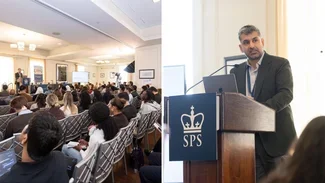
Pictured: Conference attendees and keynote speaker Kabir Khanna
The Shifting State of Election Analysis
Keynote speaker Kabir Khanna, director of Election Analytics and Technical Systems at CBS News, opened with a wide-ranging look at how election analysis has evolved. He emphasized a core constraint: “Any model that we fit to these types of data is only going to be as good as the underlying data itself.”
Khanna described a broader editorial shift from simply calling races to explaining them. CBS now integrates voter files, census data, and survey data to build granular demographic models that support on-air storytelling. One example from 2024 showed how a modest increase in turnout among infrequent voters—who skew young, male, and disengaged—could flip multiple battleground states. “What actually happened was that group did show up in large numbers,” Khanna noted.
He also highlighted hyperlocal analysis, including precinct-level mapping of New York City’s 2025 mayoral race, which revealed how working-class Asian and Muslim voters in Queens played a decisive role.
Looking ahead to the 2026 midterms, Khanna pointed to low presidential approval, high “out-party anger,” and persistent concerns about rising prices. The key question, he said, is whether the election becomes “a referendum on Trump 2.0 … rather than a choice between two unpopular parties.”
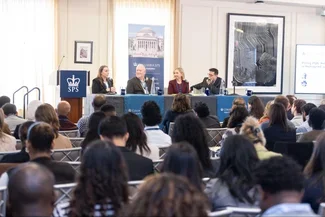
Pictured (l to r): Jane Rayburn, Wes Anderson, Maeve Ward, David Wolfson
Polling in an Era of Disruption
The first panel turned to the state of polling. Moderator Maeve Ward of Grow Progress noted that predictions of polling’s demise are nothing new.
Wes Anderson of OnMessage Public Strategies argued that the complexity of voter decision-making ensures a continued role for human judgment: “Humans will always be at the helm.” David Wolfson of DecipherAI, meanwhile, pushed back against the assertion that traditional methods like live calling remain as relevant as they once were. “I don't ever take a step in the ‘polling-to-analytics A to Z’ without using AI,” he said.
Data aside, Jane Rayburn of Workbench Strategy reminded attendees of the value of looking beyond quantitative analytics—suggesting that past failures to ask qualitative questions during campaigns “were causing a major disconnect between our community and the way that voters were feeling.”
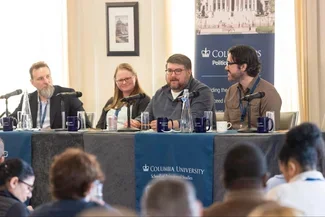
Pictured (l to r): Gregory J. Wawro, Ph.D.; Meg Schwenzfeier, Ph.D.; Benjy Messner; Yamil Velez, Ph.D.
AI: Risks, Opportunities, and Methodological Threats
A panel moderated by Gregory Wawro, POAN program director, examined AI in political campaigns directly. Meg Schwenzfeier of the DCCC warned that voters increasingly rely on chatbots for political information, effectively choosing opaque “information ecosystems.” She described an internal experiment in which newly created Wikipedia pages for real candidates were quickly surfaced in AI-generated answers.
By contrast, Benjy Messner of New River Strategies framed AI as a tool for efficiency, allowing analysts to offload routine tasks and focus on higher-level judgment, but was skeptical about its use for directly communicating with voters. “Communicating a trustworthy message at scale feels like an appropriate role for automation,” he said. “But communicating trust does not seem to me like something AI is a good fit for.”
Columbia professor Yamil Velez shared research using AI-powered adaptive surveys, conducted with student Patrick Liu, showing that issue-based messaging outperforms appeals based on identity or demographics. The findings suggest that individual policy preferences may matter more than broad voter categories.
The panel also addressed a growing threat: AI bots completing surveys. Wawro cited research suggesting that as much as 40% of responses on some platforms may be AI-generated, raising serious questions about data integrity.
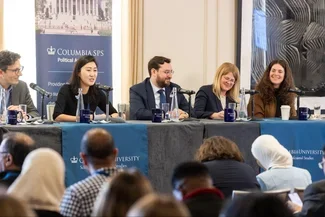
Pictured (l to r): Michael Schwam-Baird, Ph.D., Eunji Kim, Ph.D., Evan Roth Smith, Erika Franklin Fowler, Ph.D., Jackie Burns
Media, Messaging, and New Influencers
The third panel, moderated by Michael Schwam-Baird, POAN program deputy director, explored how campaigns reach voters in a fragmented media landscape. Erika Franklin Fowler of Wesleyan University presented long-term data from the Wesleyan Media Project and noted the rise in ad spending on streaming and smart television campaigns from 15% in 2022 to a projected 22% in 2026—away from traditional live TV ads. She also warned that AI-generated political content—including unauthorized voice replication—is likely undercounted.
Strategist Jackie Burns pointed to the enduring importance of human judgment. Her campaign for Mikie Sherrill in New Jersey’s 2025 gubernatorial primary spent relatively little on early paid media, relying instead on timing and strategic restraint. “Timing and political instincts still matter in campaigns,” she said.
Columbia professor Eunji Kim presented experimental research on social media influencers. Her team found that “both very political and predominantly apolitical creators were equally effective in moving people to their policy preferences in a progressive direction.” Notably, participants who followed only entertainment content drifted in a more conservative direction during the 2024 election cycle, highlighting the subtle effects of media environments.
Evan Roth Smith of Slingshot Strategies criticized the industry’s reliance on closed-ended surveys. His firm’s “scaled qualitative” approach uses AI-assisted conversations to collect open-ended responses, revealing deeper dissatisfaction than traditional metrics capture. In one case, sentiment analysis showed mostly negative views of a political party even when standard favorability ratings appeared strong.
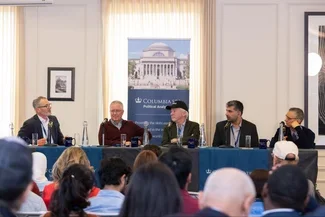
Pictured (l to r): Doug Usher, Ph.D., Joe Lenski, John Phillips, Kabir Khanna, Andrew Gelman, Ph.D.
Forecasting, Markets, and the Limits of Prediction
The closing panel, moderated by Doug Usher of Forbes Tate Partners, examined how to interpret polls, models, and prediction markets. Joe Lenski of SSRS gave an overview of past data, highlighting his methodology in predicting which states were likely to become battleground states in this November’s Senate races. Andrew Gelman, Columbia professor and statistician, similarly spoke about close electoral races throughout history and the historical variability of polls.
John Aristotle Phillips of Aristotle and PredictIt described prediction markets as a useful complement to polling, particularly for aggregating expectations quickly, though not for explaining the “why” of voter behavior.
Khanna returned to the panel setting to stress the importance of clarity in communicating forecasts, cautioning that probabilities are often misunderstood by audiences and vary widely depending on market conditions.
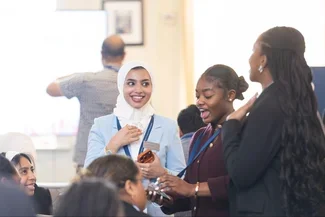
Political Analytics Students (l to r): Halla Al-Moradi, Fina Adonai Osei-Owusu, and Nkemdilim Obiamalu
About the Program
The Columbia University M.S. in Political Analytics program provides students quantitative skills in an explicitly political context, facilitating crosswalk with nontechnical professionals and decision-makers—and empowers students to become decision-makers themselves.
The 36-credit program is available part-time and full-time, on-campus. Learn more about the program here.
For general information and admissions questions, please call 212-854-9666 or email politicalanalytics [[at]] sps [[dot]] columbia [[dot]] edu.


