
Every organization wants a sleek AI strategy to show that they’re ahead of the curve. But when implemented haphazardly, the costs of an AI-driven operation may outweigh the benefits. How should executives strategize so that their use of AI is not just a case of jumping on the bandwagon?
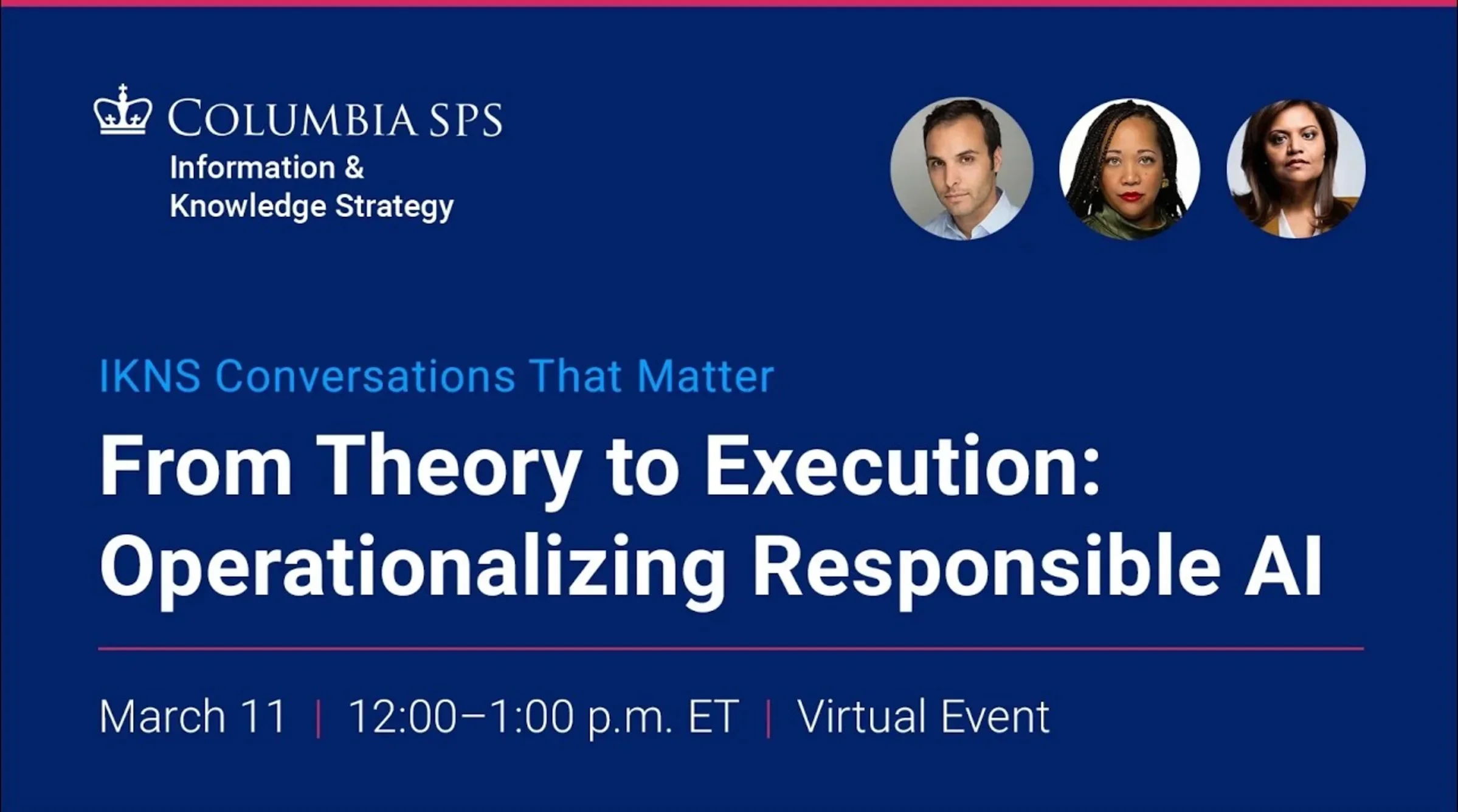
At a recent M.S. in Information & Knowledge Strategy (IKNS) webinar—part of the IKNS Conversations That Matter series at Columbia University School of Professional Studies (SPS)—faculty and practitioners explored what it truly means to move from abstract AI principles to real-world, responsible AI implementation.
Lazaro Corrales, an IKNS student and AI consultant, spoke with Nicole Alexander, a marketing executive and author specializing in ethical AI, and Manail Anis Ahmed, a global expert in AI governance and workforce development, at the event: “From Theory to Execution: Operationalizing Responsible AI.” Together, they offered advice for adopting AI effectively, prudently, and in a way that is consistent with an organization’s core principles.
Ethics vs. Responsibility
One major theme of the conversation was the distinction between ethical AI and responsible AI—terms often used interchangeably but fundamentally different in practice.
“Ethical AI is normative—it asks what should be true,” Alexander explained, pointing to principles like fairness, transparency, and human dignity. Responsible AI, by contrast, is operational: “What will you do with those values inside of your organization, inside of your systems, and inside your workflows?”
This gap between intention and execution is where many organizations falter. Companies may publish thoughtful AI principles, but without governance structures, accountability, and human oversight, “you can have a beautiful ethics policy and still deploy AI irresponsibly,” Alexander said.
Her PACT framework—personalization, accountability, contextual sensitivity, and trust—outlined in her book, Ethical AI in Marketing, offers one approach to bridging that gap, emphasizing the need for continuous feedback loops and adaptability, particularly in global contexts where cultural norms and expectations vary widely.
There is also plenty of opportunity for making AI use itself part of an organization’s social impact strategy. Ahmed noted the possibility of rolling out a system for AI like the Energy Star Ratings—which show the energy efficiency of household appliances—so that companies using AI can also signal their level of commitment to sustainability.
Rethinking AI Implementation
Throughout the session, the speakers agreed on the importance of being intentional with regard to AI policy. Alexander highlighted the importance of including a range of stakeholders in the drafting process. She suggested that, depending on who is in the room when policies are created, other parts of the company may be negatively impacted. For example, if the policies are being drafted by lawyers, there may be too much of a focus on avoiding legal risks—thus stifling opportunities for growth. She therefore urged company policymakers to consider needs across the enterprise when drawing up AI policy.
Ahmed noted that some organizations have been aggressively investing in AI in a way that might ultimately be harmful for the company’s bottom line.
“In many instances, it's proving to be true that being AI-forward is—at least not yet—as profitable as one would imagine,” she said. Ahmed highlighted that some companies justify the costs of investing in expensive AI software by cutting headcounts, and warned that such a strategy may not pay off financially in the long run.
“Instead of [an approach of] ‘Let's slash things and just bring AI in and we'll be okay,’ I think there's an opportunity to flip the approach and make it more of a data-informed, data-driven approach,” Ahmed said. “You should start by saying, ‘Where are the efficiencies to be created?’ And then within those opportunities, ‘How does an organization act responsibly?’”
Responsible AI Strategy at Each Organizational Level
“We're not in the early stages of AI anymore,” Alexander said, noting that by now it’s essential that companies have a framework for AI use. For early-career professionals, she encouraged picking up AI literacy—knowing enough about how the systems work to be able to ask uncomfortable questions about feedback loops, hallucinations, and training data.
As for mid-career professionals, the work should be about process integration. Managers should be pushing for documentation, asking questions about how the decisions are being made, and questioning whether AI outputs have gone through human review.
For senior leaders, Alexander advised setting incentives that determine whether responsible AI use is rewarded or tolerated. “That means making sure that AI accountability is in job descriptions, it's in performance reviews, it's in vendor contracts,” she said, adding that the “most important thing a senior leader can do is to make it organizationally safe for someone to ask difficult questions or to pump the brakes on something.”
Ultimately, one of the biggest takeaways from this latest installment of the IKNS Conversations That Matter series was that AI can be extremely useful to help augment and strengthen an existing competitive advantage, but it is not a magic button to be used to solve every problem—and when treated as one, it can become counterproductive.
As Corrales concluded, “Don't let the AI drive you.” Organization leaders should avoid cutting corners and falling victim to peer pressure by rolling out an irresponsible AI strategy—lest they harm the long term business with a “fantasy illusion of a short-term gain.”
About Columbia’s IKNS Degree
Columbia University’s M.S. in Information & Knowledge Strategy (IKNS) degree integrates data, people, and strategy skills for the AI age. The flexible and interdisciplinary curriculum trains leaders across the entire value chain of data-driven management: Getting the data and analytics right (e.g., AI adoption, business analytics), creating a high performing, people-centric culture (collaboration, team/project management, organizational psychology), and finally the right change management to turn your strategy into reality.
IKNS is available full-time or part-time, online or in-person on Columbia’s landmarked campus right here in New York City. To maximize opportunities for networking and community building, our online students join our New York-based students on Columbia’s campus for three in-person Residencies during their studies. The M.S. in IKNS is a STEM-designated degree.
Students train under world-class faculty, including former and current executives from Google, IBM, NASA, and Oliver Wyman, and join a powerful global alumni network in coveted positions, including at Alphabet, Goldman Sachs, Nike, Pfizer, and the World Bank.
For more IKNS insights, news, and events, please go to our website, connect with us on LinkedIn, or attend one of our online info sessions. Visit the School of Professional Studies website to learn more about the SPS Student Experience.


