
The launch of Columbia University’s new Master of Science in Biodiversity Data Analytics brought together leading voices from academia, industry, and technology for an evening centered on one urgent question: How can better data and analytics training help protect the planet’s rapidly disappearing biodiversity while promoting sustainable growth?
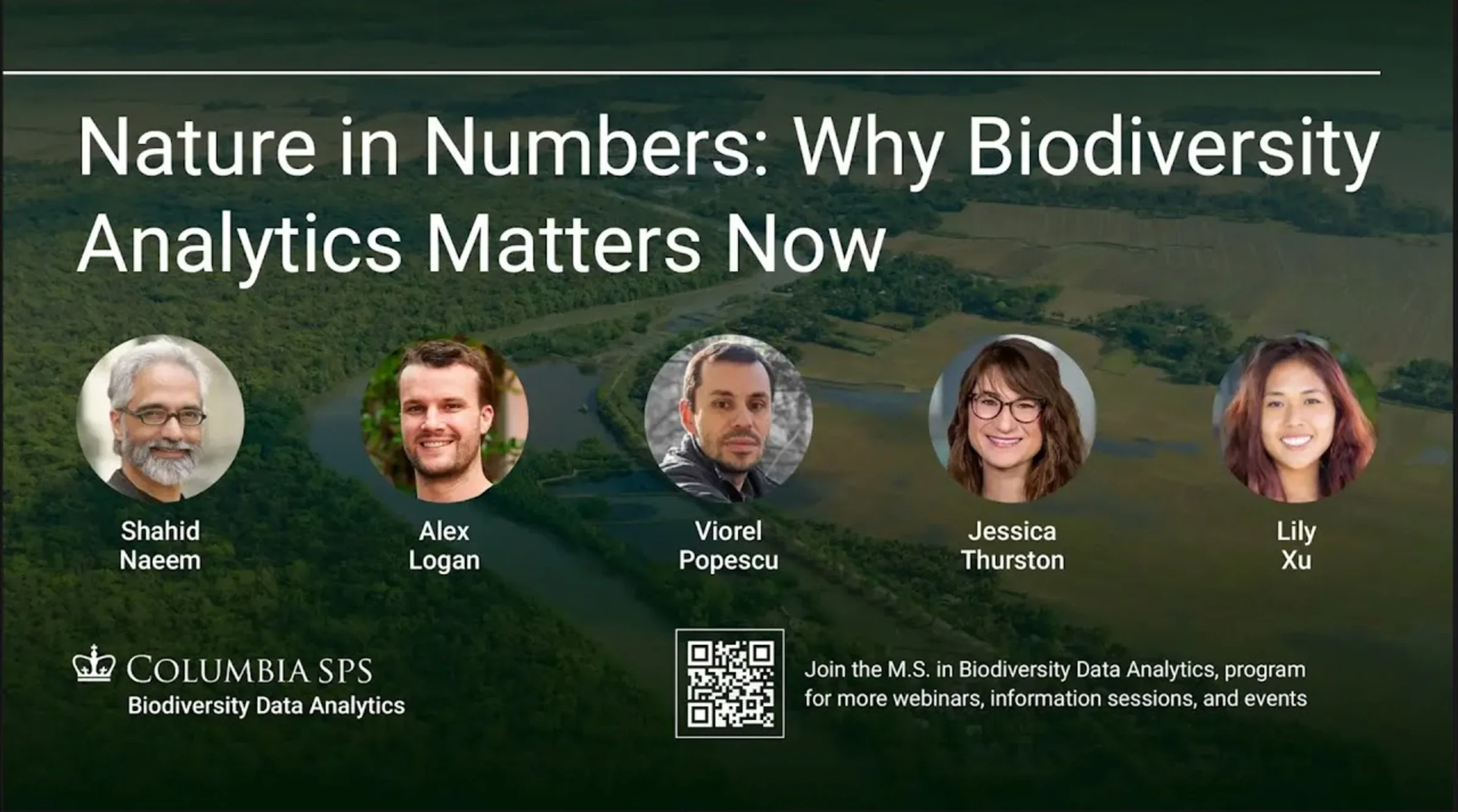
Hosted by the Columbia University School of Professional Studies (SPS), the event, Nature in Numbers: Why Biodiversity Data Analytics Matters Now, brought together experts who explored the accelerating state of biodiversity loss, the transformative role of data, tech, and AI in guiding policy and decision-making, and the growing demand for professionals who can translate ecological complexity into meaningful action.
Developed in partnership with Columbia’s Department of Ecology, Evolution and Environmental Biology (E3B), the fully online M.S. in Biodiversity Data Analytics program embodies the University’s commitment to cross-disciplinary innovation.
“The program represents an extraordinary collaboration between natural sciences, applied data analytics, and sustainability,” Columbia SPS Dean Troy Eggers said in his opening remarks. “Together we have created a degree that prepares students to turn complex ecological data into actionable insights, whether in conservation, corporate sustainability policy, or finance.”
Measuring What Matters
Renowned ecologist Shahid Naeem served as the evening’s moderator and opened the discussion by invoking management theorist Peter Drucker’s famous principle: “If you can’t measure it, you can’t improve it.” For decades, biodiversity has been notoriously difficult to quantify, with complex data collected at vastly different scales, from genetic sequences to entire ecosystems. But why, Naeem asked panelists, is biodiversity data analytics necessary now?
“Biodiversity loss is happening at a really rapid pace, and in order to be able to do something about it, we need people—we need professionals that can act,” said Viorel Popescu, director of the Biodiversity Data Analytics program. Popescu added that on top of the urgent need for more people with the skills to address biodiversity loss, the new program comes on the heels of a revolution in data collection. Biodiversity data processing is now being carried out with the help of AI platforms like Cecil, whose CEO and cofounder Alex Logan was also a panelist at the discussion. “In the past, we used to have a data problem. Now we actually have a data analysis problem,” Popescu said.
Biodiversity Data in the Corporate Setting
Cecil is a platform that helps corporations navigate biodiversity data for ESG performance. Speaking on the panel, Logan highlighted progress in making data more accessible while acknowledging remaining challenges around data licensing, management, and identifying the right datasets for specific questions. “We have come a long way,” Logan said, “but there are still plenty of challenges that need to get solved.”
Jessica Thurston, vice president of ESG and sustainability at Paramount Global and a faculty member in Columbia’s M.S. in Sustainability Management program, emphasized the need for professionals who can understand and translate complex ecological data for those who make business decisions. Thurston suggested that the era of shareholder primacy would not last forever, and that the companies that will survive are those that are “not just compliance-oriented but are driven by innovation,” and that give stakeholders—the workforce, people, and communities, but also the environment and biodiversity—a seat at the table.
With new regulations requiring companies around the world to disclose their biodiversity impacts, organizations are facing a fundamental challenge. “Right now in the corporate landscape, we don’t know what we don’t know about our nature and biodiversity impacts,” Thurston explained. From tracking the sources of lumber used in set construction to understanding site selection impacts for filming locations, media companies, like organizations across all sectors, are being asked to measure and manage their effects on the natural world in unprecedented ways.
“Companies aren’t set up to do it, and we need someone to come and just tell us what to do,” she said. The program aims to prepare graduates who can bridge the gap between technical data analysis and practical application in corporate, policy, and conservation settings.

Shahid Naeem (E3B), Professor of Ecology, Evolution, and Environmental Biology, Columbia University.
AI and the Future of Biodiversity Analytics
Lily Xu, Sun Wu Assistant Professor in Industrial Engineering at Columbia, addressed the promise and limitations of artificial intelligence in tackling biodiversity challenges. While AI has revolutionized many fields, biodiversity presents unique obstacles.
“Large language models are really, really good at synthesizing information that is already out there,” Xu explained. “But a huge challenge with biodiversity data is that information is simply not available.” Even basic foundational questions, like the population of killer whales, often lack definitive answers.
According to Popescu, another issue is the state of the data that is collected. “Biodiversity data is the messiest data that you can actually have,” he shared, describing the challenge of working with terabytes worth of data and integrating information collected across different spatial scales, taxonomic levels, and temporal periods.
Xu emphasized that AI tools, when properly applied, can dramatically accelerate conservation work. She noted that there has already been some work to process data within adjacent fields where commercial interests stand to benefit—in natural resources and agriculture—through companies like Bloomberg. “But such products don’t exist in biodiversity data,” she said. “And I think what we’re hoping is that the students coming out of this new master’s program will be part of that next generation helping develop platforms like Cecil that are making this data synthesized, useful, and informative for our downstream decision-making.”
A First-of-Its-Kind Approach
What sets Columbia’s program apart, beyond being the first graduate degree dedicated specifically to biodiversity data, is its deeply interdisciplinary design. Embedded within SPS’s broader ecosystem of sustainability offerings, the program blends advanced technical training with grounding in management, policy, finance, and decision-making frameworks. The goal is to develop professionals who can do more than analyze data: They can apply it in real-world contexts where ecological insight must inform corporate strategy, regulatory action, and conservation planning.
“It’s not just a data analytics program, but analytics embedded in sustainability, in management, in policy and decision-making, in finance,” Popescu explained. “All of these fields and skills are necessary to make effective decisions, not just analytic tools.”
The curriculum offers flexibility for students pursuing different paths within biodiversity analysis, with coursework spanning geospatial and non-geospatial data handling, AI and machine learning capabilities, and ecological literacy. This breadth, Popescu emphasized, is designed to prepare graduates not only for today’s workflows but for emerging technologies and methodologies that have yet to be developed. “The way we did data analysis 10 or 15 years ago is not how we do it now,” he said. “The program is going to train people to stay flexible—so their skills can remain relevant 10 or 15 years from now.”

Lily Xu, Sun-Wu Assistant Professor, Department of Industrial Engineering and Operations Research, Columbia University.
About the Program
The Master of Science in Biodiversity Data Analytics program at Columbia University equips a new generation of leaders with the data literacy, analytical tools, and interdisciplinary expertise to design evidence-based solutions that benefit both people and nature.
Designed for both working professionals and early-career change-makers, this online program allows students to learn from anywhere while gaining the skills to collect, analyze, and translate biodiversity data into meaningful action. Coursework prepares students to take on nature data applications across industries, from ESG finance to urban planning to environmental consulting, and culminates in a hands-on capstone with industry partners that provides practical experience, valuable networks, and the tools to make an immediate impact.
The priority application deadline for the M.S. in Biodiversity Data Analytics program is February 15, with a final deadline of June 1. Learn more about the program here.


