
By Sebastian Santander, Student in the Negotiation and Conflict Resolution Program, School of Professional Studies
The Negotiation and Conflict Resolution (NECR) program at Columbia University School of Professional Studies isn’t just about gaining the tools to make better deals. It’s also about curiosity, collaboration, and purpose. A chance to put these values and skills to the test presented itself at The Negotiation Challenge, hosted this year in Cape Town, South Africa. Representing Columbia in the competition alongside classmates Jesse Mikelberg and Alexandra (Sasha) Bilinkis was not just an academic milestone. It was a dream come true and a profound personal honor.
The competition involved three virtual and three in-person negotiation rounds, each more demanding than the last. But we never walked alone. We were supported by a full network: classmates who gave up their time to train with us, and NECR Program Director Beth Fisher-Yoshida, who pushed us to refine our tactics, reflect on our choices, and grow together as a team.
The results spoke volumes: We received top marks in every round and highly encouraging feedback from the judges. Some even reached out afterward to mentor us further. But beyond the rankings, the biggest shifts were internal.
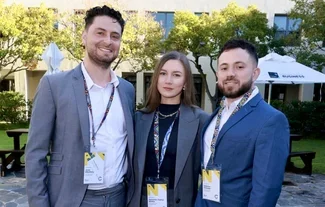
Before joining the NECR program and before flying to South Africa, I was working on something deeply personal: scaling my family business that collaborates with indigenous communities in Ecuador to produce and export alpaca to the U.S. I’ve always been a results-driven negotiator, focused on outcomes, value, and leverage. But working with Jesse and Sasha changed that. They challenged me to be more reflective and consider when pushing forward might limit growth. Jesse helped me reframe assertiveness, and Sasha modeled deep listening and empathy in a way that made me rethink my approach entirely. The teamwork wasn’t always smooth. We debated and disagreed. But in that friction, I found a new rhythm for negotiation: one that balances ambition with understanding.
This experience reminded me that negotiation is more than tactics—it’s about timing, trust, and transformation. In a world where high-stakes negotiations from climate pacts to geopolitical tensions are shaping the future, learning how to collaborate across perspectives is more urgent than ever. I return from this experience as a more skilled negotiator and a prouder representative of Columbia University, Ecuador, and the communities I serve. Being part of this journey has been extraordinary, and I now carry these lessons into my work, my business, and my mission to build more inclusive, meaningful deals around the world.
About the Program
Columbia University’s Master of Science in Negotiation and Conflict Resolution prepares students to analyze the root causes and dynamics of conflict and to transform disputes through reasoned and resourceful interventions. The program focuses on developing self-awareness, tenacity, and interpersonal competency; building common ground; opening lines of communication; ensuring representation and recognition, and building sustainable possibilities for resolution.
The program has on-campus and online (with residency) modality options. Learn more about the M.S. in Negotiation and Conflict Resolution program here.


