
By Troy Blackwell, Student in the M.S. in Strategic Communication program
This past year at Columbia University’s School of Professional Studies has been both professionally affirming and personally grounding. As I complete my first year in the M.S. in Strategic Communication program, I’ve had the privilege of engaging in conversations that go far beyond messaging and media. They’ve challenged how I think about leadership, ethics, and responsibility in a rapidly evolving information landscape.
That reflection felt especially timely earlier this month on World Press Freedom Day, a global reminder of the essential role a free and independent press plays in sustaining democracy.
Before coming to Columbia, I spent years working in the federal government and global communications, where I took an oath of office to uphold transparency, protect the public’s right to information, and combat the spread of misinformation and disinformation. At the time, those commitments felt like part of the job. Now, through the lens of my coursework, I see them as part of a much larger ethical responsibility.
In my Authentic Leadership course, taught by Jenny Fernandez and Amber Arnold, we explored what it truly means to lead with integrity, especially in moments of uncertainty or pressure. I’ve come to understand that leadership is not just about decision-making authority; it’s about creating environments where truth can be spoken, dissent is respected, and people feel psychologically safe challenging narratives that may be incomplete or misleading.
That lesson is directly connected to the role of a free press.
Similarly, in my Ethical Decision Making for Communicators course, taught by Dr. Skye Cleary and Lauren Harding, we wrestled with real-world scenarios in which competing values, including speed versus accuracy, loyalty versus truth, and narrative versus nuance, often collide. These are not abstract tensions; they are the daily reality for communicators operating in high-stakes environments. Increasingly, they are also the conditions under which journalists must do their work.
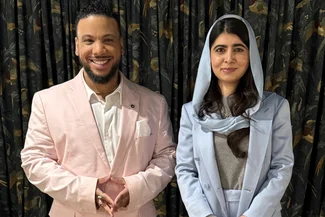
Troy Blackwell and Malala Yousafzai
What I’ve come to appreciate is that ethical communication and press freedom are deeply intertwined. A free press relies on access, transparency, and accountability. Strategic communicators—whether in government, corporate, or nonprofit spaces—play a critical role in shaping those conditions. We can either reinforce trust by engaging honestly and responsibly, or erode it by prioritizing expediency over truth.
This year, I’ve had the opportunity to speak at the Strategic Communication Winter Symposium and the SPS Next Conference, and I was deeply honored to receive the Excellence Award in Civic Engagement from SPS Dean Troy Eggers. While those moments were meaningful milestones, they also reinforced a deeper responsibility: to use the tools of communication not just to inform, but to serve.
World Press Freedom Day was a reminder that democracy depends not only on those who report the news, but also on those who shape how information flows. My experience at Columbia has made it abundantly clear that being an effective communicator is no longer enough. We must also be ethical stewards of information, committed to truth, transparency, and the public good.
As I look ahead, I carry with me a renewed sense of purpose: to lead with authenticity, communicate with integrity, and contribute to a more informed and accountable society.
About the Program
Columbia University's M.S. in Strategic Communication program empowers current and aspiring leaders to shape the future through strategic communication. It is designed to respond to the urgent need for global perspectives, critical thinking, and ethical decision-making at all levels of organization. The interdisciplinary curriculum emphasizes audience-centered strategy and digital competency. Distinguished scholar-practitioner faculty bring real-world experience into the classroom and provide a learning experience that is immediately relevant in the workplace.
The program is available full-time on campus or part-time online with residencies. The part-time format is ideal for experienced full-time professionals based in or outside the New York metropolitan area. Learn more about the program
here.


