
By Christina Georgiadi, Student in the Information & Knowledge Strategy (IKNS) Program
The currency of intelligence is changing. By 2035, the most valued human capacities may be practical wisdom, social architecture, and the courage to ask the right questions. If that is the new map of genius, a striking observation follows: women, on the whole, may already be there.
Returning to university after a few years away, I found myself surrounded by conversations about AI and the future of work. What I noticed was that the skills being celebrated (systems thinking, ethical reasoning, empathy) were capacities I had seen exercised by women around me for most of my life. The question this piece tries to answer is therefore a simple but uncomfortable one: in a world that is finally noticing the value of these capacities, will the people who have historically cultivated them also be the ones who benefit?
The Inconvenient Data
The alignment between what the AI economy will likely prize and what women have long been socialized to develop is empirically documented. The World Economic Forum’s Future of Jobs Report 2025 found that empathy, resilience, analytical reasoning, and creative thinking have surpassed technical execution as the most sought-after human competencies. A landmark Korn Ferry study of 55,000 professionals across 90 countries found that women outperformed men in 11 of 12 emotional intelligence (EQ) competencies, were 86% more likely to demonstrate emotional self-awareness, and 45% more likely to demonstrate empathy. As Daniela Amodei, co-founder of Anthropic, has argued, AI’s strength in STEM shifts the premium of human capital toward understanding ourselves and what makes us tick.
By all indications, women have been building that skillset for generations. The logical conclusion might suggest a historic moment of female economic ascendancy. History, however, counsels skepticism.
How Patriarchy Reclaims Feminized Value
The pattern of what may happen next is well documented in the sociology of work. Researchers Asaf Levanon and Paula England have shown that when women enter a field in large numbers, its wages and status tend to decline, and when men enter a previously female-dominated field, pay and prestige tend to rise. This is what sociologists call occupational feminization and occupational devaluation. What I want to explore here is how this mechanism appears to be playing out specifically in the context of AI, and what form said recapture is likely to take.
The history of computing offers a precise example. In the 1940s through the late 1960s, computer programming was feminized work. Women such as the ENIAC programmers (the team of women who programmed one of the world’s first electronic computers), alongside Katherine Johnson and Grace Hopper, built the computing industry’s technical foundation.
Then the money arrived. The field was rebranded from “programming” to “software engineering,” women were systematically pushed out, and the “computer geek” archetype encoded maleness as the industry default. Women earning computer science degrees peaked at 37% in 1984 and declined dramatically. As of 2025, 80% of software developers were men.
The skills did not change. The narrative did.
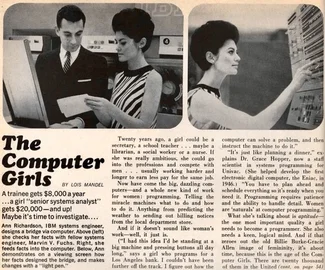
1967 Cosmopolitan Magazine article advertising programming jobs to women.
A near-identical process appears to be underway in marketing right now. Marketing is a field where roughly 60% of roles in the United States are held by women. Since 2023, those same roles have increasingly been relabeled with engineering titles (GTM engineer, content engineer, revenue systems engineer) as AI and automation have made the work more technical in appearance. Brand consultant Miranda Shanahan, whose observation on this trend reached over one million views on TikTok, noted that “marketing was feminized when it was about making things pretty,” and is now being masculinized because “the biggest problem is distribution.” LinkedIn listed over 3,000 open GTM Engineer roles at the start of 2026, representing 205% year-over-year growth in postings. The rebranding is moving fast.
A similar mechanism appears to be underway around soft skills more broadly. More than 55% of C-suite executives associate “soft skills” explicitly with the female gender. Corporations are already considering rebranding the language: “soft skills” are becoming “power skills.” I want to push this observation further and predict that the rebranding will become increasingly specific and gendered. “Empathy” might become “stakeholder attunement.” “Nurturing” might become “human capital cultivation.” “Compassion” could be “Psychological Safety Leadership.” The content is identical. The salary attached to it will not be. And crucially, the women who have practiced these capacities for generations will find themselves once again having to prove they already possess what men are simply assumed to bring.
Leadership job descriptions saturated with relational requirements are systematically written in masculine-coded language, causing women to self-select out of the application process. When women do perform these skills, what researchers call attribution bias (the tendency to credit men for potential and brilliance while evaluating women on past performance alone) ensures they receive little strategic credit. The “prove-it-again” cycle, a well-documented pattern in which women must repeatedly demonstrate competence that men are assumed to possess from the outset, remains the default mode of evaluation. A man’s empathy signals leadership potential. A woman’s empathy is noted as natural warmth.
The Risk of Sitting This One Out
A second crisis compounds the first: Women are adopting generative AI at significantly lower rates than men: 33% versus 44% in the United States, with double-digit gaps across the U.K. and Europe. This gap is, in all likelihood, rational rather than born out of timidity. Research from Northeastern University and Caltech finds women are 11% more likely to perceive AI risks as outweighing its benefits, driven by direct exposure to those risks: the proliferation of non-consensual intimate images generated by AI, job displacement concentrated in female-coded roles, and documented algorithmic bias in hiring and health care. Only 49% of women receive formal AI training at work, against 79% of men. Their skepticism is, by most accounts, well-founded.
The danger, however, is that principled abstinence becomes a self-fulfilling mechanism of exclusion. I want to reframe the adoption gap as a product safety issue, one that goes beyond social equity: AI systems are increasingly shaped by the data, feedback, and usage patterns generated by their users.. If women are not among those users, their needs, preferences, and blind spots will be absent from the feedback loops that shape the next generation of these tools. UC Berkeley’s Solène Delecourt argues this risk plainly: systems built without female input will embed patriarchal assumptions into the foundational logic of the future. The architecture of the future appears to be taking shape now. The question is who is in the room.
Reclaiming the Narrative
The risks are real and the precedents unambiguous. However, they are not destiny. Drawing on the research reviewed above, I want to propose four strategic moves that are within reach.
The first is mastering the jargon. The renaming of empathy as “stakeholder attunement” will become a gatekeeping mechanism dressed as neutral vocabulary. A woman who describes herself as empathetic is speaking a language the boardroom has coded as discountable. A woman who frames herself as an expert in “emotional capital management” and “insight-driven leadership” is speaking the language in which the room transacts power. The content is identical. The reception is not. Fluency in both AI terminology and the corporate vocabulary being constructed around soft (power) skills is the entry ticket for the negotiations that determine compensation and advancement.
The second is quantifying the unquantifiable. The assumption that emotional intelligence is exempt from financial measurement is a primary tool used to justify its undercompensation. The ROI Institute, McKinsey, and Harvard Business Review have developed methodologies that challenge this assumption, with case studies placing soft-skills training ROI between 100% and 500%. Empathy tied to turnover reduction, customer retention, and first-call resolution rates is no longer just a personality trait. It becomes a measurable driver of organizational efficiency. Until women make this case through numbers that the room understands, the room will likely continue to price their labor as baseline rather than premium.
The third is engaging the technology rather than abstaining from it. The ethical concerns driving female skepticism are valid. They do not, however, justify strategic withdrawal. Every interaction with a generative AI system is a data point that shapes its future outputs. Women currently constitute less than a third of the global AI development workforce. That gap is, I would argue, a product safety issue: a system built without female input will encode the blind spots of those who built it. Engaged, critical participation in these tools, combined with advocacy for mandatory algorithmic auditing (independent reviews of how AI systems make decisions, similar to financial audits), environmental transparency, and representative governance bodies, is evidently the path from critique to architecture.
The fourth, and perhaps most consequential, is showing up where the rules are written. Corporate fluency and individual participation are insufficient if the regulatory architecture governing AI is built without female voices. The standards bodies, government committees, international coalitions, and industry working groups that will define how AI is trained, audited, deployed, and constrained are convening now. Women must be in those rooms as permanent participants with standing, rather than as consultants brought in after the decisions are made.
The history of the internet, of social media, and of algorithmic hiring shows what happens when transformative technologies are governed exclusively by the demographics that built them. One could reasonably say that presence in political and social discourse around AI is the difference between having protections designed with you in mind and having them designed around your absence.
Conclusion: Why This Moment Is Different
Women have been practicing the “new intelligence” for generations, in the relational labor that held organizations together, in the empathic judgment that navigated impossible trade-offs, in the ethical attentiveness that so much of their professional lives has demanded. The AI era did not create these capacities. It simply made them impossible to ignore.
The above occupational devaluation mechanism and its current manifestations are visible in real time. But there is something meaningfully different about this moment: In the 1980s, the masculinization of programming happened quietly, without a name, while it was underway. This time, the pattern is being identified as it unfolds. Miranda Shanahan’s observation about marketing job titles reached a million people in weeks. Researchers at Berkeley, Northeastern, and the IMF are documenting the gaps and naming the mechanisms. This piece is part of that conversation. The capture is not invisible this time, and that matters enormously.
Naming a mechanism is the first act of resisting it. The women reading this are already doing that work, by staying in the room, by learning the language, by showing up in the spaces where the rules are being written. The moment is not guaranteed, but it is not lost either. And for the first time in this particular cycle of history, we can see it clearly enough to fight for it.
That, for me, is reason enough for cautious optimism.
Views and opinions expressed here are those of the authors, and do not necessarily reflect the official position of Columbia School of Professional Studies or Columbia University.
About Columbia’s IKNS Degree
Columbia University’s M.S. in Information & Knowledge Strategy (IKNS) degree integrates data, people, and strategy skills for the AI age. The flexible and interdisciplinary curriculum trains leaders across the entire value chain of data-driven management: Getting the data and analytics right (e.g., AI adoption, business analytics), creating a high performing, people-centric culture (collaboration, team/project management, organizational psychology), and finally the right change management to turn your strategy into reality.
IKNS is available full-time or part-time, online or in-person on Columbia’s landmarked campus right here in New York City. To maximize opportunities for networking and community building, our online students join our New York-based students on Columbia’s campus for three in-person Residencies during their studies. The STEM-designated Master of Science degree offers International Students (F-1/J-1 visa) an opportunity for Curricular Practical Training during their studies (CPT) and 3 years of work authorization in the US upon completing their studies (OPT).
Students train under world-class faculty, including former and current executives from Google, IBM, NASA, and Oliver Wyman, and join a powerful global alumni network in coveted positions, including at Alphabet, Goldman Sachs, Nike, Pfizer, and the World Bank.
For more IKNS insights, news, and events, please go to our website, connect with us on LinkedIn, or attend one of our online info sessions. Visit the School of Professional Studies website to learn more about the SPS Student Experience.