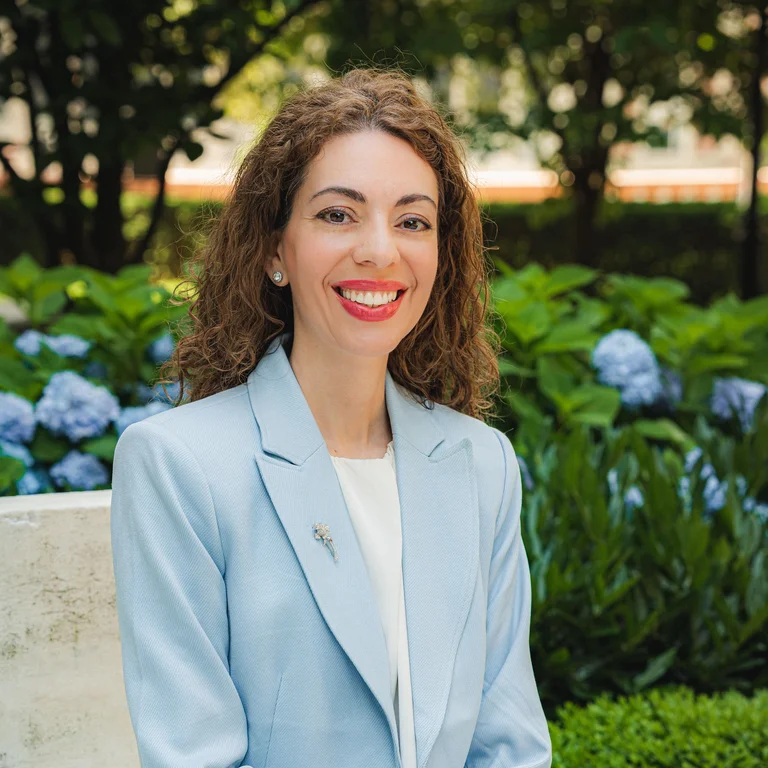
Projects shape the world around us—from delivering major infrastructure to advancing sustainability, from launching innovative technologies to running global sporting events. Behind each successful project is a skilled project manager who can coordinate teams, manage risk, and maintain progress under pressure.
That’s the vision driving the new Columbia University School of Professional Studies (SPS) Master of Science in Project Management. Building on the foundation of the long-standing Construction Administration program and leveraging the interdisciplinary strengths of Columbia, the new degree prepares students to become agile leaders across industries, gaining core competencies while pursuing their areas of personal interest.
Project management was once viewed primarily as a construction-focused discipline, explains Evangelia Ieronymaki, director of the new Columbia SPS program. But the reality is that every industry depends on the same core skills—planning, leadership, and problem-solving—to move projects forward. Today, project management is just as essential in technology, sustainability, sports, and countless other fields.
In an interview with SPS, Ieronymaki shares her professional journey, explains the evolution of the program, and highlights how Columbia is preparing graduates to lead the projects that matter most.
To begin, could you share a bit about your professional journey and what first brought you to the field of project management?
I am a civil engineer by training. My Ph.D. from MIT focused on geotechnical engineering—soil-tunnel-structure interaction—and I have worked on complex infrastructure projects, from tunneling to large-scale soil structure interaction studies.
Early on, I realized that, beyond technical challenges, what truly determines a project’s success is the ability to align different stakeholders and their needs, and manage uncertainty. Basically, the ability to keep projects moving forward under unpredictable conditions. That is what drove me toward project management and, specifically, construction project management.
The new M.S. in Project Management program has its roots in Columbia’s longstanding Construction Administration program. Can you tell us about that evolution—how the idea for this program came about and why it’s being launched now?
The new M.S. in Project Management program is deeply rooted in Columbia’s long-standing Construction Administration program; in fact, it would not exist without it. The Construction Administration program laid the foundation. For over a decade, it has trained professionals to lead complex capital projects, manage contractors and consultants, navigate budgets and schedules, and deliver results in high-stakes environments. Those same values, technical excellence, disciplined execution, and real-world application, remain at the core of the new Project Management program.
The idea for this new program grew out of conversations with faculty, industry partners, and alumni about the growing need for professionals who can lead increasingly complex, multidisciplinary projects. While “project manager” used to be a title primarily associated with construction and infrastructure, today it extends across industries such as technology, sustainability, and sports.
The Construction concentration is now offered in collaboration with Columbia Engineering’s Department of Civil Engineering and Engineering Mechanics, preserving the rigor of the Construction Administration curriculum while reinforcing a strong technical and analytical foundation, ensuring that students continue to develop the engineering mindset and problem-solving skills essential for managing sophisticated projects.
Who should be considering Columbia’s M.S. in Project Management, and what kinds of career pathways can graduates expect?
People coming from finance, from business, from engineering, from health care, from any field where a project drives results. Our program is designed for professionals who want to strengthen their ability to lead successful initiatives. If you already have experience managing teams, or if you are in a supporting role and ready to step into greater responsibility, this degree will provide you with the tools, frameworks, and skills to grow as a project leader in your industry.
The program offers four specializations: Construction, Sports Management, Sustainability Management, and Technology Management. Could you walk us through each concentration and introduce the leaders who are shaping them?
The four concentrations were intentionally designed to leverage the existing strengths of SPS.
The Construction concentration is rooted in the previous Construction Administration program and is now offered in collaboration with Columbia Engineering. It is a much stronger concentration now because it adds an engineering component to administration and management skill building. This concentration equips students to manage infrastructure and build environmental projects from planning and design through execution and delivery. It is led by Dr. Ibrahim Odeh, who is also the chair of the Construction Engineering and Management program at Columbia Engineering.
Another concentration is in Sustainability Management. This is a track that emphasizes how project management contributes to advancing environmental and climate-focused initiatives and prepares graduates to lead complex projects in energy grid infrastructure and corporate sustainability. It is led by Dr. Steve Cohen, who is senior vice dean of SPS and also the director of the Sustainability Management program.
The Technology Management concentration addresses how digital transformation data and emerging technologies like AI are shaping industries, and prepares students to lead innovation-driven projects in the business and technology industry. It is led by Sharyar Shaghaghi, who is a professor and director of the Technology Management program.
The last concentration is Sports Management, which highlights how project management drives major sporting events and facilitates processes and operations, scheduling, logistics, and stakeholder coordination in the sports industry. It is led by Scott Rosner, who is a professor and director of the Sports Management program at SPS.
We also have the general route of Project Management, which consists of the same six core courses that all students have to follow, but instead of four concentration courses and two electives, students can enroll in six elective courses from anywhere among the four concentrations, or from a pool of preapproved electives. That way, a student can shape their own concentration and can mix and match and tailor their studies according to their needs.
Columbia’s Project Management program is entering a competitive landscape. What makes this program unique among other graduate programs in the field?
Our program is heavily focused on the skills that a project manager needs, not just theoretical business administration courses or courses focused on global markets in general. Our program teaches fundamentals of project management: The core program talks about scheduling, budgeting, control, and financing. The concentration courses build skills necessary within each industry.
Our faculty are active leaders in different fields and bring to the classroom knowledge from their own projects as case studies. I use many case studies when teaching—from my experience and from my colleagues’ experiences.
Students also have opportunities to work on their own projects hands-on. The capstone, for example, gives students the opportunity to work on real, ongoing projects at companies in New York. Additionally, we hold events very often that connect students directly with industry leaders, like career fairs and networking events, and invite guest lecturers frequently to all our classes, so that students can learn from these professionals and even secure internships or full-time jobs.
Considering the speed at which industries are changing, from your perspective, what does “project management” mean in 2025? How does this program align with current and future industry demands, and how do you expect it to evolve in the years to come?
Something that we have worked diligently to bring to the new curriculum is the incorporation of AI. Through our teaching and showing the applications in different industries, AI can be used to facilitate faster, more efficient, and more effective delivery of different projects. AI is everywhere. If you’re not familiar with it, or can’t use it, you’ll be left out in the future. We understand that very, very well and are preparing our courses with AI as a fundamental component, so that students graduate with the skills to use it to their benefit.
Project management is expanding in various fields, and projects nowadays are more complex than ever—especially with so much technological advancement. I see Columbia students at the forefront of the evolution of this role. Given the program that we have prepared, our students will be among the first to lead projects with agility, apply technology wisely, and ensure that projects create real impact for organizations and communities. Over the next 5 to 10 years, I see us expanding our partnerships across Columbia and industries to offer more concentrations, and to ensure that our students are learning from real-world challenges and case studies.
About the Program
The Columbia University Master of Science in Project Management program equips individuals with the strategic, analytical, and leadership skills essential for a successful career managing complex projects across industries and borders.
Available full-time or part-time, the M.S. in Project Management is designed for professionals who want to advance into leadership roles or formalize their project management experience with a strong academic and practical foundation. Students can opt for the general Project Management program or choose from one of the four specialized concentrations: Construction, Sports Management, Sustainability Management, and Technology Management.
Taught by scholar-practitioners and enhanced by Columbia’s location in New York City, the curriculum integrates emerging digital tools and AI-driven practices to help graduates make data-informed decisions and improve operational efficiency. Graduates will be prepared to lead high-stakes projects with confidence and clarity, and return to the job market with a competitive edge.
Learn more about the program here.