
By Camryn Louder ('26SPS, SUSCI), Alumna of the M.S. in Sustainability Science Program, School of Professional Studies
On any given day, millions of washing machines hum in homes around the world. What most people don't see is what flows out with every rinse cycle: microscopic plastic fibers shed from synthetic clothing, slipping through wastewater systems and into rivers, oceans, and ultimately, our food chain. In Columbia's M.S. in Sustainability Management (SUMA) and M.S. in Sustainability Science (MoSSS) programs, that invisible problem became a call to action.
As students in the SUMA program, Yoni Ronn ('23SPS, Sustainability Management) and Siddhant Srivastava ('23SPS, Sustainability Management) began asking a deceptively simple question: What if we could stop microplastics at the source?
Working alongside Dr. Beizhan Yan, a research professor at the Lamont-Doherty Earth Observatory (LDEO) and now co-director of the MoSSS program, the two students turned academic inquiry into applied innovation. Through research conducted at LDEO, they collaborated to design a microplastic filtration system capable of capturing fibers released during the laundry process before they enter waterways.
What began as a research collaboration has evolved into something bigger. Recognizing the scale of the problem and the opportunity to create measurable environmental impact, Ronn and Srivastava founded Moby Filter, a startup dedicated to reducing laundry-induced microplastic pollution.
Read on for the full story of how SUMA students and MoSSS faculty bridged research, entrepreneurship, and environmental stewardship by transforming a hidden pollution stream into a tangible solution.

Working alongside Dr. Beizhan Yan, a research professor at the Lamont-Doherty Earth Observatory and now co-director of the MoSSS program, SUMA students Yoni Ronn and and Siddhant Srivastava turned academic inquiry into applied innovation.
How did the idea for Moby first take shape, and how has it evolved since its inception?
Ronn: Moby is on a mission to stop microplastics at the source. We do this by helping businesses cut costs and avoid pollution, capturing and reusing particles before they enter the environment and human bodies. I come from a family of water engineers, and although I thought I had left the family business, I ended up right back in it—but from another angle.
Moby's story is intertwined with my time at SUMA. The idea first took shape in Prof. Christoph Meinrenken's LCA class, where I learned just how large and urgent the microplastics problem is. I noticed a gap between how serious the issue is and how little attention it received, with most of the sustainability conversation focused on carbon, energy transition, and direct emissions. That gap felt like an opportunity to "zig" while everyone else "zagged," and I was hooked.
An independent study with Prof. Meinrenken laid the groundwork for what became Moby Filters, founded with LCA thinking from the start—considering carbon, biodiversity, toxicity, and trade‑offs so we wouldn't solve one problem by creating another. That research evolved into the company's early infrastructure. It led to our first external validation and awards from Columbia SEAS, SPS, and the Tamer Fund's Hack for Humanity, where I met Siddhant, who later became our CTO.
Around the same time, the opportunity to collaborate with Dr. Yan emerged. That collaboration led to my establishment of “Laundrolab,” supported by a $3M NOAA grant focusing on preventing pollution from textile manufacturing and washing. Since then, Moby has secured substantial funding, joined the Columbia StartupLab, participated in programs like Techstars and the NYCEDC/Newlab Founder Fellowship, and built key partnerships, including with the City of Los Angeles and pilot sites in New York. What started as an idea in a SUMA classroom is now a venture operating at the intersection of science, infrastructure, and real‑world deployment, while staying rooted in the academic ecosystem that made it possible.
In what ways have the MoSSSand SUMA programs supported your work on microplastics, and which aspects of the programs have been most impactful?
Ronn: Our holistic yet pragmatic solution reflects a very SUMA-esque approach. Whether it was LCA, Resiliency in the Built Environment, the water courses, or the law and entrepreneurship ones, they all taught us how to look at, approach, and communicate about a problem. I truly leveraged the opportunity to tailor my time at Columbia to be hyper-focused on a problem I was passionate about, and I also audited many additional courses to maximize it. That experience played a significant role in shaping the company. The tools both Siddhant and I acquired at SUMA have helped us stay ahead of the competition while advancing research and gaining a deep understanding of the problem and insight into the industries we work with. Of course, being part of groundbreaking research at LDEO was also crucial to our ongoing traction and success.
Srivastava: For me, Theory and Practice of Life Cycle Assessment (LCA) by Prof. Meinrenken has been one of the most rewarding classes. The fundamentals of LCA thinking forced me to stop looking at sustainability in isolated pieces and instead think in terms of systems, trade-offs, and unintended consequences. It shaped how I now approach sustainability problems. I liked LCA so much that I also work as a professional LCA practitioner, directly applying learnings from the coursework.
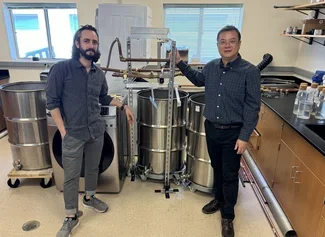
Yoni Ron and Dr. Beizhan Yan in The Laundrolab.
What was your experience launching a sustainability startup, and what guidance do you have for aspiring student entrepreneurs?
Yan: Sustainability is an emerging, non-traditional discipline with significant potential. It is a natural step for students to develop startup companies during or after their studies, as they generate new ideas through coursework, discussions, or involvement in faculty research. Developing a startup involves translating science-based solutions into real-world applications, navigating longer development timelines, and balancing environmental impact with economic feasibility. Both sustainability programs address this need. For example, in the new course I taught last Fall, Plastic Pollution and Society: Impacts, Challenges, and Sustainable Solutions, three students discussed startup ideas with me, and two of them used those ideas as their term projects. In one term project, a student conducted cost and feasibility analyses and discussed team formation and strategies for securing initial funding.
My advice is to think big but be cautious and conduct detailed market and risk analyses before taking action. In addition, I encourage students to take full advantage of Columbia's resources and networks. The Columbia Technology Ventures office has assisted Moby substantially, including helping to establish its initial network, recommending appropriate award application opportunities, and facilitating patent licensing agreements.
How do you envision your work in microplastics advancing the broader sustainability movement now and into the future?
Yan: Sustainability as a field evolves constantly as new scientific findings and technologies emerge. Plastics were historically promoted as a sustainable alternative to natural materials such as wood, based on their durability, resource efficiency, and public health benefits. However, this assessment did not account for long-term environmental persistence and fragmentation into micro- and nanoplastics, which are now recognized as major sustainability challenges—and my research has contributed to this shift in understanding. My current plastic mitigation work, such as laundry microfiber filters and AI-assisted systems for plastic water monitoring and collection, aims to help control plastic pollution. In addition, our ongoing efforts to regulate plastic may significantly change the landscape of plastic production, use, and recycling, leading toward a more sustainable world.
Ronn: Literally everything we do influences sustainability and pushes the needle forward. Despite their omnipresence, our knowledge of and research into microplastics and their adverse effects on human health, the natural environment, and biodiversity are still in their infancy. Microplastics were first hypothesized in a paper around 2007 and were identified only a few years later. Nanoplastics are even more novel, as the lack of methods and instrumentation to accurately identify and monitor these minuscule particles can impede progress. But don't worry, we're here to solve the problem! The field is rapidly evolving as our understanding deepens. I am extremely proud that Moby is at the forefront of research, technology, and commercialization.
Srivastava: Working on microplastics has shaped how I think about sustainability in very practical ways. Microplastics are invisible, fragmented, and spread across systems. We would never see them affecting our day-to-day lives, but in hindsight, we are already seeing their effects everywhere. I feel very happy and content to be part of an organization working to solve such a huge problem.
What are your next steps in advancing your broader impact goals?
Yan: Our work has received sustained support from the Climate School. We won the Climate School’s Global Impact Lab award, through which we will promote the commercialization of the Moby filters and advance microfiber filter regulation at the state, federal, and international levels. Over the next several years, I plan to involve more MoSSS and SUMA students in my research and encourage them to take an active role in combating plastic pollution. One example is the Capstone Workshop project I'm advising this spring semester, in which we will work with clients in Kazakhstan to identify sustainable solutions to address plastic pollution. If successful, this effort may help reduce barriers to the passage of a global plastics treaty.
Ronn: Just as a few years ago, we couldn't imagine where we would be today. I am very excited for what's next to come as we scale Moby across the globe until we've stopped microplastics from polluting the environment and our bodies! That brings me to another major bonus, one you only realize after being "out in the wild" for a couple of years: the vast SUMA community and network. No matter the location, industry, or sector, public or private, it's always great to connect with a fellow alum who can offer deep insight and speaks the same "SUMA lingo." Most of our interns and student groups that have conducted projects for us, like SUMA Net Impact, come from the programs. We also frequently hold office hours with current students seeking advice based on our experience.
Srivastava: Five years ago, I decided to pivot into a sustainability career, and it turned out to be the best decision of my life. I love solving problems and building things. I feel fortunate to be part of Moby to solve such a fundamental problem. I am enjoying the journey and looking forward to taking the solution across the world.
About the Programs
About the Sustainability Science Program
The Columbia University M.S. in Sustainability Science program, offered by the School of Professional Studies in partnership with the Climate School, prepares students for management and leadership positions in which they help organizations address environmental impacts. Students learn strategies to respond to the ever-changing environment and predict future environmental changes—and the impact on corporations, not-for-profits, and the public.
Designed by Research Faculty at the Lamont-Doherty Earth Observatory in collaboration with Columbia's Earth Institute, the program develops a new generation of scientific leaders through a cutting-edge curriculum led by the world's top sustainability scientists, the majority of whom are Lamont Research Professors. Graduates are well prepared for management and leadership positions, armed with the scientific expertise to drive meaningful environmental change and lead organizations in a rapidly evolving sustainability landscape. With the flexibility to choose from a variety of courses, students can tailor their education to career goals. At the same time, New York City serves as a living laboratory for sustainability innovations and connects them with employers actively seeking program graduates.
Learn more about the program here.
About the Sustainability Management Program
The Columbia University M.S. in Sustainability Management program, offered by the School of Professional Studies in partnership with the Climate School, provides students with cutting-edge policy and management tools to help public and private organizations and governments address environmental impacts and risks, pollution control, and remediation to achieve sustainability. The program is customized for working professionals and is offered as a full-time and part-time course of study.
The program fosters creativity and adaptability by equipping students with the skills to tackle real-world sustainability challenges through an interdisciplinary approach from the world's premier sustainability academics, researchers, and practitioners. The up-to-the-minute curriculum and flexibility prepare graduates for careers in the dynamic and rapidly changing field of sustainability.
Learn more about the program here.


