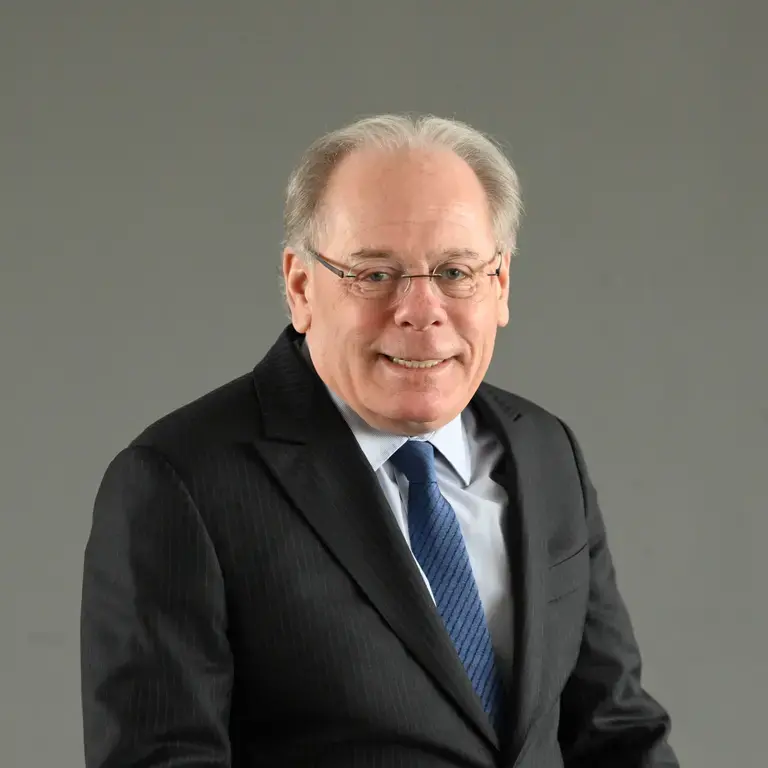
By Steven Cohen, Ph.D., Director of the M.S. in Sustainability Management program, School of Professional Studies
Looking at my Sustainability Management students at orientation last week and at my Environmental Science and Policy students earlier this summer, I was proud of their persistence, determination, and courage. They are the future, and they are a source of my faith that tomorrow will be better than today. I direct two master’s programs at Columbia: one an MPA in Environmental Science and Policy at the School of International and Public Affairs and the other an MS in Sustainability Management at the School of Professional Studies. Both are partner programs with Columbia’s Climate School. Last week, I spoke with about 180 Sustainability Management students at orientation, and at the end of May, we welcomed 50 Environmental Science and Policy students to Columbia. They came in the face of overt hostility from our federal government for their field of study, and in the case of international students, for their ability to come to the United States to pursue their studies. Despite the efforts of the White House’s xenophobic Deputy Chief of Staff Stephen Miller, about half of our new students were international. Their hunger for world-class education was not deterred by the difficulty of navigating our State Department’s opaque rules and slow-moving visa bureaucracy.
I realized that my sense of pride and even relief at seeing these new students was, in part, caused by President Trump and his performative and sadly unqualified leadership team’s constant drive to dominate every news cycle. They are working relentlessly to convince us that the nation is in some type of emergency, and that the world we live and work in must be dramatically changed to cope with this imaginary crisis. That leads to our fear that the routines we value and derive purpose from will no longer hold. That we will wake up one morning and somehow the world will be turned upside down. Reality will be replaced by lies and fiction. The stability, peace, and well-being enjoyed by the vast majority of Americans will suddenly disappear. Every day, some unprecedented and ill-advised initiative emanates from this Administration, and we find ourselves working hard to drive all this noise from our awareness to enable us to live our normal lives and undertake the work we value. Personally, I am eager to ensure that life continues as it did before and am determined that the important work of our profession continues undeterred by distraction and mindless opposition. A room full of over 200 aspiring and practicing sustainability professionals reassures me that the impact of the performative aspiring authoritarians in Washington may not be deep enough to change the world we live in. Perhaps I am fooling myself, but my sense is that if I can control my own narrative, I can also control my own work and home lives.
Last Tuesday night, about 50 of Columbia’s Sustainability Management Practitioner Professors introduced themselves and their courses to our new students. It is a spectacular collection of experts and includes over a dozen of our own graduates. At the reception afterward, students were excited about their arrival and new colleagues, and international students praised the welcome they felt here in New York City, where, no matter where they came from, they kept running into people from their home country. While immigration to America has declined precipitously this year, New York City remains the world’s most global city. Nearly 40% of the people who live here were born outside the United States, and the rest of us are nearly all the children or grandchildren of immigrants. Many of us were concerned that our international students might not make it to school this year, and some were unable to get here. But nearly all have arrived. And when they travel to Columbia and New York City, they are finding that we have remained true to our tradition of being what President John F. Kennedy once termed, “A Nation of Immigrants.” As I addressed our new Sustainability Management students this past Tuesday evening, I was deeply moved by their sense of commitment, of mission, and their very presence. We had a full house, despite our fears that students who wanted to study with us would be unable to find their way to Morningside Heights.
At Columbia, we have worked hard to attract and welcome our new class. The university’s reputation has been damaged over the past several years, but the quality of our educational programs in environmental sustainability continues to improve. Social media images of Columbia are far from reality, although the Morningside campus remains locked down due to what is termed an “abundance of caution.” Personally, I’d rather see “business as usual,” with our gates wide open to welcome everyone. Our master’s programs, students, and faculty do not have the luxury or desire to approach our studies cautiously. We are careful and rigorous, but not cautious or timid. New courses have been developed to address the challenges and opportunities of our dynamic ecological, political, and economic environment. We move forward, an undeterred and mission-driven community of sustainability professionals.
The needs we address continue to challenge the world as our population continues to grow, and new technologies are gradually being developed to reduce the impact of economic growth on environmental quality. Today, incredibly enough, America’s national government is canceling renewable energy projects and even trying to compel foreign governments to re-carbonize rather than decarbonize their economies. Their anti-immigrant, anti-trade, and anti-environmental policy agenda is beyond unfortunate, but will simply add to the challenges our graduates will face as professionals. The American national government may believe they can ignore the impacts of a degrading environment, but they are virtually alone in their unwillingness to face reality. A warming planet, extreme weather, inadequate supplies of water, and declining biodiversity are realities with real economic and human health impacts. Our graduates will be ready, willing, and able to address these problems. Their educational experiences are designed to help them become problem-solving, sustainability professionals.
The field of sustainability management is, at its core, a field of management. It acknowledges that as we enter the 21st century’s second quarter, the world that management navigates is far more complicated than it has ever been. Technology has shrunk the planet with massive increases of communication, transportation, and information. Artificial intelligence is now required to enable humans to manage that complexity, but it must be combined with mindfulness and awareness of the impact of the organization on its surroundings and the impact of the world on the organization. Our students come to us, understanding these challenges, and we teach them the concepts and practical tools needed to manage organizations in the face of this complexity.
Labor Day in New York City marks the unofficial end of summer as New Yorkers return from beaches, mountains, and journeys far from the five boroughs. For me, it has always represented a return to longer hours of work and has always brought a sense of renewed purpose. I am reminded that this is the 50th year I’ve been learning about environmental policy. It was in the fall of 1975 that I walked into my first course in environmental policy, taught by Professor Lester Milbrath at SUNY/Buffalo. I’ve seen enormous progress in addressing our environmental crisis over this past half-century, and I strongly believe that the students who arrived this week will see even more progress over the next half-century.
Views and opinions expressed here are those of the authors, and do not necessarily reflect the official position of Columbia School of Professional Studies or Columbia University.
About the Program
The Columbia University M.S. in Sustainability Management program offered by the School of Professional Studies in partnership with the Climate School provides students cutting-edge policy and management tools they can use to help public and private organizations and governments address environmental impacts and risks, pollution control, and remediation to achieve sustainability. The program is customized for working professionals and is offered as both a full- and part-time course of study.