
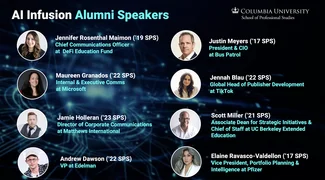
When the M.S. in Strategic Communication (SCOM) program approached Brandy Dawson in December 2025 about developing and teaching a zero-credit, online AI course for the spring semester, she immediately said yes, even though it would mean building her first-ever syllabus and course from scratch over the Christmas break. She also tapped former classmates, students, and her professional network to be guest speakers, including eight alumni.
Her biggest worry, however, was that not enough students would be interested in the course, titled AI Infusion.
“Honestly, I hoped 10 students would register so the course wouldn’t get canceled,” she said.
Fifty-six signed up.
In a new interview with SPS, Dawson shares more about how the course is designed and how she’s preparing students for the future.
Can you tell us a bit about your career? What led to your interest in AI and communications?
I spent 28 years at Pearson, the world's leading learning company, working across sales, marketing, and communications in increasingly senior leadership roles. I eventually served as senior vice president of Global Employee & Executive Communications, leading communications for more than 20,000 employees across 70-plus countries.
I earned my master's in strategic communication from Columbia University in 2017 while working at Pearson. I later spent three and a half years as a course associate for The Authentic Leader and The Compelling Communicator at Columbia's School of Professional Studies before returning as a lecturer last fall.
After leaving Pearson in 2024, I joined Audible (an Amazon company) in 2025, where I now lead People & Places communications across our global hubs. This experience has given me front-row access to enterprise AI tools, training, and experimentation at scale.
Tell us about the new AI Infusion course and what inspired you to add it to the curriculum.
The moment that changed my perspective on AI happened at Audible last fall. I gave a new AI tool a research prompt, walked away for 30 minutes, and came back to a fully structured 30-page brief with citations. I remember staring at the screen thinking, "Holy ... this changes everything."
Suddenly, I was brainstorming and solving problems differently. It became very clear to me that AI was already reshaping how people work and that our students needed to see what this actually looks like inside organizations.
Can you share why you decided to include guest speakers, and what they bring to the classroom?
From the beginning, the course was designed to feel less like a traditional lecture and more like a speaker series. We wanted students to have access to real-world, real-time perspectives from people actively building, testing, and governing these tools, not just theoretical conversations about where the technology might eventually go.
The guest speakers were really the heart of the course. Every session included at least one SCOM alum and leaders from organizations including Audible, TikTok, Reddit, Pfizer, Xbox, AWS, Edelman, UC Berkeley, and GE HealthCare, among others.
But the value was never just the company logos. It was the honesty and range of perspectives students were exposed to.
Different organizations are approaching AI very differently depending on their industry, culture, tool access, governance, and level of experimentation. Students heard candid conversations about workflow changes, leadership challenges, trust, responsible use, and the tension between speed and quality.
Including alumni was especially meaningful because students could see graduates only a few years ahead of them already wrestling with these questions professionally. That made the future feel much more immediate and real.
How have students responded to the AI course?
I think many students were processing the same thing professionals across industries are processing right now: excitement about the possibilities of AI alongside real anxiety about overreliance, job disruption, and whether people are unknowingly training their own replacements.
The course evaluation scores were 5.0 out of 5.0 across all key measures, and students consistently described the course as practical, relevant, and directly connected to the workplace. In fact, ten students have already signed up to retake the course next semester.
How does the course strengthen ties to the industry?
Students were not learning about AI through static case studies or hypothetical examples. They were hearing from practitioners while the technology is still evolving, with all the uncertainty and messiness that comes with it. That matters because most of what gets published about AI is often outdated by the time it reaches a syllabus. This course moves at the speed the industry actually moves at.
How are professionals in the strategic communication field currently using AI, and how do you think they will use it in the future?
Communications practitioners are already using AI to research, brainstorm, plan, and draft. I use it daily as a thought partner to help slow down my thinking, test my assumptions, and draft and revise communications.
But one thing I noticed early on is that AI tends to generate a lot of words and a lot of flat but grammatically perfect writing—with a lot of em-dashes. That’s why I still come back to William Zinsser's principles from On Writing Well: clarity, simplicity, brevity, and humanity.
There are a lot of headlines about employees having an existential crisis about their own relevance. No training or policy will fix that.
That’s the communications challenge of this moment. Not "How do we write faster or do more with AI?" but “How do we help people understand that their judgment, creativity, and ability to adapt and navigate uncertainty still matter?”
What do you hope students take away from the course?
I want my students to leave the course feeling relevant and knowing that the knowledge and skills they're developing matter.
AI is going to generate an enormous amount of content. And honestly, a lot of it will feel repetitive and interchangeable. The people who stand out will be the ones who can think strategically, exercise good judgment, understand audiences, tell authentic stories, and communicate in ways that genuinely connect with other human beings.
That’s what strategic communication has always been about. AI doesn’t change that. If anything, it makes it matter more.
Views and opinions expressed here are those of the author and do not necessarily reflect the official position of Columbia School of Professional Studies, Columbia University, or Audible.
About the Program
Columbia University's M.S. in Strategic Communication program empowers current and aspiring leaders to shape the future through strategic communication. It is designed to respond to the urgent need for global perspectives, critical thinking, and ethical decision-making at all levels of organization. The interdisciplinary curriculum emphasizes audience-centered strategy and digital competency. Distinguished scholar-practitioner faculty bring real-world experience into the classroom and provide a learning experience that is immediately relevant in the workplace.
The program is available full-time on campus or part-time online with residencies. The part-time format is ideal for experienced full-time professionals based in or outside the New York metropolitan area. Learn more about the program here.


