
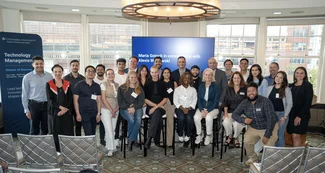
Last month, newly enrolled students in the M.S. in Technology Management online program gathered at Columbia’s Faculty House to hear from Maria Gotsch, president and CEO of the Partnership Fund for New York City. Gotsch was interviewed by Alexis Wichowski, Ph.D., a professor of professional practice in the Technology Management program.
The discussion touched on the history of New York City’s fintech sector, its potential future as a center for the life sciences, quantum computing and robotics, career advice for a rapidly changing world and how acting class can help you negotiate a deal.
“You need to manage your own career,” said Gotsch, who worked at BT Wolfensohn (now part of Deutsche Bank), LaSalle Partners and Merrill Lynch before starting at the fund in 1999. “Don’t count on your boss to manage your career. Your boss is going to give you work; they’re not there to manage your career. That’s your job.”
The Partnership Fund for New York City is the evergreen investment arm of the nonprofit Partnership for New York City, which was created by David Rockefeller in the 1970s in response to the financial and economic crisis then gripping the city, Gotsch explained.
“David felt that the business community of New York was asleep at the switch and really not participating in their local economy in any way of substance,” she said. “So he set up a partnership to convene the leadership of the business community in an ongoing way, and to enable business to sit at the table and deal with the city and the state.”
Today, the partnership’s members include the CEOs of 350 major employers in New York City.
“It really is like a CEO’s club,” Gotsch said. “And they are bringing to the table the perspective, the expertise, the voice and sometimes the resources of the business community to help make sure New York City remains competitive, to identify future trends and work together to move things forward.”
The fund was set up in the late 1990s by Henry Kravis (’69, Columbia Business School), and it is geographically restricted to investing capital within New York’s five boroughs. Unlike a traditional fund, the $130 million fund holds investors’ funds for 45 years, at which point it returns the money in full, with no guarantee of profit. This, she explained, gives the fund “tremendous flexibility in terms of what you can do”; half of the fund’s investments go to low-income neighborhoods, nonprofits and public-private partnerships, while the other half is used to jump-start entire sectors of the New York City economy.
“We are about trying to fill gaps and solve problems,” she said. “We are mission-driven . . . and our mission is New York City.”
New York’s past, present and future in technology
Under Gotsch’s leadership, the fund played a critical role in supporting financial technology startups and entrepreneurs in New York City and positioning the city as a global center for fintech. In 2010, Gotsch co-founded with Accenture the FinTech Innovation Lab, a New York City-based accelerator program for financial technology startups. The fund also invested heavily in developing New York’s life sciences sector, for example awarding $5 million to 20 local academic scientists to help them create businesses based on their discoveries.
When asked by Wichowski about where the fund sees a potential for growth in the New York economy, Gotsch pointed to science-based technology.
“There was no tech sector in New York until the late nineties, so we have made huge progress,” she said. “But the area where we do not have as much strength as Silicon Valley and Boston is science-based technology — that has been the hole in the New York ecosystem.”
“If any of you have a strong technical background, we would love for you to stay in New York and build a company,” she added, addressing the roomful of Technology Management students. “Well, you should stay in New York no matter what.”
Take an acting class, and other career advice
Later in the talk, Gotsch and Wichowski shifted to discussing how students in the Technology Management program should tackle their job search in the rapidly evolving tech sector of New York City and beyond.
“The first thing you have to be cognizant of,” Gotsch said, “is that everything you do can be of use to you at some point. It may not be in the way that you think it will be, but it can be.”
For example, at the beginning of her career, Gotsch spent “a dreadful 18 months working in commercial real estate” in New Jersey.
“I got out of there as fast as I could,” she said. “However, when you’re in economic development, which I came back to 15 years later, you have to know about real estate. All of that stuff I learned, that I found deeply boring and frustrating, and which I didn’t want to spend any more time thinking about, I’m glad I knew it because I was able to use it in this job. If you land someplace, and it’s not a good fit, learn whatever you can there, because I am telling you that something from that experience is going to be useful to you.”
While working as an investment banker, Gotsch took a yearlong sabbatical to study acting. Though she quickly realized she “had no talent,” she found that her acting education had armed her to be a better negotiator when she returned to her job.
“Acting is 90% nonverbal communication,” she explained. “I was doing mergers and acquisitions, and I walked into a conference room where the other side was negotiating something. The other side was literally handing information to me that I had never noticed before.”
Gotsch said she eventually used her improved ability to read people and interpersonal dynamics to clinch two better deals for her clients.
“In addition to the skills you learn, it’s the people you meet at all levels,” Wichowski added. “You never know who will turn out to be a colleague in a future job, or will lead to a connection to something else. One of the lessons I’ve taken from this whole talk, and just living in New York City, is it’s really about the people here. Knowing people, convening them and making sure that you find a reason for people to stay invested, interested and connected.”
Gotsch also advised keeping in mind two important goals when landing a new job: learn something new and “decide if you like the job of the person three levels above you.”
If you do, “then you have to make sure your job is set up to give you the range of experiences you need within that organization to get to that level, and that the culture of the place allows you to move around, do new things and move up.”
About the Program
Columbia University’s Master of Science in Technology Management is a hands-on technology leadership development program designed to train professionals for equal fluency in tech fundamentals, business operations, and ethical leadership.
The program is available for part-time or full-time enrollment. Learn more about the program here.


