
Columbia University’s M.S. in Biodiversity Data Analytics welcomed its inaugural cohort to campus for a three-day residency designed to introduce students to the program, build connections across the cohort and explore how data and technology are transforming the study and conservation of biodiversity.
The residency brought students together with faculty, conservation professionals, industry leaders and University resources through panel discussions, collaborative projects and site visits, and reflected the interdisciplinary approach at the center of the program.
Across three days, students moved between conversations about biodiversity science and analytics, conservation technology and policy, career development, teamwork and the growing role of nature-related data in organizations. A real-world case challenge gave students an opportunity to work collaboratively throughout the residency and apply ideas from the sessions before presenting their work on the final day.
The opening panel, “What is Biodiversity Data Analytics? An Interdisciplinary Lens,” introduced students to many of the questions they will explore throughout the program. Faculty members Jay Schoen (research scientist at Cary Institute of Ecosystem Studies), Viorel Popescu (director of the M.S. in Biodiversity Data Analytics program) and Bekka Brodie (director of Columbia’s M.A. Program in Ecology, Evolution and Conservation Biology) drew on their own research, professional and teaching experiences spanning ecology, conservation biology, spatial analysis and biodiversity to examine how increasingly diverse sources of data can help scientists and practitioners better understand the state of nature. The discussion reinforced that biodiversity itself is multidimensional, spanning genes, populations, species, communities and ecosystems, and that turning those layers of information into meaningful, decision-ready metrics requires both ecological understanding and analytical expertise.
A central theme was the importance of moving beyond simply collecting more data. Camera traps, acoustic monitors, remote sensing, environmental DNA, and rapidly expanding databases can generate extraordinary amounts of information, but students were challenged to consider what those datasets capture, what they leave out and how their limitations affect analysis and inference. The conversation also underscored one of the program’s central goals: preparing professionals who can serve as translators of complex biodiversity data into decisions being made by conservation organizations, policymakers, businesses, financial institutions and other organizations.

Those ideas continued during “Measuring Nature from Space: Geospatial Analysis & Data Visualization,” featuring Schoen and Jonathan Palmer, Executive Director of Conservation Technology at the Wildlife Conservation Society (WCS). Palmer provided students with a practitioner’s perspective on how technology and data infrastructure support conservation across landscapes around the world. Through examples from WCS, students saw how information about species, habitats, protected areas, and local communities can be organized and visualized to evaluate conservation efforts, communicate impact and support decisions.
The residency also connected analytics directly to policy and professional practice. A workshop with WCS policy leaders Alfred DeGemmis and Noah Chesnin explored where conservation technology and nature data meet policy, while the final day’s industry panel brought together professionals working across conservation nonprofits, nature technology, financial services and nature-related risk. Together, these sessions expanded the conversation beyond scientific analysis to consider how biodiversity information can inform policy, organizational strategy, nature-risk assessment and emerging approaches to nature impact and dependency disclosure.
Building a strong cohort was another major focus of the experience. Columbia’s Career Design Lab led students through StrengthsFinder and team effectiveness activities designed to help them better understand their individual strengths and how they work within teams. Students also learned about advising, well-being, career and academic resources available to support them throughout the program. A cohort networking dinner provided another opportunity to build relationships outside of the classroom.
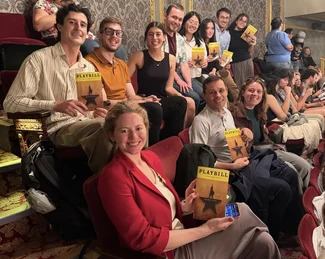
Experiential learning extended beyond campus as well. Students spent an afternoon at the American Museum of Natural History’s Center for Biodiversity and Conservation, connecting themes from the program with one of New York City’s leading scientific and cultural institutions. The residency also included opportunities for students to experience the broader New York City community, including an evening performance of “Hamilton” and a Central Park tour.
By the final day, students had experienced many of the connections that will define their work in the M.S. in Biodiversity Data Analytics: between ecology and data science, field observations and emerging technology and analysis and communication. The residency offered more than an introduction to the curriculum; it provided a preview of how the program will connect students with faculty, practitioners, institutions and one another as they develop the skills to transform complex nature data into meaningful insight and action.

About the Program
The Master of Science in Biodiversity Data Analytics program at Columbia University equips a new generation of leaders with the data literacy, analytical tools, and interdisciplinary expertise to design evidence-based solutions that benefit both people and nature.
Designed for both working professionals and early-career changemakers, this online program allows students to learn from anywhere while gaining the skills to collect, analyze, and translate biodiversity data into meaningful action. Coursework prepares students to take on nature data applications across industries, from ESG finance to urban planning to environmental consulting, and culminates in a hands-on capstone with industry partners that provides practical experience, valuable networks, and the tools to make an immediate impact.
The application deadline for the M.S. in Biodiversity Data Analytics program is June 1. Learn more about the program here.


