

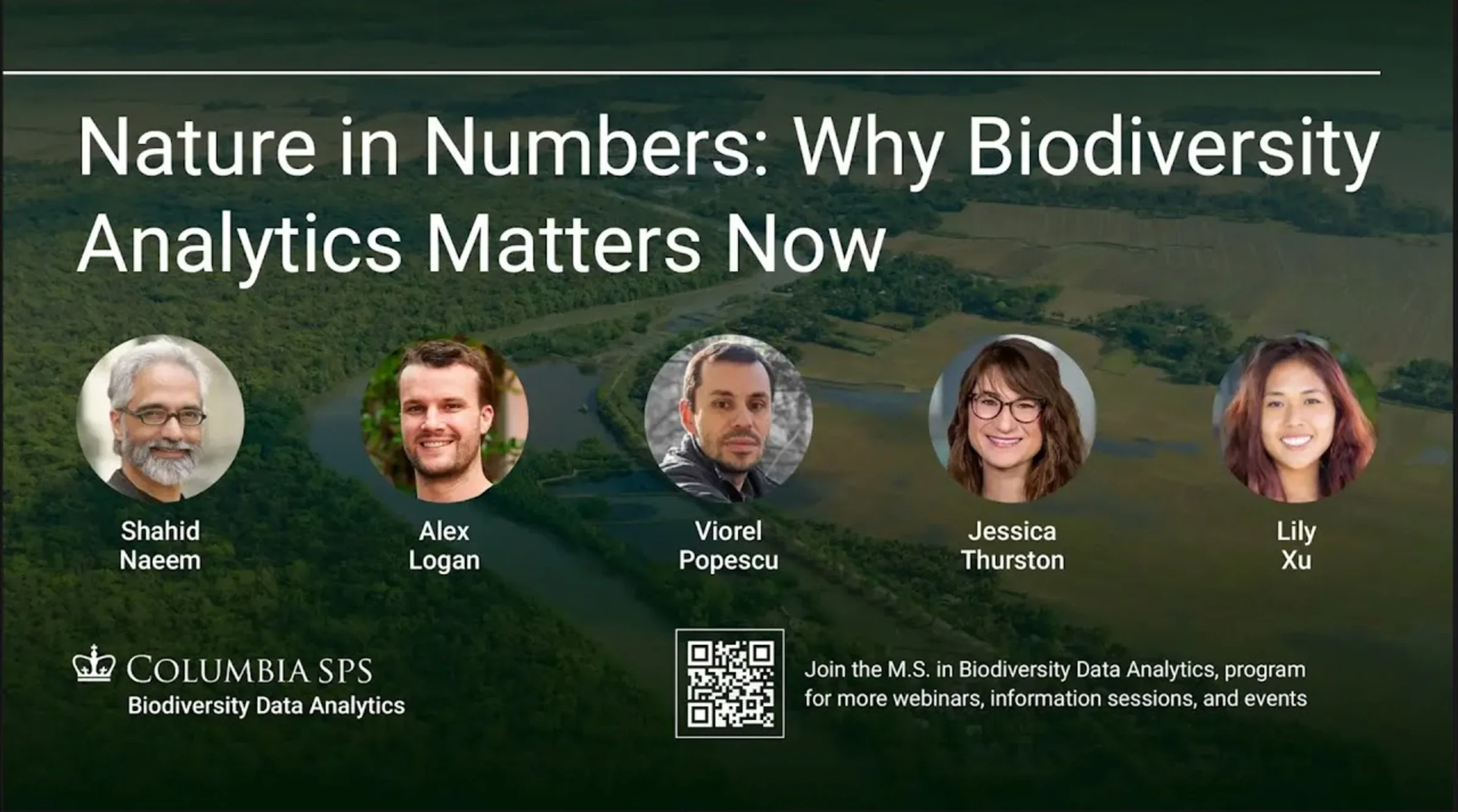
Nature in Numbers: Why Biodiversity Analytics Matters Now
Introducing Columbia University’s Master of Science in Biodiversity Data Analytics
How do we measure biodiversity? How do we bring nature data into responsible business, investment, and policy decisions?
The new Master of Science in Biodiversity Data Analytics, developed by Columbia University’s School of Professional Studies and the Department of Ecology, Evolution, and Environmental Biology, answers these questions by harnessing the power of the nature data revolution and AI. The program blends cutting-edge analytics, finance, policy, and decision-making tools to demystify biodiversity and equip professionals with the skills to thrive in a rapidly growing field—while addressing the urgent global challenge of biodiversity loss.
The program’s launch event will feature a panel of distinguished experts in biodiversity conservation, data analytics and AI, business, and finance. Moderated by Dr. Shahid Naeem, a leading ecologist and biodiversity scholar at Columbia University, the discussion will explore the role of biodiversity and nature data in sustainable decision-making, highlight emerging trends in data analytics and the nature job market, and underscore the need for interdisciplinary training to confront the biodiversity crisis. Saving the Earth as a career has never been more timely.
This event is available both in-person and online.
Speakers/Presenters:
Moderator:
Shahid Naeem (E3B), Professor of Ecology, Evolution, and Environmental Biology, Columbia University.
Shahid Naeem studies the ecological and environmental consequences of biodiversity loss. He is interested in how changes in the distribution and abundance of plants, animals, and microbes, affect how ecosystems function and, by extension, how ecosystems services are affected. His work combines theoretical, observational, and experimental studies under field and laboratory conditions, to uncover the mechanistic bases for the impacts of biodiversity loss on ecosystems. His work has demonstrated how the loss of species from ecosystems affect their ability to resist invasion by other species, affect production and nutrient cycling, and affect the reliability and stability of ecosystems. He is actively involved in bringing the science of biodiversity and ecosystem functioning to conservation, restoration, and policy development.
Panel:
Alex Logan (cecil.earth), CEO and Co-Founder of Cecil.
Alex has over a decade of experience building technology businesses - working with multinational corporations at Boston Consulting Group and building early-stage companies in Sydney’s start-up ecosystem including Hellofresh.
In 2021, Alex co-founded Cecil with the mission to democratize access to nature data. Today Cecil’s platform is used by leading corporates, financial institutions, and nature tech start-ups to access over 40 open and commercial datasets from providers such as IBAT, Planet, and Global Forest Watch - all through a single point of access.
Viorel Popescu, a Lecturer and Director of the M.S. in Biodiversity Data Analytics program at Columbia University School of Professional Studies and the Department of Ecology, Evolution, and Environmental Biology (The BEAST Lab). The research in his group is driven by the urgent need for rapid, effective strategies to address biodiversity loss, with a focus on understanding how biodiversity responds to human activities in order to inform conservation strategies.
Popescu’s research relies on advanced statistical methods to measure biodiversity and trends in terrestrial and freshwater species. He works with management agencies, NGOs, industry, governments and other parties with vested interests in biodiversity conservation to provide concrete and applied solutions to real-world issues, such as overexploitation of wildlife species, tradeoffs between renewable energy and biodiversity or endangered species recovery across many jurisdictions (United States, Canada, Eastern Europe, China, Peru). He has served as the science advisor for several EU-funded biodiversity conservation projects in Eastern Europe and as a consultant for public utility companies and governments in British Columbia and Romania on biodiversity-friendly renewable energy sitting.
A recipient of the David H. Smith Conservation Research Fellowship (2012–2014), Popescu is also a life member of the Society for Conservation Biology and a member of both the IUCN Bear Specialist Group and The Wildlife Society.
Jessica Thurston, Vice President of ESG and Sustainability at Paramount Global.
Jessica Thurston is the Vice President of Environmental, Social, and Governance (ESG) and Sustainability at Paramount Skydance. She has global responsibility for leading the development and execution of the media company’s ESG priorities across its operations and brands, from MTV to CBS Sports, and from consumer products to real estate and facilities. Jessica’s background is in ESG and corporate sustainability strategy development and goal-setting, having consulted for major CPG, pharmaceutical, food service, and other companies. She began her career in sustainable procurement policy for the U.S. federal government. She teaches graduate-level sustainability strategy and governance in an Adjunct Faculty role at Columbia University and Middlebury College. She received her M.S. in Sustainability Management from Columbia University in 2014.
Lily Xu (data science / AI / conservation expert, IEOR), Sun-Wu Assistant Professor, Dept. of Industrial Engineering and Operations Research, Columbia University.
Lily Xu will join Columbia IEOR as an Assistant Professor in July 2025. Her research develops methods across machine learning, optimization, and causal inference for planetary health challenges, with a focus on biodiversity conservation. She aims to enable practitioners to make effective decisions in the face of limited data, taking actions that are robust to uncertainty, effective at scale, and future-looking. In her work, Lily partners closely with NGOs to bridge research and practice, serving as AI Lead for the SMART Partnership. Since 2020, she has co-organized the EAAMO research initiative, committed to advancing Equity and Access in Algorithms, Mechanisms, and Optimization.
Lily received her PhD in computer science from Harvard University, and was a postdoctoral fellow at the University of Oxford, with the Leverhulme Centre for Nature Recovery. Her research has been recognized with best paper runner-up at AAAI, the INFORMS Doing Good with Good OR award, a Google PhD Fellowship, and a Siebel Scholarship.
Event timings:
- 6:00 PM - Welcome guests to the event panel discussion
- 6:10 PM - Panel discussion
- 6:45 PM - Q&A
- 7:00 PM - Reception (In person attendees)
- 8:00 PM - Event concludes, departures
RECEPTION
The event will conclude with a reception featuring light refreshments, passed hors d’oeuvres, and opportunities to connect for in person attendees.
This event is free and open to the public. Registration is required and is open until Monday, November 3rd, 2025.
For more information, please contact the Biodiversity Data Analytics team, dvp2110 [[at]] columbia [[dot]] edu (dvp2110[at]columbia[dot]edu).
To obtain additional information about program offerings at Columbia University’s School of Professional Studies, please contact an Admissions Counselor at inquire [[at]] sps [[dot]] columbia [[dot]] edu (inquire[at]sps[dot]columbia[dot]edu).
If you require closed captioning, sign-language interpretation, or any other disability accommodations, please contact Disability Services, disability [[at]] columbia [[dot]] edu (disability[at]columbia[dot]edu), at least 10 days in advance.
Please visit Columbia University’s Hub for Emergency Preparedness (https://preparedness.columbia.edu/) to stay up to date on the latest campus health and safety policies.
This event is open to individuals irrespective of identity and sex.