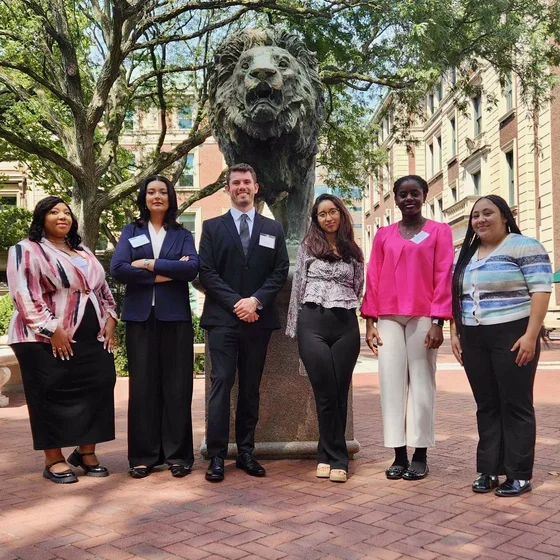
The 2025 Columbia University Sports Management Conference brought together some of the most influential voices in sports for a day of insight, reflection, and forward-looking dialogue. Hosted by the M.S. in Sports Management program, the annual event gathered students, faculty, and industry leaders to examine the challenges of the day and the forces shaping the future of global sports business.
This year’s program featured more than two dozen speakers from across the industry across four panel discussions and four interviews with prominent executives who have steered major organizations through eras of rapid change. Throughout the day's events, their remarks showcased how today’s leaders balance tradition with transformation in an industry increasingly defined by innovation and evolving expectations from fans and athletes alike. Watch the full keynote speeches and panel discussions here.
Balancing Business and the Love of the Game
The first discussion of the day was a conversation with Stacey Allaster, chief executive of professional tennis at the U.S. Tennis Association (USTA), moderated by L. Jon Wertheim, a correspondent for 60 Minutes and senior writer and executive editor of Sports Illustrated. Allaster began by reflecting on her journey as a “kid from Canada with very little tennis talent” to becoming the first woman to serve as tournament director of the U.S. Open—a position she held until September.
Wertheim connected Allaster’s love for the sport of tennis with her success in leading it, underscoring the value of sports in imparting a work ethic and team skills that carry beyond professional athletics. Allaster took it a step further, noting the high statistical correlation between women's senior management positions and past experience with sports, referencing findings that 94% of women in the C-suite played sports.
“I have worked with many of the Columbia students and grads. I know some of you are here today. And what I love about those that have come through this program and who have played sports is that it teaches you all those life lessons that we can't really teach in the classroom,” said Allaster.
Allaster also offered a peek into the efforts that go into running the U.S. Open and the unique challenges of the job. These included working to make the event profitable while expanding access to free matches to attract new fans; staying true to tradition while cultivating new partnerships in music, fashion, and food (more than 730,000 Honey Deuces were sold at this year’s Open, underscoring the impact of good branding); to managing the last-minute logistics of a visit to the tournament by President Donald Trump.
Reform on the Collegiate Frontier
For Tony Petitti, commissioner of the Big Ten Conference, leadership has meant guiding one of the most storied collegiate organizations through growth and a new era. In a conversation with Len Elmore, senior lecturer of discipline in Columbia’s Sports Management program, Petitti detailed how the Big Ten has evolved alongside unprecedented times.
“I think the first thing I noticed when I got the job was how much unmanaged change there was in the space,” said Petitti, adding that different stakeholders were each trying to take the enterprise in a different direction. He spoke about the challenges of maintaining an expanding operation, which now reaches both coasts, and discussed the effort to reset the relationship between athletes and institutions—most notably through the recent settlement of the House v. NCAA lawsuit, which allows institutions to share revenue directly with student athletes.
Since the House ruling, the Conference has added over 400 new scholarships for women, and that number is expected to grow. “This is all about providing resources, making it sustainable,” said Pettiti. “Every institution of the Big 10 is slightly different in terms of what their current needs are. And our job is to find the best path for all.”
Stable Leadership in an Age of Change
Gary Bettman, the longest-serving commissioner in major North American professional sports, reflected on his three decades leading the National Hockey League. Longtime colleague Frank Brown began the conversation by asking about the long tenure of sports executives relative to the heads of Fortune 500 companies, and his particular success as the first and only commissioner of the NHL. Although Bettman responded humorously by suggesting that replacing him would rock the boat too much, his career success might be better attributed to his adaptability as a leader.
“You have to be flexible and you have to be willing to not only embrace change, but you need to keep your eyes and ears open so that you can anticipate change,” Bettman said, noting that sports leagues didn’t even have websites when he began the job 33 years ago. “We've tried to be not just tech savvy and use tech to enhance the experience that fans can have with the game, but we've tried to be leaders in the field embracing technology.”
Bettman emphasized that in order to sell the game, one must also know and love the game. “There’s no substitute for authenticity and integrity,” he said. As much as the entertainment experience has changed, however, one thing seems to remain constant: “The most important, most valued content is live sports.”
Bridging Sports and Technology
Two keynote speakers offered in-depth insight into the work being done to usher in new ways for fans to engage with sports: Jay Marine of Prime Video and Monica Ellingson of IBM Consulting.
Speaking with Tom Richardson, SVP of strategy and business development at Mercury Intermedia, Marine addressed the so-called “great re-bundling” of combining various cable and streaming services. To make the experience more streamlined for viewers, Prime Video users can access and subscribe to various services through a single app, Marine explained. “And it's working. It's working because anytime you remove friction for customers, they will do more of it.”
There’s a saying at Amazon, Marine said: “It’s always day one”—meaning that there’s always more innovation ahead than in the past. “Even what we thought was possible a year ago has been totally changed, which is incredibly exciting,” he said, emphasizing Amazon’s team of data scientists and AI specialists focused specifically on the sports experience. From using data to improve game analysis to offering a betting feed with live odds, the team is working to improve the viewing experience for sports fans.
In a presentation to the audience, Ellingson spoke about the work being done at IBM within the AI sphere to create digital experiences for sports fans. Among these is a “highlights solution,” which scans a game replay to identify the most exciting or noteworthy shots within the video and generates a reel. She also displayed how AI is also able to offer multilingual sports commentary, among many other innovative tools being developed.
“Really the highlight of my job is the people that I work with and my clients, as well as the opportunity to create first-of-a-kind fan experiences for sports fans,” said Ellington.
About the Program
The Columbia University M.S. in Sports Management provides students with a comprehensive curriculum and access to sports industry practitioners and influencers. Students acquire skills in areas such as entrepreneurship and innovation, global sports management, facility and event management, and sports law and ethics.
The spring 2026 application deadline for the M.S. in Sports Management program is November 1. The program is available for part-time or full-time enrollment. Learn more about the program here.